Trumpeter Hornbill
Bycanistes bucinator
Avilumen editorial team ·

The trumpeter hornbill is a medium-sized hornbill, with length between 58 and 65 cm, characterized by a large grey casque on the bill, smaller in females. The eyes are brown or red, with pink surrounding skin. Body mass is between 0.45 and 1 kg. It is similar to silvery-cheeked hornbill. Distinguishing features include an all-black back, white belly and white underwing coverts, and red facial skin.
The trumpeter hornbill (Bycanistes bucinator) is a medium-sized hornbill, with length between 58 and 65 cm (23 and 26 in), characterized by a large grey casque on the bill, smaller in females. The eyes are brown or red, with pink surrounding skin. Body mass is between 0.45 and 1 kg (0.99 and 2.20 lb). It is similar to silvery-cheeked hornbill. Distinguishing features include an all-black back, white belly and white underwing coverts (in flight, wings present white tips), and red facial skin.
The trumpeter hornbill is a gregarious bird, usually living in groups of two to five individuals, although sometimes as many as fifty. This hornbill is a locally common resident of the tropical evergreen forests of Burundi, Mozambique, Botswana, Congo, North Pare Mountains of Tanzania, Kenya, the Caprivi strip of Namibia and eastern South Africa, where it feeds on fruits and large insects. Like other hornbills, the females incubate four to five white eggs while sealed in the nest compartment.
Aviculture
When they are kept and fed in captivity, they are tame, loving birds that can be taught a variety of tricks and enjoy companionship with their owner. They require large, spacious cages to move about in because of their active nature. Care is needed with their high fruit diet because of their susceptibility to excessive iron storage (similar to the excessive iron storage seen in the disease hemochromatosis in humans). They are very intelligent and have a life expectancy of up to 20 years.
Widespread throughout its large range, the trumpeter hornbill is evaluated as least concern on the IUCN Red List of Threatened Species.
Text adapted from Wikipedia · CC BY-SA 4.0
Taxonomy
- Order
- Bucerotiformes
- Family
- Bucerotidae
- Genus
- Bycanistes
- Conservation status
- Least concern
Listen to its call
No recording yet
Illustration gallery
6 illustrations of Bycanistes bucinator (Trumpeter Hornbill) in different styles, true to its real plumage. Shown watermarked; the art pack includes the high-resolution originals, ready to print.
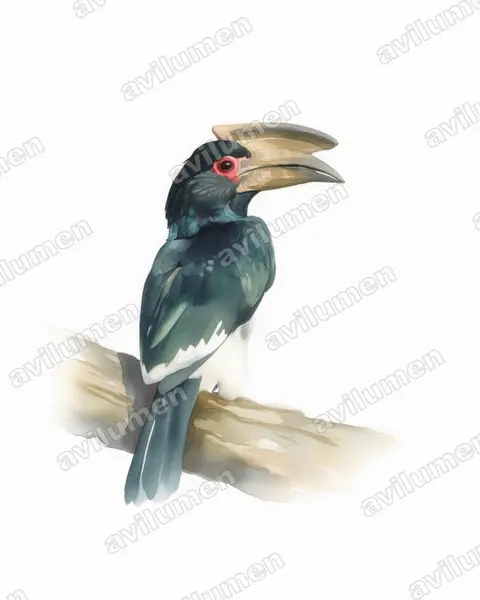
Watercolor 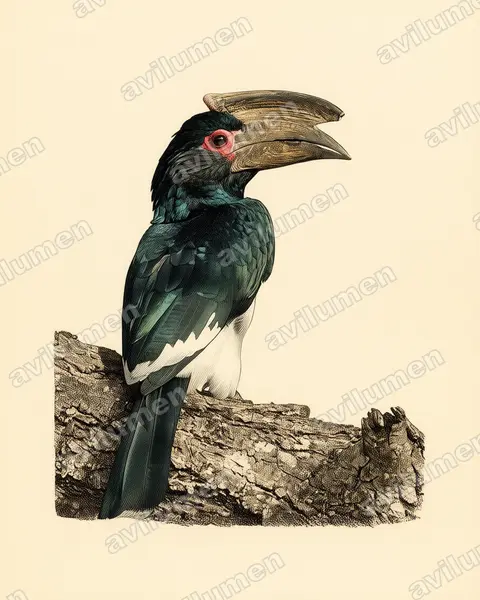
Vintage plate 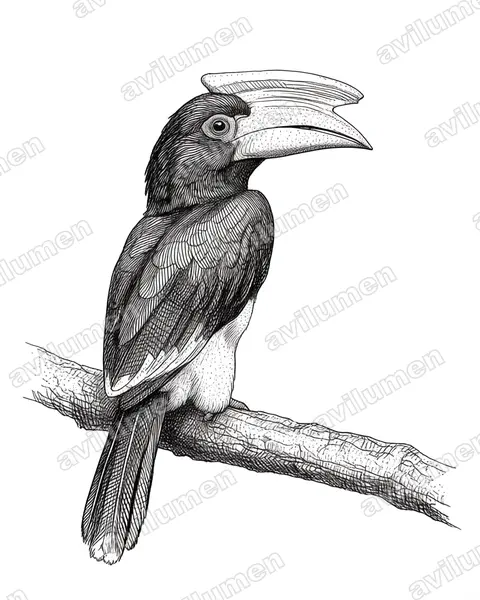
Ink 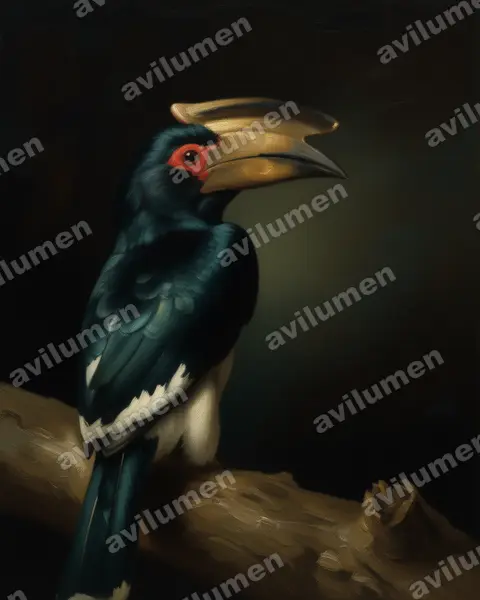
Oil 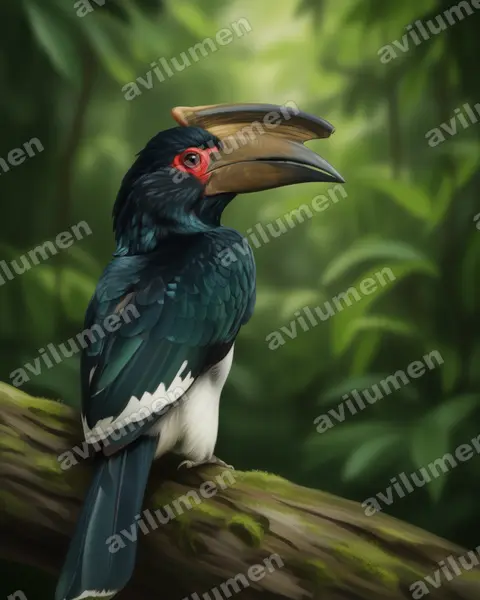
Realistic 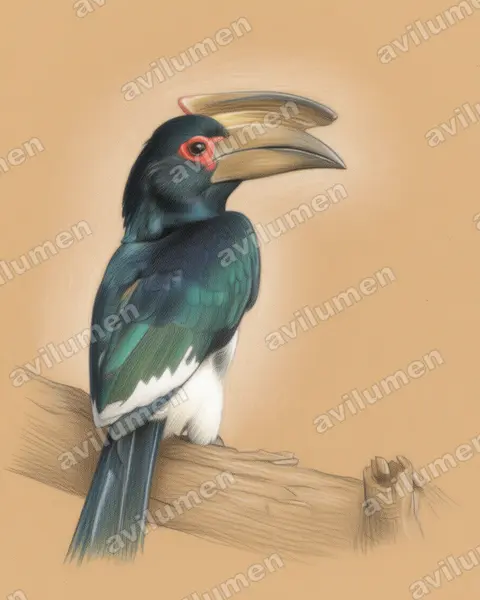
Colored pencil
Illustrations based on the photograph by Clint Ralph (CC BY-SA 4.0), from Wikimedia Commons.
Digital editions
HD Digital Art Pack — Trumpeter Hornbill
Digital download: 6 high-resolution illustrations of the Trumpeter Hornbill (Bycanistes bucinator), print-ready. This is a digital file; no animal or physical item is included.
AI Avatar — Trumpeter Hornbill
Generate an avatar fusing your face with the Trumpeter Hornbill (Bycanistes bucinator). Delivered digitally in 8K, watermark-free. Digital product; no animals are sold or brokered.
Instant download. No live birds are sold.
Frequently asked questions
- Is Bycanistes bucinator (Trumpeter Hornbill) endangered?
- The IUCN Red List places Bycanistes bucinator, commonly known as the Trumpeter Hornbill, in the «Least concern» category. «Least concern» means it is not currently threatened.
- Where does Bycanistes bucinator (Trumpeter Hornbill) live?
- Bycanistes bucinator (Trumpeter Hornbill) is found in Africa.
- What family does Bycanistes bucinator (Trumpeter Hornbill) belong to?
- Bycanistes bucinator (Trumpeter Hornbill) belongs to the family Bucerotidae, in the order Bucerotiformes.
- What colour is Bycanistes bucinator (Trumpeter Hornbill)?
- The plumage of Bycanistes bucinator (Trumpeter Hornbill) combines these colours: Black, White, and Red.
More from the same family
 Vulnerable
Rufous-necked Hornbill
Aceros nipalensis
The rufous-necked hornbill is a species of hornbill in Bhutan, northeastern India, especially in Arunachal Pradesh, Indian subcontinent and Southeast Asia. It is locally extinct in Nepal due to hunting and significant loss of habitat. There are less than 10,000 adults left in the wild. With a length of about 117 cm (46 in), it is among the largest Bucerotine hornbills.
from $1.99
 Near threatened
Austen's Brown Hornbill
Anorrhinus austeni
Austen's brown hornbill, also known as the white-throated brown hornbill or brown hornbill, is a medium-sized species of hornbill found in forests from northeastern India to Vietnam and northern Thailand. It is rare throughout its range and is threatened by habitat loss and fragmentation.
from $1.99
 Near threatened
Bushy-crested Hornbill
Anorrhinus galeritus
The bushy-crested hornbill is a bird in the hornbill family. It is found in Brunei, Indonesia, Malaysia, Myanmar, and Thailand. Its natural habitat is subtropical or tropical moist lowland forests.
from $1.99
 Near threatened
Austen's Brwon Hornbill
Anorrhinus tickelli
Tickell's brown hornbill, also known as the rusty-cheeked hornbill, is a species of hornbill found in forests in Burma and adjacent western Thailand. Austen's brown hornbill is sometimes considered as a subspecies of Tickell's brown hornbill.
from $1.99