Brown-cheeked Hornbill
Bycanistes cylindricus
Avilumen editorial team ·

The brown-cheeked hornbill is a species of hornbill in the family Bucerotidae. It is found in Ivory Coast, Ghana, Guinea, Liberia, Sierra Leone, and Togo. Its natural habitats are tropical and subtropical moist broadleaf forests, plantations, and secondary growth forests. It is threatened by habitat destruction, as timber is harvested and the forests become increasingly fragmented.
The brown-cheeked hornbill (Bycanistes cylindricus) is a species of hornbill in the family Bucerotidae. It is found in Ivory Coast, Ghana, Guinea, Liberia, Sierra Leone, and Togo. Its natural habitats are tropical and subtropical moist broadleaf forests, plantations, and secondary growth forests. It is threatened by habitat destruction, as timber is harvested and the forests become increasingly fragmented.
Description
The brown-cheeked hornbill is a large bird, measuring 60 to 70 cm (24 to 28 in) in length. The male has a large yellow, down-curving beak topped by a casque, a hollow structure attached to the upper mandible. The head, upper parts and underparts are black apart from the reddish-brown cheeks, and the white rump, belly and tail. The female is smaller but otherwise similar to the male apart from having a black beak and casque. Its call is a descending series of coarse croaks "rrah...rrah...rrah...rrah" or "rack kack kak-kak".
Distribution and habitat
The brown-cheeked hornbill is native to the Upper Guinean forests region of tropical West Africa, its range including southern Guinea, Sierra Leone, Liberia, Ivory Coast, southwestern Ghana and Togo. These forests are moist deciduous, semi-evergreen mixed forests, typically containing a range of tree species, some of which drop their leaves during the dry season. It is also found in mature second-growth forest.
Ecology
The brown-cheeked hornbill covers large distances while foraging in the forest. It feeds on fruits and is an excellent disperser of the seeds, which may be deposited as far from their origin as 6.9 km (4.3 mi). Many forest trees have large seeds, and any decrease in the populations of frugivorous birds like the brown-cheeked hornbill is likely to impact adversely on the dispersal of seeds and the regeneration of forest. This hornbill also feeds on insects, which it catches on the wing. It nests in cavities in trees some 20 m (66 ft) above the ground, and may be dependent on there being large trees, alive or dead, for suitable nesting sites. Breeding may not take place every year.
Status
The fragmentation of the forest and the removal of timber deprives this bird of the habitat it needs in order to find sufficient fruit. The brown-cheeked hornbill is one of the first species of hornbill to disappear following timber extraction. Many of the forested areas within its range have disappeared, being replaced by agricultural land and oil palm and other plantations, however it is present in a number of protected areas. Hunting the birds for sale as live birds or for use as bushmeat is a significant threat for hornbills, and because of their low reproductive rate, species like the brown-cheeked hornbill are put at risk by this practice. For these reasons, the International Union for Conservation of Nature has assessed the conservation status of this species as "vulnerable".
Text adapted from Wikipedia · CC BY-SA 4.0
Taxonomy
- Order
- Bucerotiformes
- Family
- Bucerotidae
- Genus
- Bycanistes
- Conservation status
- Vulnerable
Listen to its call
No recording yet
Illustration gallery
6 illustrations of Bycanistes cylindricus (Brown-cheeked Hornbill) in different styles, true to its real plumage. Shown watermarked; the art pack includes the high-resolution originals, ready to print.
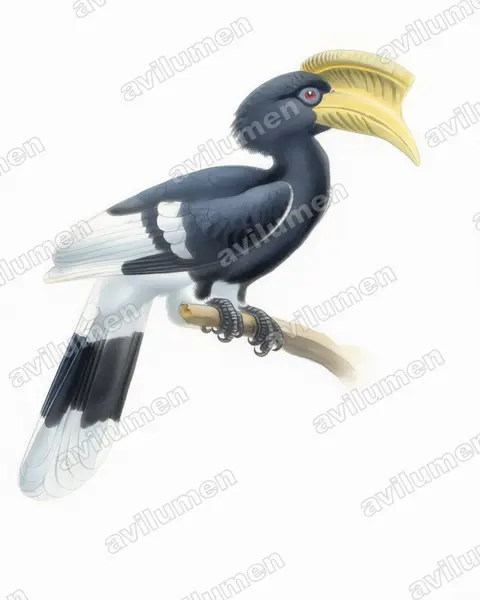
Watercolor 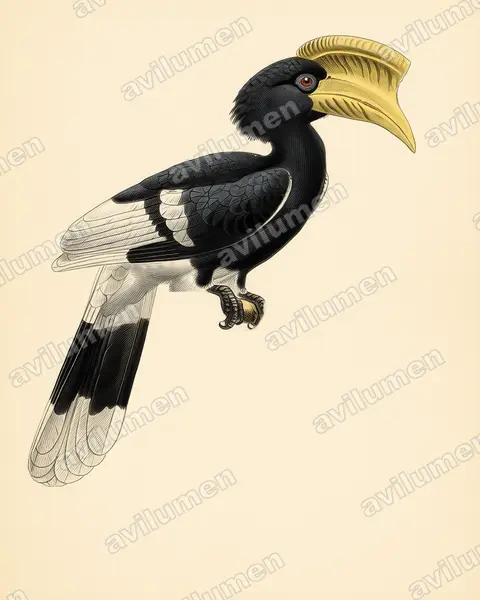
Vintage plate 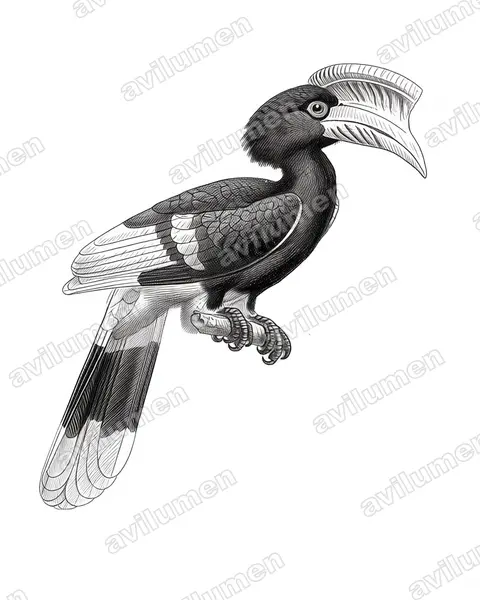
Ink 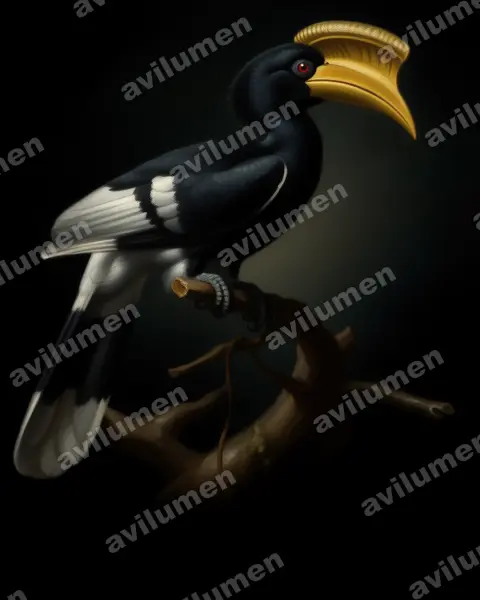
Oil 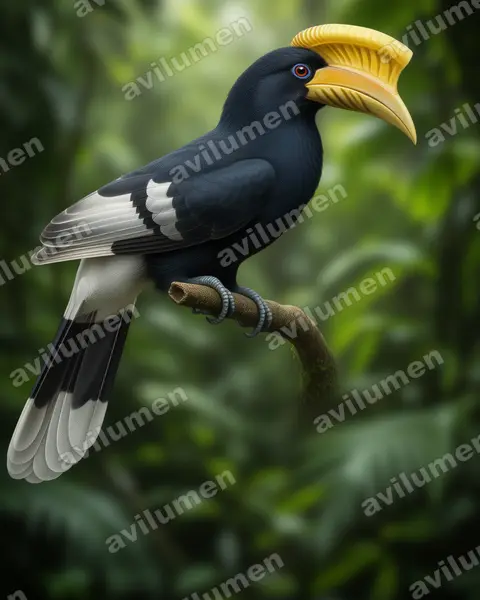
Realistic 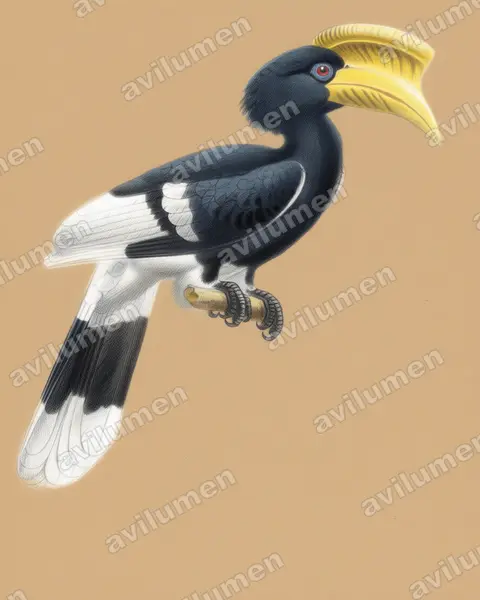
Colored pencil
Illustrations based on the photograph by Elliot, Daniel Giraud (Public domain), from Wikimedia Commons.
Digital editions
HD Digital Art Pack — Brown-cheeked Hornbill
Digital download: 6 high-resolution illustrations of the Brown-cheeked Hornbill (Bycanistes cylindricus), print-ready. This is a digital file; no animal or physical item is included.
AI Avatar — Brown-cheeked Hornbill
Generate an avatar fusing your face with the Brown-cheeked Hornbill (Bycanistes cylindricus). Delivered digitally in 8K, watermark-free. Digital product; no animals are sold or brokered.
Instant download. No live birds are sold.
Frequently asked questions
- Is Bycanistes cylindricus (Brown-cheeked Hornbill) endangered?
- The IUCN Red List places Bycanistes cylindricus, commonly known as the Brown-cheeked Hornbill, in the «Vulnerable» category. «Vulnerable» means it faces a high risk of extinction in the medium term.
- Where does Bycanistes cylindricus (Brown-cheeked Hornbill) live?
- Bycanistes cylindricus (Brown-cheeked Hornbill) is found in Africa.
- What family does Bycanistes cylindricus (Brown-cheeked Hornbill) belong to?
- Bycanistes cylindricus (Brown-cheeked Hornbill) belongs to the family Bucerotidae, in the order Bucerotiformes.
- What colour is Bycanistes cylindricus (Brown-cheeked Hornbill)?
- The plumage of Bycanistes cylindricus (Brown-cheeked Hornbill) combines these colours: Brown and Black.
More from the same family
 Vulnerable
Rufous-necked Hornbill
Aceros nipalensis
The rufous-necked hornbill is a species of hornbill in Bhutan, northeastern India, especially in Arunachal Pradesh, Indian subcontinent and Southeast Asia. It is locally extinct in Nepal due to hunting and significant loss of habitat. There are less than 10,000 adults left in the wild. With a length of about 117 cm (46 in), it is among the largest Bucerotine hornbills.
from $1.99
 Near threatened
Austen's Brown Hornbill
Anorrhinus austeni
Austen's brown hornbill, also known as the white-throated brown hornbill or brown hornbill, is a medium-sized species of hornbill found in forests from northeastern India to Vietnam and northern Thailand. It is rare throughout its range and is threatened by habitat loss and fragmentation.
from $1.99
 Near threatened
Bushy-crested Hornbill
Anorrhinus galeritus
The bushy-crested hornbill is a bird in the hornbill family. It is found in Brunei, Indonesia, Malaysia, Myanmar, and Thailand. Its natural habitat is subtropical or tropical moist lowland forests.
from $1.99
 Near threatened
Austen's Brwon Hornbill
Anorrhinus tickelli
Tickell's brown hornbill, also known as the rusty-cheeked hornbill, is a species of hornbill found in forests in Burma and adjacent western Thailand. Austen's brown hornbill is sometimes considered as a subspecies of Tickell's brown hornbill.
from $1.99