Outcrop sabrewing
Campylopterus calcirupicola
Avilumen editorial team ·

The outcrop sabrewing or dry-forest sabrewing is a vulnerable species of hummingbird in the "emeralds", tribe Trochilini of subfamily Trochilinae. It is endemic to eastern Brazil.
The outcrop sabrewing or dry-forest sabrewing (Campylopterus calcirupicola) is a vulnerable species of hummingbird in the "emeralds", tribe Trochilini of subfamily Trochilinae. It is endemic to eastern Brazil.
Taxonomy and systematics
What is now the outcrop sabrewing was treated as part of the diamantinensis subspecies of the grey-breasted sabrewing (Campylopterus largipennis). In a 2017 paper Lopes et al. provided convincing evidence that both the outcrop sabrewing and diamantinensis sensu stricto deserved species status. The South American Classification Committee of the American Ornithological Society and worldwide taxonomic systems agreed, recognizing the outcrop and Diamantina sabrewings. Both are monotypic.
Description
The outcrop sabrewing is very similar to its "parents", the grey-breasted and especially the Diamantina sabrewings. Males weigh about 7.0 g (0.25 oz) and females 5.9 g (0.21 oz). The sexes have almost identical plumage. Their bill is long and slightly decurved. Their upperparts are bright bronze green with coppery reflections on the darker crown. They have a white spot behind the eye. Their underparts are pale gray that lightens to whitish on the abdomen and light gray on the undertail coverts. Their central pair of tail feathers is bright bronze green, the next pair bright bronze green with a dark olive gray spot at the end, and the rest have bright bronze green bases, narrow dark olive gray bands near the tip, and white tips.
Distribution and habitat
The outcrop sabrewing is found only in a small part of eastern Brazil. It is known from northeastern Goiás, southwestern Bahia, and northern Minas Gerais, and suspected to also be found in southeastern Tocantins and southern Piauí. Though exact details of its habitat requirements have not been determined, it is known mostly from dry forests on limestone outcrops and calcareous soils derived from them. It is known only in a very limited elevational range between 460 and 880 m (1,500 and 2,900 ft).
Movement
The outcrop sabrewing's movements, if any, have not been documented.
Feeding
The outcrop sabrewing's foraging strategy and diet are poorly known, but it does take nectar from a variety of native and introduced plant species.
Breeding
The outcrop sabrewing's breeding season appears to span from May to December, but nothing else is known about its breeding phenology. Its nest and eggs have not been described.
Vocalization
The outcrop sabrewing's vocalizations have not been put into words, but recordings are available in xeno-canto and the Cornell Lab of Ornithology's Macaulay Library.
Status
The IUCN has assessed the outcrop sabrewing as Vulnerable. It has a very limited range and habitat requirements. Its estimated population of between 2400 and 15,000 mature individuals is believed to be decreasing. Though forest in much of its range has been altered or destroyed, the outcrop areas are not very desirable for agriculture. Mining and hydroelectric power projects do pose future threats. Parts of its range are protected in one national and one state park.
Text adapted from Wikipedia · CC BY-SA 4.0
Where it lives
Plumage colours
Distribution

Taxonomy
- Order
- Apodiformes
- Family
- Trochilidae
- Genus
- Campylopterus
- Conservation status
- Vulnerable
Listen to its call
No recording yet
Illustration gallery
6 illustrations of Campylopterus calcirupicola (Outcrop sabrewing) in different styles, true to its real plumage. Shown watermarked; the art pack includes the high-resolution originals, ready to print.
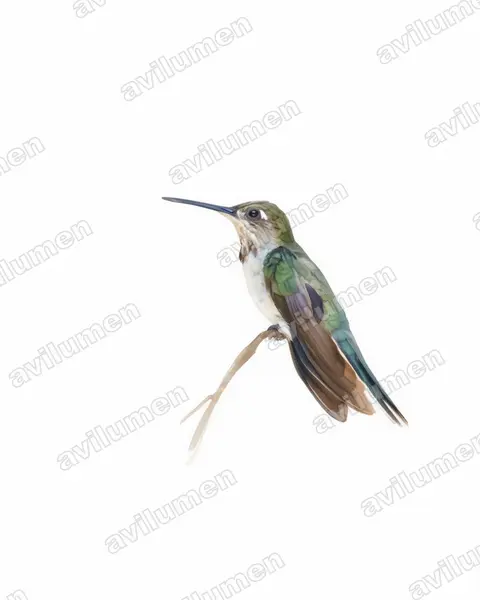
Watercolor 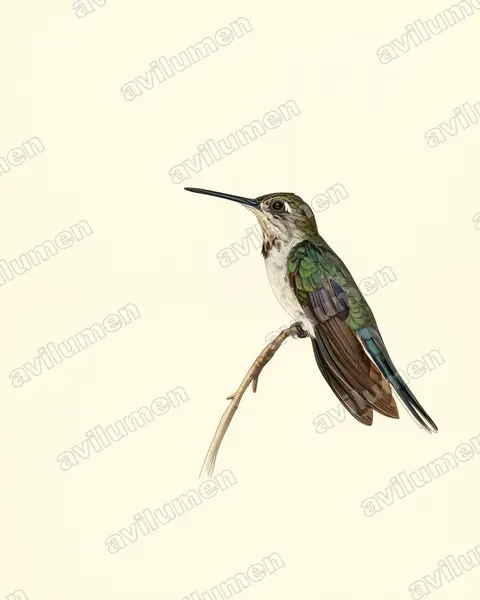
Vintage plate 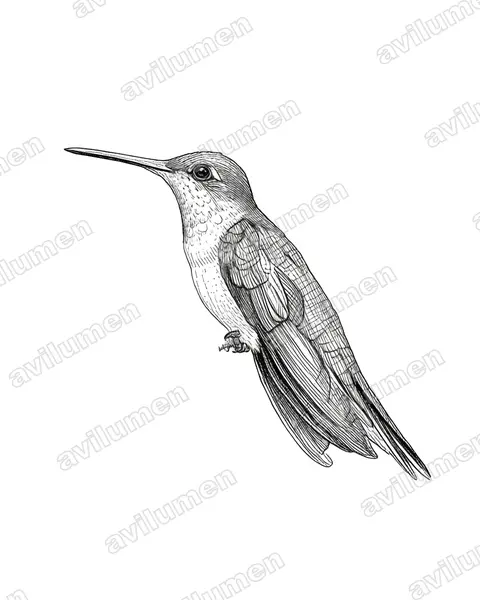
Ink 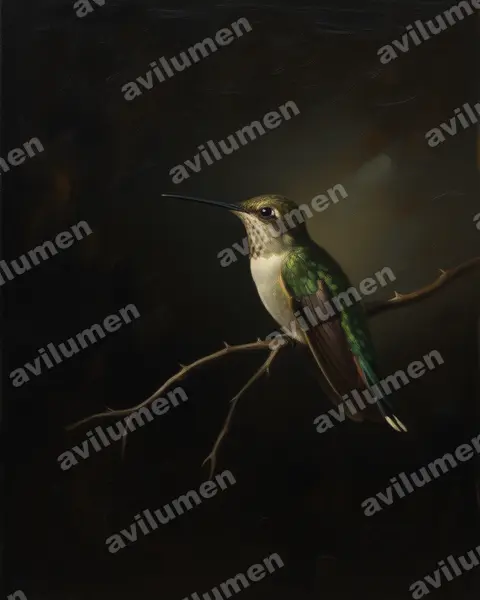
Oil 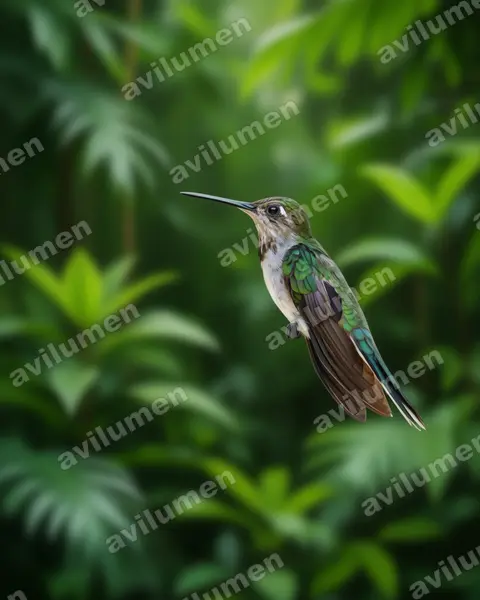
Realistic 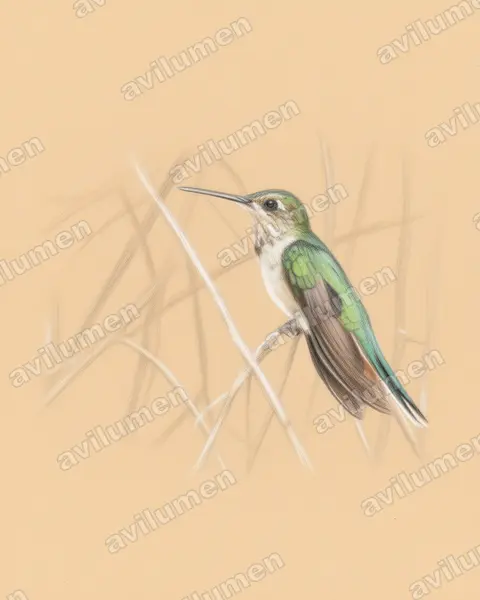
Colored pencil
Illustrations based on the photograph by Hector Bottai (CC BY-SA 4.0), from Wikimedia Commons.
Digital editions
HD Digital Art Pack — Outcrop sabrewing
Digital download: 6 high-resolution illustrations of the Outcrop sabrewing (Campylopterus calcirupicola), print-ready. This is a digital file; no animal or physical item is included.
AI Avatar — Outcrop sabrewing
Generate an avatar fusing your face with the Outcrop sabrewing (Campylopterus calcirupicola). Delivered digitally in 8K, watermark-free. Digital product; no animals are sold or brokered.
Instant download. No live birds are sold.
Frequently asked questions
- Is Campylopterus calcirupicola (Outcrop sabrewing) endangered?
- The IUCN Red List places Campylopterus calcirupicola, commonly known as the Outcrop sabrewing, in the «Vulnerable» category. «Vulnerable» means it faces a high risk of extinction in the medium term.
- Where does Campylopterus calcirupicola (Outcrop sabrewing) live?
- Campylopterus calcirupicola (Outcrop sabrewing) is found in Brazil and South America.
- What family does Campylopterus calcirupicola (Outcrop sabrewing) belong to?
- Campylopterus calcirupicola (Outcrop sabrewing) belongs to the family Trochilidae, in the order Apodiformes.
- What colour is Campylopterus calcirupicola (Outcrop sabrewing)?
- The plumage of Campylopterus calcirupicola (Outcrop sabrewing) combines these colours: Green.
More from the same family
 Least concern
Emerald-chinned Hummingbird
Abeillia abeillei
The emerald-chinned hummingbird is a species of hummingbird in the "emeralds", tribe Trochilini of subfamily Trochilinae.
from $1.99
 Least concern
Speckled hummingbird
Adelomyia melanogenys
The speckled hummingbird is a species of hummingbird. It is the only member of the genus Adelomyia. It inhabits Neotropical montane cloud forests at elevations of 1,000–2,500 meters and is confined to the Andes of Argentina, Bolivia, Peru, Ecuador, Colombia and Venezuela; as well as to some isolated montane forests in western Ecuador and Venezuela.
from $1.99
 Vulnerable
Purple-backed sunbeam
Aglaeactis aliciae
The purple-backed sunbeam is a bird species in the family Trochilidae. It is found only in Peru.
from $1.99
 Near threatened
White-tufted sunbeam
Aglaeactis castelnaudii
The white-tufted sunbeam is a species of hummingbird in the family Trochilidae. It is found only in Peru. Its natural habitats are subtropical or tropical moist montane forest and subtropical or tropical high-altitude shrubland.
from $1.99