Amazonian umbrellabird
Cephalopterus ornatus
Avilumen editorial team ·

The Amazonian umbrellabird is a species of bird in the family Cotingidae native to the Amazon basin with a separate population on the eastern slopes of the Andes. The male bird is entirely black, with a black crest and inflatable wattle on the throat, and at 48 to 55 cm, may be the largest passerine bird in South America. The female is slightly smaller.
The Amazonian umbrellabird (Cephalopterus ornatus) is a species of bird in the family Cotingidae native to the Amazon basin with a separate population on the eastern slopes of the Andes. The male bird is entirely black, with a black crest and inflatable wattle on the throat, and at 48 to 55 cm (19 to 22 in), may be the largest passerine bird in South America. The female is slightly smaller. Both have an undulating flight, described as woodpecker-like, and the male has a loud, booming call.
The Amazonian umbrellabird feeds on fruit and berries, and may opportunistically take insects and spiders. It forages singly, in pairs or in small groups, in the forest canopy, hopping from branch to branch, but is a secretive species and is more often heard than seen.
Description
Much larger than the female, the male Amazonian umbrellabird is likely the largest passerine in South America as well as the largest suboscine passerine in the world. The male Amazonian umbrellabird grows to a weight of 480–571 grams (1.06–1.26 lb) and a length of 48–55 centimetres (18.9–21.7 in). The female typically stands 41–44 centimetres (16.1–17.3 in) tall and weighs up to 380 grams (0.84 lb). As in the other umbrellabirds, the Amazonian umbrellabird is almost entirely black, has a conspicuous crest on the top of their head, and an inflatable wattle on the neck, which serves to amplify their loud, booming calls. This species has pale eyes, whereas in other umbrellabirds, the eye is black. The undulating flying method of this species is considered quite woodpecker-like, with the lack of white on the umbrellabird's plumage distinguishing it from large woodpeckers with which it co-exists. The Amazonian umbrellabird is usually seen flying only across openings in the forest, such as over rivers, and usually boldly hops branch to branch while in trees.
Distribution
It is present in almost the entirety of the immense Amazon basin, from the Andean foothills of Colombia, Ecuador, Peru and Bolivia, to the east to the south of Venezuela (basins of the upper and middle Orinoco River), locally in the southwest of Guyana, and Brazil (eastward to the Negro and Xingú river basins, southward to southern Mato Grosso, reaching the headwaters of the Paraguay River).
This species occurs in two main populations: One found in woodland and forest, mainly near rivers, in the Amazon basin, and a second found in forested foothills of the eastern Andes. The Amazonian umbrellabird is found variously in small groups, pairs or individually. They are usually seen in or near the canopy, but due to their wary behavior and scarcity at open spots, they are easily missed for a bird of this size. They are heard in the field more often than they are seen. Fruit and berries are usually preferred, but insects, spiders, and insect larvae are eaten opportunistically.
Text adapted from Wikipedia · CC BY-SA 4.0
Where it lives
Plumage colours
Distribution

Taxonomy
- Order
- Passeriformes
- Family
- Cotingidae
- Genus
- Cephalopterus
- Conservation status
- Least concern
Listen to its call
No recording yet
Illustration gallery
6 illustrations of Cephalopterus ornatus (Amazonian umbrellabird) in different styles, true to its real plumage. Shown watermarked; the art pack includes the high-resolution originals, ready to print.
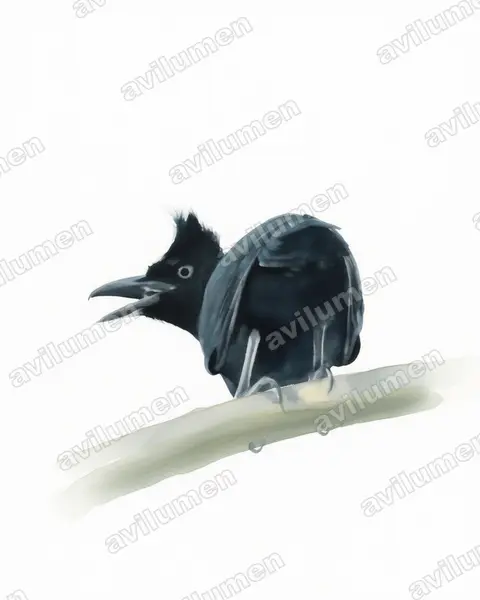
Watercolor 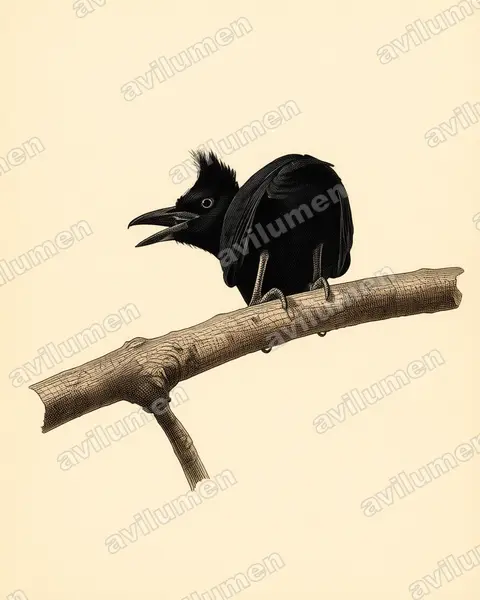
Vintage plate 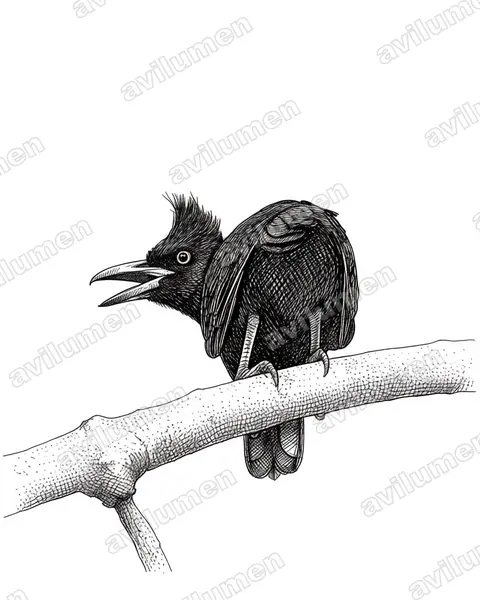
Ink 
Oil 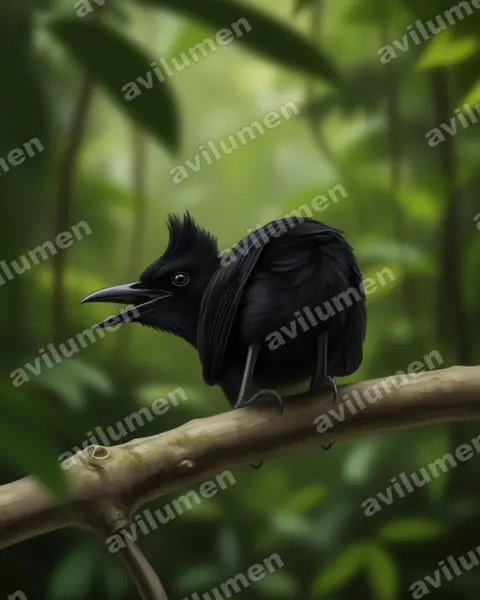
Realistic 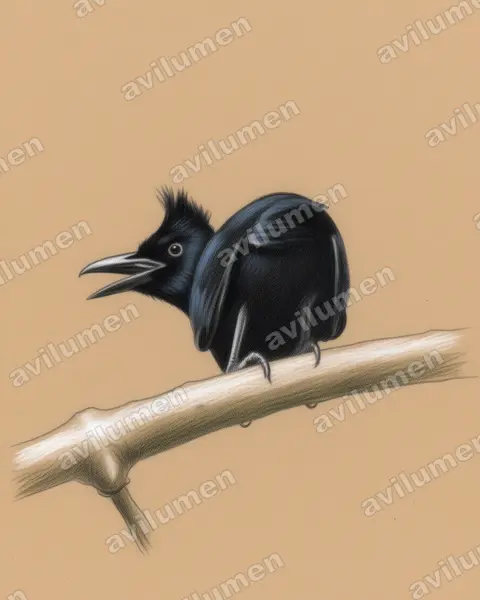
Colored pencil
Illustrations based on the photograph by Hector Bottai (CC BY-SA 4.0), from Wikimedia Commons.
Digital editions
HD Digital Art Pack — Amazonian umbrellabird
Digital download: 6 high-resolution illustrations of the Amazonian umbrellabird (Cephalopterus ornatus), print-ready. This is a digital file; no animal or physical item is included.
AI Avatar — Amazonian umbrellabird
Generate an avatar fusing your face with the Amazonian umbrellabird (Cephalopterus ornatus). Delivered digitally in 8K, watermark-free. Digital product; no animals are sold or brokered.
Instant download. No live birds are sold.
Frequently asked questions
- Is Cephalopterus ornatus (Amazonian umbrellabird) endangered?
- The IUCN Red List places Cephalopterus ornatus, commonly known as the Amazonian umbrellabird, in the «Least concern» category. «Least concern» means it is not currently threatened.
- Where does Cephalopterus ornatus (Amazonian umbrellabird) live?
- Cephalopterus ornatus (Amazonian umbrellabird) is found in Brazil and South America.
- What family does Cephalopterus ornatus (Amazonian umbrellabird) belong to?
- Cephalopterus ornatus (Amazonian umbrellabird) belongs to the family Cotingidae, in the order Passeriformes.
- What colour is Cephalopterus ornatus (Amazonian umbrellabird)?
- The plumage of Cephalopterus ornatus (Amazonian umbrellabird) combines these colours: Black.
More from the same family
 Least concern
Scaled Fruiteater
Ampelioides tschudii
The scaled fruiteater is a species of bird in the family Cotingidae. It is the only member of the genus Ampelioides. This bird is found in Bolivia, Colombia, Ecuador, Peru, and Venezuela, where its natural habitat is the high elevation tropical forests of the Andes mountains. The scaled fruiteater is a chunky, short-tailed, flat-headed bird measuring 19–20 cm (7.5–7.9 in) in length.
from $1.99
 Least concern
Red-crested Cotinga
Ampelion rubrocristatus
The red-crested cotinga is a species of bird in the family Cotingidae. It is found in Bolivia, Colombia, Ecuador, Peru, and Venezuela.
from $1.99
 Least concern
Chestnut-crested Cotinga
Ampelion rufaxilla
The chestnut-crested cotinga is a species of bird in the family Cotingidae. It is found in Bolivia, Colombia, Ecuador, and Peru.
from $1.99
 Critically endangered
Kinglet Calyptura
Calyptura cristata
The kinglet calyptura is a small Critically Endangered passerine bird in the family Tyrannidae, the tyrant flycatchers. It is endemic to southeastern Brazil.
from $1.99