Long-wattled Umbrellabird
Cephalopterus penduliger
Avilumen editorial team ·

The long-wattled umbrellabird is an umbrellabird in the Cotingidae family. Its Spanish names include pájaro bolsón, pájaro toro, dungali, and vaca del monte. The long-wattled umbrellabird is considered rare and it resides in humid to wet premontane and cloud forest. They are often found on the Pacific slopes of southwest Colombia and western Ecuador, but occasionally are found at lower altitudes.
The long-wattled umbrellabird (Cephalopterus penduliger) is an umbrellabird in the Cotingidae family. Its Spanish names include pájaro bolsón, pájaro toro, dungali, and vaca del monte. The long-wattled umbrellabird is considered rare and it resides in humid to wet premontane and cloud forest. They are often found on the Pacific slopes of southwest Colombia and western Ecuador, but occasionally are found at lower altitudes.
Description
The male is 40–42 cm in height, with the female being slightly smaller at 35–37 cm. Both sexes are short-tailed and carry an erectile head crest; those of the males are slightly longer at 20–30 cm. The male is distinguished by a large throat wattle of feathers, while females and juveniles have no or a much smaller wattle. The length of the wattle can be controlled, and it can be retracted in flight. The male generally has black colored shafts in its feathers.
The long-wattled umbrellabird's specific name penduliger derives from Latin pendulus, hanging, and refers to the wattle.
Distribution and habitat
The species shows a high level of endemism and is found from the southwestern part of Colombia to the province of El Oro in Ecuador, in the bioregion of Tumbes–Chocó–Magdalena. It inhabits humid montane forests at 1,500-1,800 m above sea level on the ridges and sides of the Andes range.
Feeding
The species is mostly frugivorous, and feeds on large fruit. The fruits of the Arecaceae, Lauraceae, and Myrtaceae are preferred. Invertebrates and small vertebrates are also taken.
Reproduction
The long-wattled umbrellabird engages in lek mating, where the males congregate in common areas (leks) for display, which are visited by the solitary females. Females select a male with prominent secondary traits such as aggression and territorial behavior. Nests are built in trees or treeferns, and have been recorded at heights of 4.5–5.0 m above ground.
Clutch sizes in the genus Cephalopterus are generally low; only one egg is laid per nesting attempt. Incubation lasts 27 or 28 days. Only the female incubates and cares for the nestling. She provides food for the nestling on average once per hour and includes invertebrates, vertebrates, and regurgitated material.
Conservation
The species has been classified as vulnerable by the IUCN. A total population of 7,500-15,000 mature individuals was estimated in 2023. It is thought to be under pressure from habitat destruction through deforestation and from hunting. The easy-to-locate lek mating areas make it particularly susceptible to trapping.
The long-wattled umbrellabird is present in several protected areas. The consolidation of existing scattered reserves, as well as the nomination of several existing protected areas as biosphere reserves, could be very beneficial for the species. The curating of forest composition and reforestation have been pointed out as important approaches.
Text adapted from Wikipedia · CC BY-SA 4.0
Where it lives
Plumage colours
Distribution

Taxonomy
- Order
- Passeriformes
- Family
- Cotingidae
- Genus
- Cephalopterus
- Conservation status
- Vulnerable
Listen to its call
No recording yet
Illustration gallery
6 illustrations of Cephalopterus penduliger (Long-wattled Umbrellabird) in different styles, true to its real plumage. Shown watermarked; the art pack includes the high-resolution originals, ready to print.
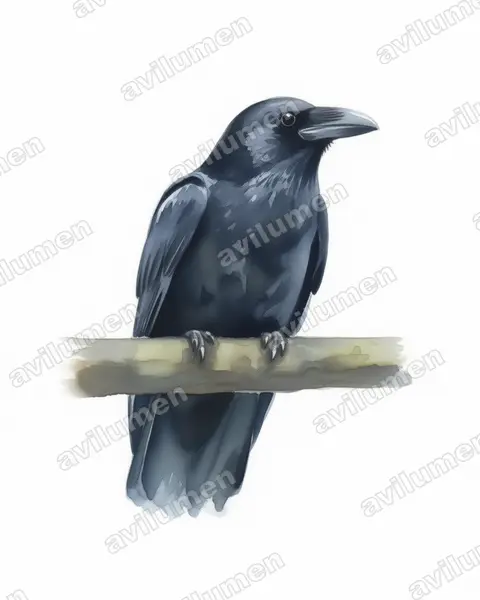
Watercolor 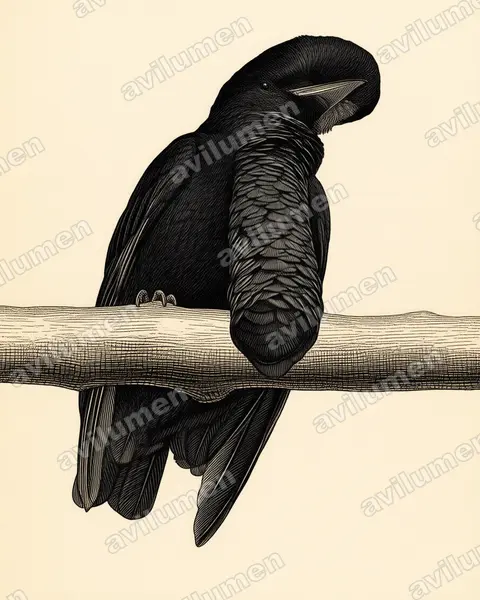
Vintage plate 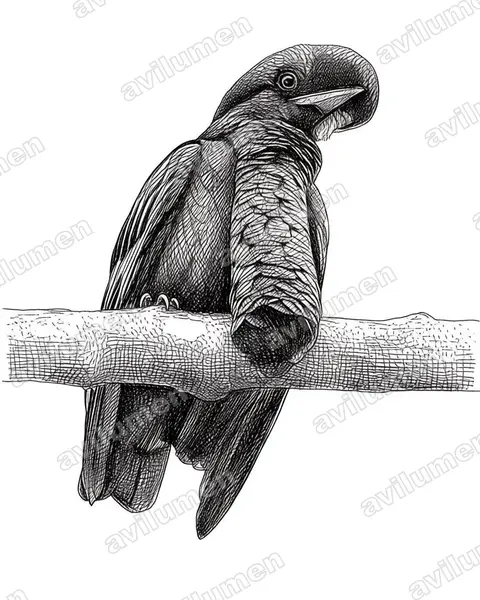
Ink 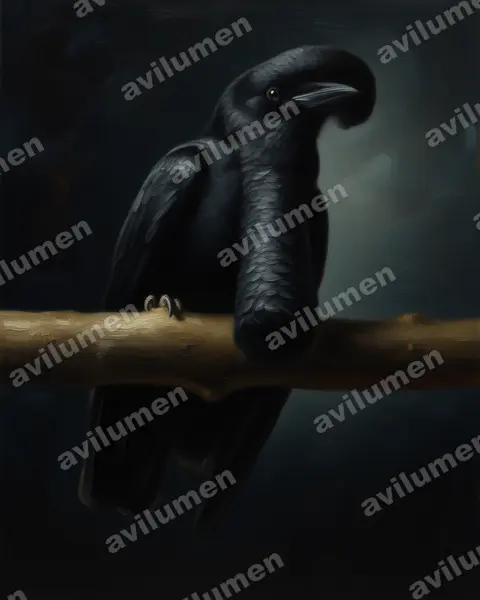
Oil 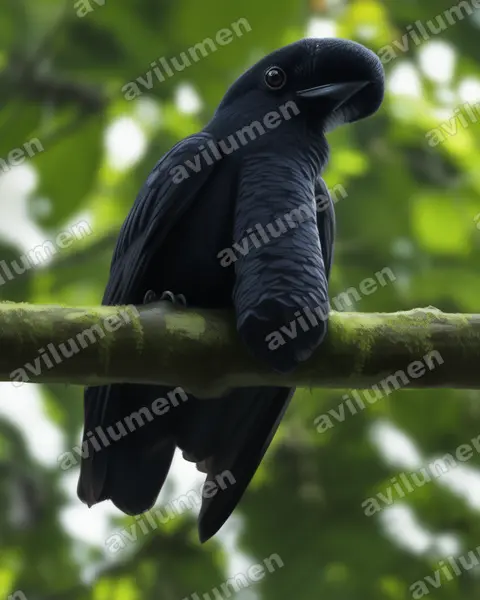
Realistic 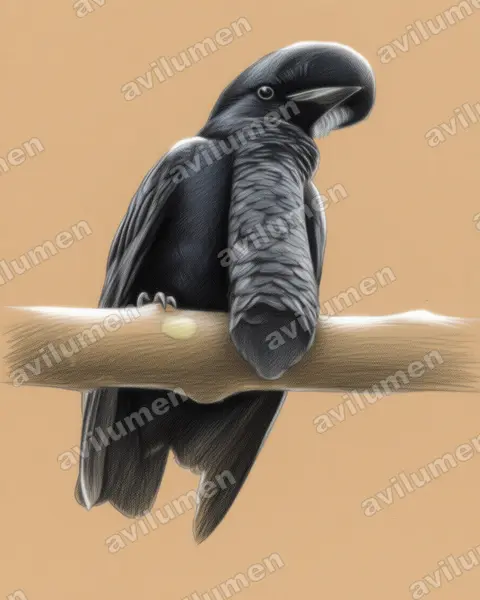
Colored pencil
Illustrations based on the photograph by Francesco Veronesi from Italy (CC BY-SA 2.0), from Wikimedia Commons.
Digital editions
HD Digital Art Pack — Long-wattled Umbrellabird
Digital download: 6 high-resolution illustrations of the Long-wattled Umbrellabird (Cephalopterus penduliger), print-ready. This is a digital file; no animal or physical item is included.
AI Avatar — Long-wattled Umbrellabird
Generate an avatar fusing your face with the Long-wattled Umbrellabird (Cephalopterus penduliger). Delivered digitally in 8K, watermark-free. Digital product; no animals are sold or brokered.
Instant download. No live birds are sold.
Frequently asked questions
- Is Cephalopterus penduliger (Long-wattled Umbrellabird) endangered?
- The IUCN Red List places Cephalopterus penduliger, commonly known as the Long-wattled Umbrellabird, in the «Vulnerable» category. «Vulnerable» means it faces a high risk of extinction in the medium term.
- Where does Cephalopterus penduliger (Long-wattled Umbrellabird) live?
- Cephalopterus penduliger (Long-wattled Umbrellabird) is found in South America.
- What family does Cephalopterus penduliger (Long-wattled Umbrellabird) belong to?
- Cephalopterus penduliger (Long-wattled Umbrellabird) belongs to the family Cotingidae, in the order Passeriformes.
- What colour is Cephalopterus penduliger (Long-wattled Umbrellabird)?
- The plumage of Cephalopterus penduliger (Long-wattled Umbrellabird) combines these colours: Black.
More from the same family
 Least concern
Scaled Fruiteater
Ampelioides tschudii
The scaled fruiteater is a species of bird in the family Cotingidae. It is the only member of the genus Ampelioides. This bird is found in Bolivia, Colombia, Ecuador, Peru, and Venezuela, where its natural habitat is the high elevation tropical forests of the Andes mountains. The scaled fruiteater is a chunky, short-tailed, flat-headed bird measuring 19–20 cm (7.5–7.9 in) in length.
from $1.99
 Least concern
Red-crested Cotinga
Ampelion rubrocristatus
The red-crested cotinga is a species of bird in the family Cotingidae. It is found in Bolivia, Colombia, Ecuador, Peru, and Venezuela.
from $1.99
 Least concern
Chestnut-crested Cotinga
Ampelion rufaxilla
The chestnut-crested cotinga is a species of bird in the family Cotingidae. It is found in Bolivia, Colombia, Ecuador, and Peru.
from $1.99
 Critically endangered
Kinglet Calyptura
Calyptura cristata
The kinglet calyptura is a small Critically Endangered passerine bird in the family Tyrannidae, the tyrant flycatchers. It is endemic to southeastern Brazil.
from $1.99