Duchess Lorikeet
Charmosyna margarethae
Avilumen editorial team ·

The duchess lorikeet is a species of parrot in the family Psittaculidae. It is found throughout the Solomon Islands archipelago. Its natural habitats are subtropical or tropical moist lowland forest, subtropical or tropical moist montane forest, and plantations. It is threatened by habitat loss.
The duchess lorikeet (Vini margarethae) is a species of parrot in the family Psittaculidae. It is found throughout the Solomon Islands archipelago. Its natural habitats are subtropical or tropical moist lowland forest, subtropical or tropical moist montane forest, and plantations. It is threatened by habitat loss.
Taxonomy
The duchess lorikeet was formally described in 1879 by the English clergyman and ornithologist Henry Baker Tristram from a specimen collected at Makira Harbour, San Cristoval, Solomon Islands. Tristam coined the binomial name Charmosyna margarethae. The specific epithet was chosen to honour Princess Louise Margaret of Prussia who became the Duchess of Connaught and Strathearn when she married Queen Victoria's son Prince Arthur in 1879. The lorikeet was moved to the genus, Vini, based on a molecular phylogenetic study published in 2020.
Description
The duchess lorikeet is 20 cm (8 in) in length, and weighs 40–60 g (1.4–2.1 oz). An adult is mainly bright red, with purple to black hindcrowns and yellow-orange eyes. It has an orange bill and a wide yellow chest band along with a thin yellow collar on the mantle bordered by a purple or black line. It has a dull mauve to black lower breast, with dull yellow underwings. Its tail are red, with green upper tail coverts and yellow tips. Females look the same as males, but additionally have yellow patches on the side of the rump.
Juvenile lorikeets have black markings on the head and underparts, along with a dusky black patch on the occiput. The breast band is a faint yellow and the yellow collar on the mantle has a dusky wash. They have a brown to black bill, with grey eyes.
Distribution and habitat
The species is found only on Bougainville Island and 6 islands in the Solomon Islands. It is a localised species that is absent from large areas of habitat in its range that are potentially suitable for it. It is most often found in lower montane forest and in coconut plantations. It is found from sea level to an elevation of 1,350 m (4,430 ft) asl. It may be nomadic and inhabit habitats at different altitudes.
Behavior and ecology
The calls of the duchess lorikeet are generally more squeaky than that of other species of lorikeets. Their flight calls are loud and high-pitched, while high-pitched screek notes are made while feeding.
Food and feeding
The lorikeet mostly feed on nectar, pollen, and small fruits, especially Schefflera.
Threats
Much of the lowland forest in its range is scheduled to be logged, although it could survive at higher altitudes. Another threat to the species is the possibility of large scale pet trade.
In culture
It was featured on a stamp for the Solomon Islands made in 1975.
Status
The species is widespread and relatively common through its range, but the population may decline rapidly in the future if large scale pet trade begins. The species is considered to be of Least Concern by BirdLife International and the IUCN.
Aviculture
The species is traded in the pet trade, but there is an export quota of 60 birds per year to avoid population decline.
Text adapted from Wikipedia · CC BY-SA 4.0
Where it lives
Plumage colours
Taxonomy
- Order
- Psittaciformes
- Family
- Psittacidae
- Genus
- Charmosyna
- Conservation status
- Least concern
Listen to its call
No recording yet
Care guide
Lory and Lorikeet Care Guide: Nectar Diet and Housing
How to care for lories and rainbow lorikeets: nectar and pollen diet, hygiene, cage setup, health, behavior and CITES legal status for lorikeet owners.
Read the guide →Illustration gallery
6 illustrations of Charmosyna margarethae (Duchess Lorikeet) in different styles, true to its real plumage. Shown watermarked; the art pack includes the high-resolution originals, ready to print.
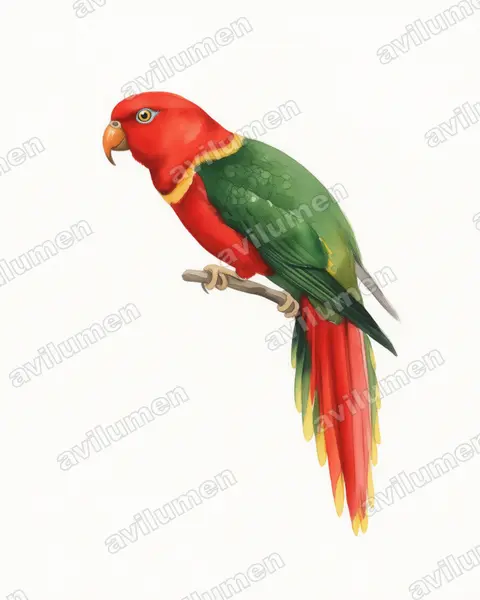
Watercolor 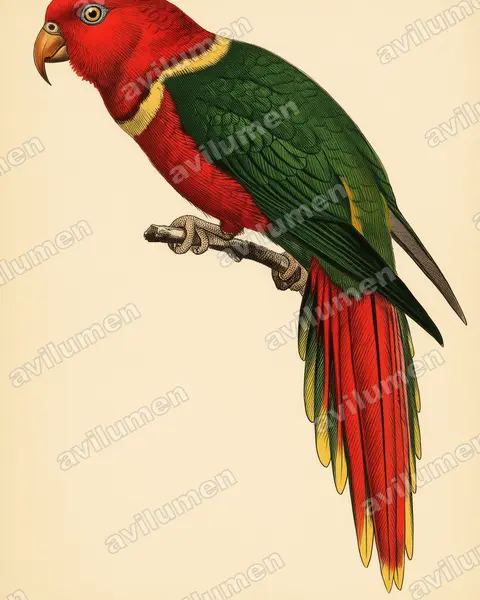
Vintage plate 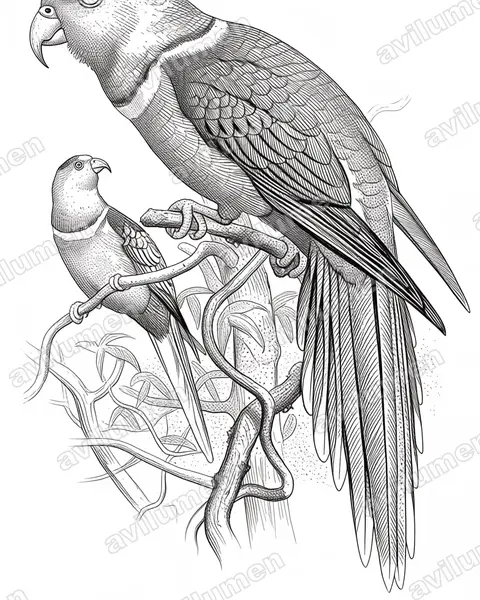
Ink 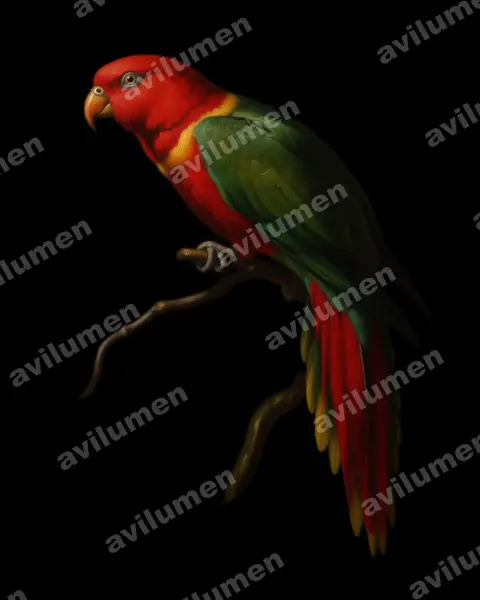
Oil 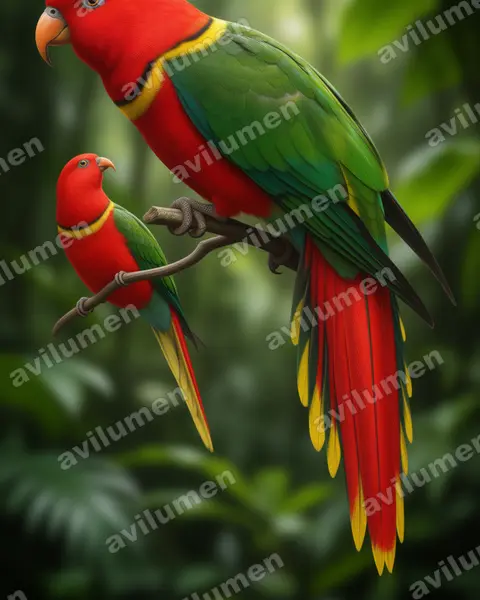
Realistic 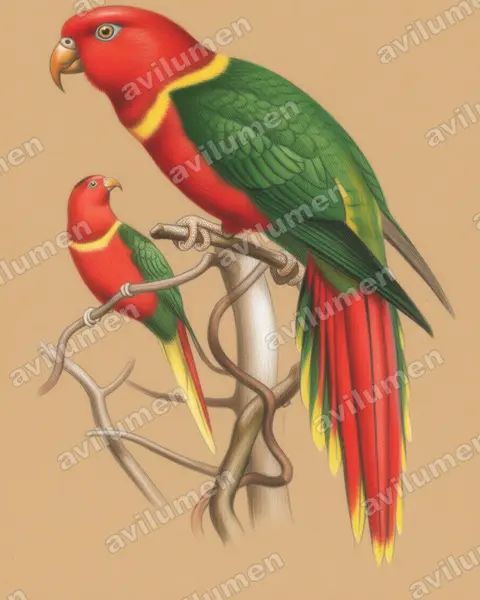
Colored pencil
Illustrations based on the photograph by John Gerrard Keulemans (Public domain), from Wikimedia Commons.
Digital editions
HD Digital Art Pack — Duchess Lorikeet
Digital download: 6 high-resolution illustrations of the Duchess Lorikeet (Charmosyna margarethae), print-ready. This is a digital file; no animal or physical item is included.
AI Avatar — Duchess Lorikeet
Generate an avatar fusing your face with the Duchess Lorikeet (Charmosyna margarethae). Delivered digitally in 8K, watermark-free. Digital product; no animals are sold or brokered.
Instant download. No live birds are sold.
Frequently asked questions
- Is Charmosyna margarethae (Duchess Lorikeet) endangered?
- The IUCN Red List places Charmosyna margarethae, commonly known as the Duchess Lorikeet, in the «Least concern» category. «Least concern» means it is not currently threatened.
- Where does Charmosyna margarethae (Duchess Lorikeet) live?
- Charmosyna margarethae (Duchess Lorikeet) is found in Solomon Islands.
- What family does Charmosyna margarethae (Duchess Lorikeet) belong to?
- Charmosyna margarethae (Duchess Lorikeet) belongs to the family Psittacidae, in the order Psittaciformes.
- What colour is Charmosyna margarethae (Duchess Lorikeet)?
- The plumage of Charmosyna margarethae (Duchess Lorikeet) combines these colours: Green.
More from the same family
 Near threatened
Yellow-faced Parrot
Alipiopsitta xanthops
The yellow-faced parrot, formerly also known as the yellow-faced amazon, is the only species of the genus Alipiopsitta. It is a Neotropical parrot, and was classified in the genus Amazona for many years. It is a predominantly green and yellow-plumaged bird with a yellow head. It is a semi-nomadic species found in the cerrado region of Brazil and adjacent Bolivia.
from $1.99
 Least concern
Moluccan King Parrot
Alisterus amboinensis
The Moluccan king parrot is a parrot endemic to Peleng Island, Maluku, and West Papua in Indonesia. It is sometimes referred to as the Ambon king parrot or Amboina king parrot, but this is potentially misleading, as it is found on numerous other islands than Ambon. The male and female are similar in appearance, with a predominantly red head and underparts, green wings, and blue back and tail.
from $1.99
 Least concern
Papuan King Parrot
Alisterus chloropterus
The Papuan king parrot, also known as the green-winged king parrot, is a species of parrot in the family Psittaculidae found in New Guinea. Its natural habitats are subtropical or tropical moist lowland forest and subtropical or tropical moist montane forest.
from $1.99
 Least concern
Australian King Parrot
Alisterus scapularis
The Australian king parrot is a species of parrot endemic to eastern Australia ranging from Cooktown in Queensland to Port Campbell in Victoria. Found in humid and heavily forested upland regions of the eastern portion of the continent, including eucalyptus wooded areas in and directly adjacent to subtropical and temperate rainforest. They feed on fruits and seeds gathered from trees or on the ground.
from $1.99