Western emerald
Chlorostilbon melanorhynchus
Avilumen editorial team ·

The western emerald is a species of hummingbird in the "emeralds", tribe Trochilini of subfamily Trochilinae. It is found in Colombia and Ecuador.
The western emerald (Chlorostilbon melanorhynchus) is a species of hummingbird in the "emeralds", tribe Trochilini of subfamily Trochilinae. It is found in Colombia and Ecuador.
Taxonomy and systematics
The western emerald was originally described as a species and later treated as a subspecies of the blue-tailed emerald (Chlorostilbon mellisugus). Since the early 2000s the South American Classification Committee (SACC) of the American Ornithological Society, the International Ornithological Committee (IOC), and the Clements taxonomy have again treated it as a species in its own right. However, as of 2020 BirdLife International's Handbook of the Birds of the World (HBW) retained it as the C. mellisugus subspecies.
The IOC treats the western emerald as monotypic. The SACC and Clements recognize two subspecies, the nominate C. m. melanorhynchus and C. m. pumilus, though the SACC accepts that the latter "might not be recognizable". HBW treats melanorhynchus and pumilis as subspecies of blue-tailed emerald.
Description
The western emerald is 10.9 to 11.4 cm (4.3 to 4.5 in) long and weighs about 2.6 g (0.092 oz). Both sexes of both subspecies have a short black bill. The nominate male has an iridescent green forehead and crown with gold highlights, a bright green face, shining bronzy green upperparts, and a steel blue tail. Its underparts are glittering emerald green, with greater iridescence and a blue tinge on the breast. It has white thigh tufts. The female has a bronzy green forehead and crown and a blackish face with a pale gray spot behind the eye. The rest of its upperparts are metallic grass green and the tail is blue-black with white tips. Its underparts are pale gray to white with a buffy tone on the throat and belly. C. m. pumilus, when treated separately, differs only by having a slightly shorter bill and a brighter crown than the nominate.
Distribution and habitat
The western emerald is found from the Western Andes of Colombia south into Ecuador. C. m. melanorhynchus occurs in the upper subtropical zone of Colombia and the temperate zone in Ecuador. C. m. pumilus is found at lower elevations, in the arid and semi-arid tropical and subtropical zones. In Colombia it ranges between elevations of 1,000 and 2,000 m (3,300 and 6,600 ft). In the northwestern Ecuadoran valleys it occurs between 1,500 and 2,700 m (4,900 and 8,900 ft) and mostly between 600 and 1,800 m (2,000 and 5,900 ft) elsewhere in Ecuador. It has been recorded as low as sea level and as high as 3,050 m (10,000 ft).
The western emerald inhabits open to semi-open landscapes such as the edges and clearings of mature forest, plantations, cultivated areas and fields, and gardens.
Movement
The western emerald is generally sedentary but might make limited seasonal elevational changes.
Feeding
The western emerald usually feeds at fairly low levels. Almost nothing else is known about its feeding strategy or diet because most observations are published as the blue-tailed emerald without distinguishing the subspecies.
Breeding
The western emerald's breeding season in Colombia appears to span from January to June. As is the case with feeding, most observations of its breeding phenology are published as the blue-tailed emerald without distinguishing the subspecies.
Vocalization
The western emerald's song is "a continuous series of subdued scratchy and wheezy notes... sometimes preceded by a few introductory notes, witsitsitsi...chirr..chirr..chirr..chirr.. or tsit-trr, tsit-trr, tsit-trr, tsit-trr...." Its calls include "a soft tsip, pit, and chwep."
Status
The IUCN follows HBW taxonomy and so has not assessed the western emerald separately from the blue-tailed emerald. It "[r]eadily accepts man-made habitat and is fairly common across its range."
Text adapted from Wikipedia · CC BY-SA 4.0
Where it lives
Plumage colours
Distribution

Taxonomy
- Order
- Apodiformes
- Family
- Trochilidae
- Genus
- Chlorostilbon
- Conservation status
- Not evaluated
Listen to its call
No recording yet
Illustration gallery
6 illustrations of Chlorostilbon melanorhynchus (Western emerald) in different styles, true to its real plumage. Shown watermarked; the art pack includes the high-resolution originals, ready to print.
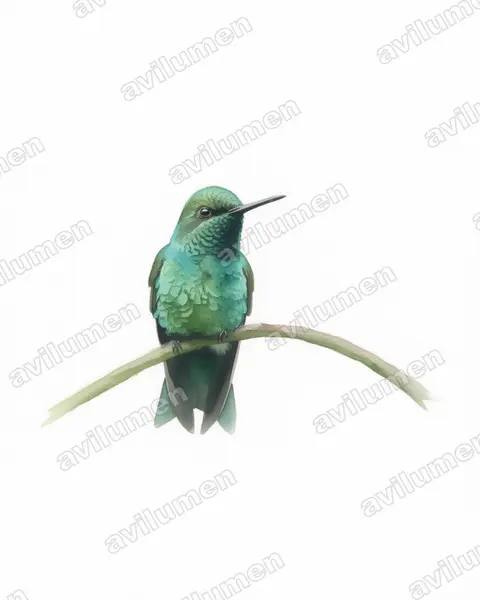
Watercolor 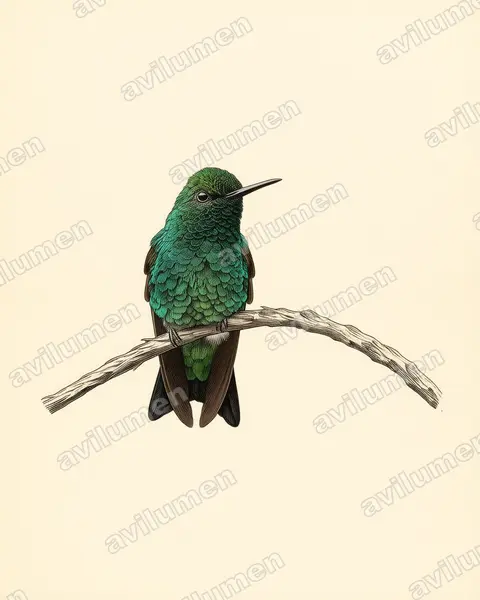
Vintage plate 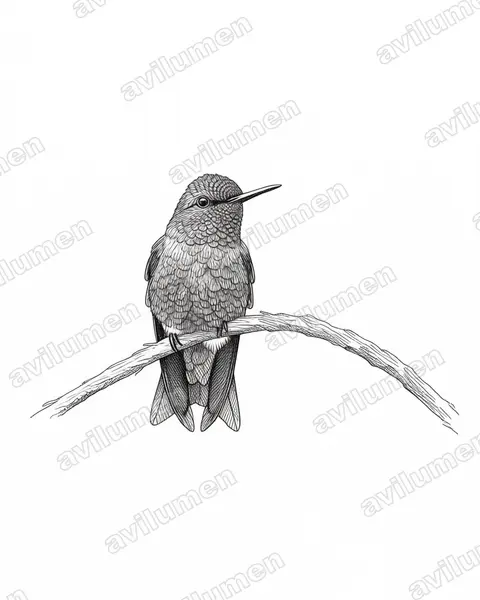
Ink 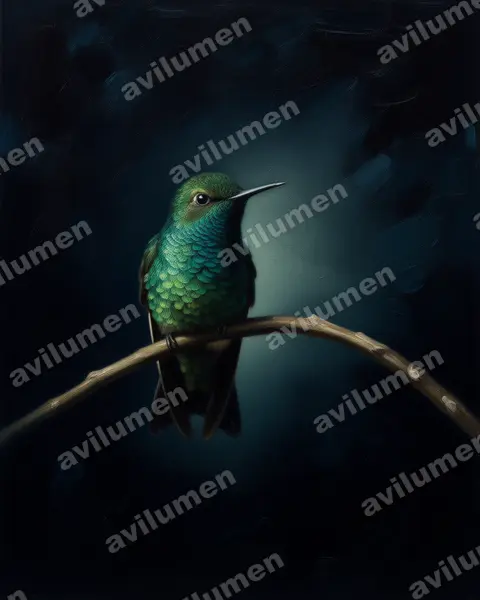
Oil 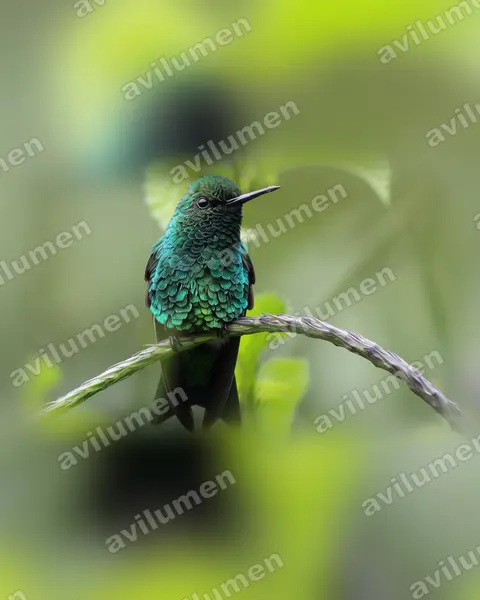
Realistic 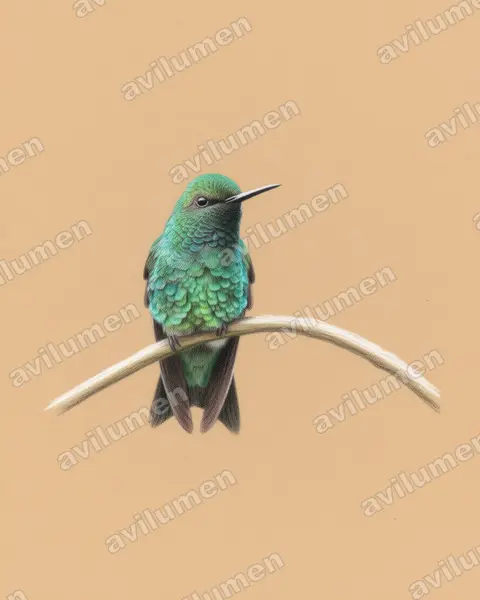
Colored pencil
Illustrations based on the photograph by Segidawiki (CC BY 4.0), from Wikimedia Commons.
Digital editions
HD Digital Art Pack — Western emerald
Digital download: 6 high-resolution illustrations of the Western emerald (Chlorostilbon melanorhynchus), print-ready. This is a digital file; no animal or physical item is included.
AI Avatar — Western emerald
Generate an avatar fusing your face with the Western emerald (Chlorostilbon melanorhynchus). Delivered digitally in 8K, watermark-free. Digital product; no animals are sold or brokered.
Instant download. No live birds are sold.
Frequently asked questions
- Is Chlorostilbon melanorhynchus (Western emerald) endangered?
- The IUCN Red List places Chlorostilbon melanorhynchus, commonly known as the Western emerald, in the «Not evaluated» category. «Not evaluated» means the IUCN has not yet assessed this species.
- Where does Chlorostilbon melanorhynchus (Western emerald) live?
- Chlorostilbon melanorhynchus (Western emerald) is found in South America.
- What family does Chlorostilbon melanorhynchus (Western emerald) belong to?
- Chlorostilbon melanorhynchus (Western emerald) belongs to the family Trochilidae, in the order Apodiformes.
- What colour is Chlorostilbon melanorhynchus (Western emerald)?
- The plumage of Chlorostilbon melanorhynchus (Western emerald) combines these colours: Green.
More from the same family
 Least concern
Emerald-chinned Hummingbird
Abeillia abeillei
The emerald-chinned hummingbird is a species of hummingbird in the "emeralds", tribe Trochilini of subfamily Trochilinae.
from $1.99
 Least concern
Speckled hummingbird
Adelomyia melanogenys
The speckled hummingbird is a species of hummingbird. It is the only member of the genus Adelomyia. It inhabits Neotropical montane cloud forests at elevations of 1,000–2,500 meters and is confined to the Andes of Argentina, Bolivia, Peru, Ecuador, Colombia and Venezuela; as well as to some isolated montane forests in western Ecuador and Venezuela.
from $1.99
 Vulnerable
Purple-backed sunbeam
Aglaeactis aliciae
The purple-backed sunbeam is a bird species in the family Trochilidae. It is found only in Peru.
from $1.99
 Near threatened
White-tufted sunbeam
Aglaeactis castelnaudii
The white-tufted sunbeam is a species of hummingbird in the family Trochilidae. It is found only in Peru. Its natural habitats are subtropical or tropical moist montane forest and subtropical or tropical high-altitude shrubland.
from $1.99