Black inca
Coeligena prunellei
Avilumen editorial team ·

The black inca is a species of hummingbird in the "brilliants", tribe Heliantheini in subfamily Lesbiinae. It is endemic to Colombia.
The black inca (Coeligena prunellei) is a species of hummingbird in the "brilliants", tribe Heliantheini in subfamily Lesbiinae. It is endemic to Colombia.
Taxonomy and systematics
In the mid-1800s the black inca was placed in genera Bourcieria and Lamproygia by different authors. By the early 1900s it and most other current members of genus Coeligena were placed in genus Helianthea. The incas have been in their current placement since the mid-1900s. The black inca, bronzy inca (C. coeligena), and brown inca (C. wilsoni) are sister species.
The black inca is monotypic.
Description
The black inca is about 14 cm (5.5 in) long and weighs about 6.6 to 7.0 g (0.23 to 0.25 oz). Both sexes have a long, straight, black bill and a white spot behind the eye. Adult males' upperparts are purplish black with dark metallic blue shoulders and a black forked tail. Their underparts are also dark purplish black with an iridescent blue-green gorget and a white patch on each side of the breast. Adult females are essentially the same as males but duller, with a longer bill, less blue on the shoulders, and a less forked tail. Immatures are duller than the adults and do not have a gorget.
Distribution and habitat
The black inca is endemic to Colombia. It is found on the west slope of the Eastern Andes from southeastern Santander and western Boyacá departments south into western Cundinamarca Department, and also on both slopes of Serranía de los Yariguíes in Santander. It mostly inhabits the interior of humid montane forest, especially those dominated by oaks, but males are also found in fragmented forest and other human-modified landscapes. In elevation it ranges between 1,200 and 2,800 m (3,900 and 9,200 ft).
Movement
The black inca's movements, if any, are not known.
Feeding
The black inca mostly forages for nectar by trap-lining, visiting a circuit of a wide variety of flowering plants, though it occasionally defends concentrated flower patches. It nectars at mid-levels within forest and low levels at the edges. It prefers tubular red and yellow flowers such as those of genera Fuchsia, Bomarea, Aetanthus, Aphelandra, Palicourea, Psammisia, and Thibaudia. It prefers native plants when they are abundant but in one study frequented plants of genus Abutilon and other introduced species. In addition to feeding on nectar, the black inca gleans small arthropods from foliage.
Breeding
The black inca's breeding season is not well known but could be as long as from June to February. Only two nests are known. They were cups of tree fern scales cemented with spider silk and lined with plant down. Both were in the interior of oak forest and placed between 1.5 and 1.8 m (5 and 6 ft) above the ground. The species' incubation times and time to fledging are not known.
Vocalization
The black inca is generally quiet but does produce short ick or pip notes.
Status
The IUCN originally assessed the black inca as Threatened. It changed the assessment to Vulnerable in 1994, to Endangered in 2000, and back to Vulnerable in 2008. Its population is estimated to be than 7,500 mature individuals as of 2022 and is believed to be decreasing. Colombian authorities consider it endangered. About 90% of the forest habitat in its small range has been cleared for settlement or agriculture and what remains is fragmented.
Text adapted from Wikipedia · CC BY-SA 4.0
Where it lives
Distribution

Taxonomy
- Order
- Apodiformes
- Family
- Trochilidae
- Genus
- Coeligena
- Conservation status
- Vulnerable
Listen to its call
No recording yet
Illustration gallery
6 illustrations of Coeligena prunellei (Black inca) in different styles, true to its real plumage. Shown watermarked; the art pack includes the high-resolution originals, ready to print.
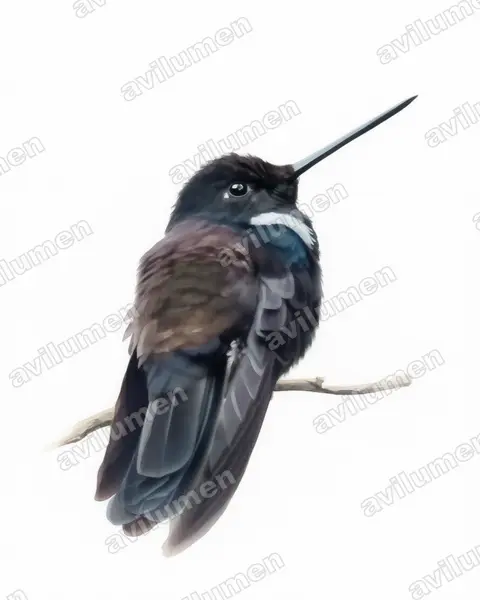
Watercolor 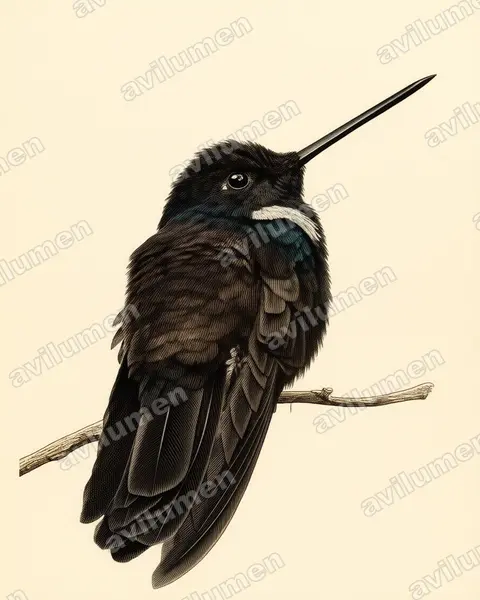
Vintage plate 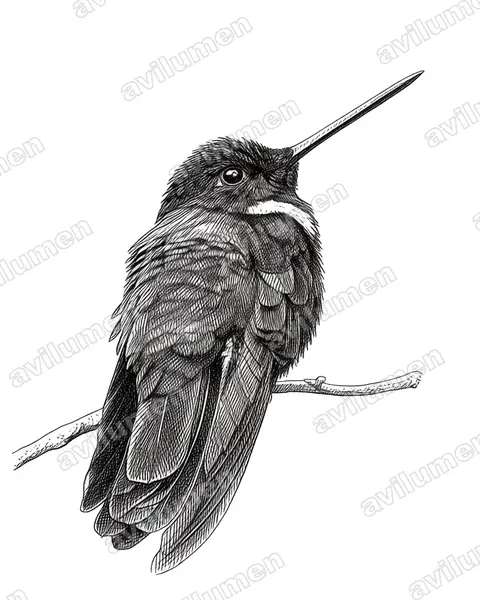
Ink 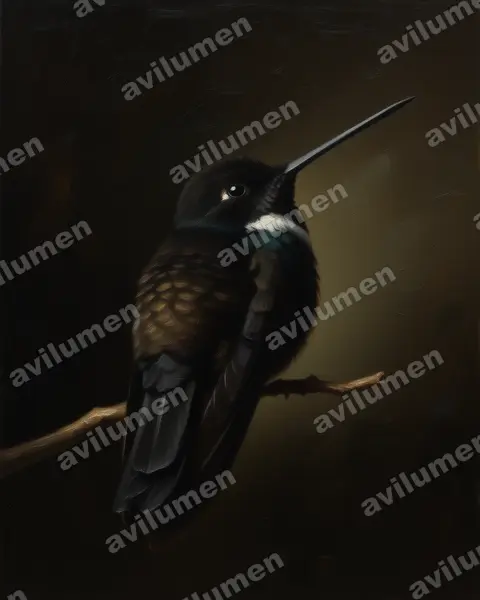
Oil 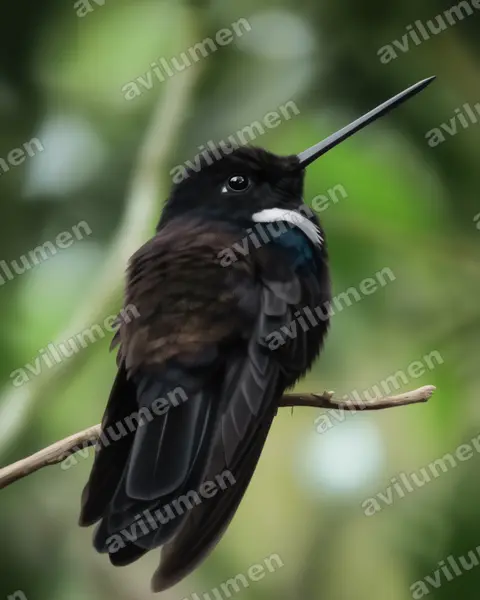
Realistic 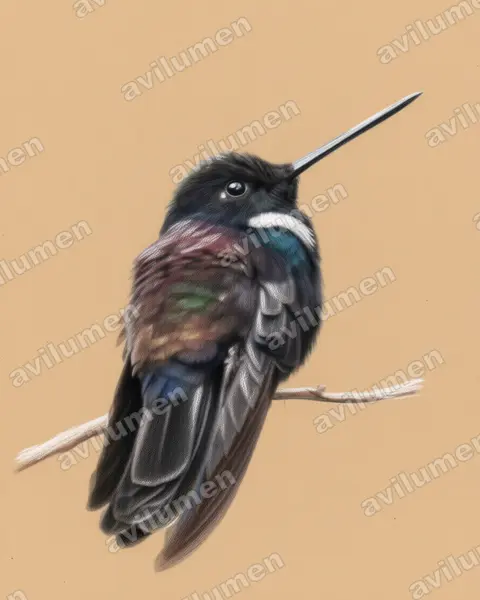
Colored pencil
Illustrations based on the photograph by Félix Uribe from Rionegro, Antioquia, Colombia (CC BY-SA 2.0), from Wikimedia Commons.
Digital editions
HD Digital Art Pack — Black inca
Digital download: 6 high-resolution illustrations of the Black inca (Coeligena prunellei), print-ready. This is a digital file; no animal or physical item is included.
AI Avatar — Black inca
Generate an avatar fusing your face with the Black inca (Coeligena prunellei). Delivered digitally in 8K, watermark-free. Digital product; no animals are sold or brokered.
Instant download. No live birds are sold.
Frequently asked questions
- Is Coeligena prunellei (Black inca) endangered?
- The IUCN Red List places Coeligena prunellei, commonly known as the Black inca, in the «Vulnerable» category. «Vulnerable» means it faces a high risk of extinction in the medium term.
- Where does Coeligena prunellei (Black inca) live?
- Coeligena prunellei (Black inca) is found in South America.
- What family does Coeligena prunellei (Black inca) belong to?
- Coeligena prunellei (Black inca) belongs to the family Trochilidae, in the order Apodiformes.
- What colour is Coeligena prunellei (Black inca)?
- The plumage of Coeligena prunellei (Black inca) combines these colours: Green and Black.
More from the same family
 Least concern
Emerald-chinned Hummingbird
Abeillia abeillei
The emerald-chinned hummingbird is a species of hummingbird in the "emeralds", tribe Trochilini of subfamily Trochilinae.
from $1.99
 Least concern
Speckled hummingbird
Adelomyia melanogenys
The speckled hummingbird is a species of hummingbird. It is the only member of the genus Adelomyia. It inhabits Neotropical montane cloud forests at elevations of 1,000–2,500 meters and is confined to the Andes of Argentina, Bolivia, Peru, Ecuador, Colombia and Venezuela; as well as to some isolated montane forests in western Ecuador and Venezuela.
from $1.99
 Vulnerable
Purple-backed sunbeam
Aglaeactis aliciae
The purple-backed sunbeam is a bird species in the family Trochilidae. It is found only in Peru.
from $1.99
 Near threatened
White-tufted sunbeam
Aglaeactis castelnaudii
The white-tufted sunbeam is a species of hummingbird in the family Trochilidae. It is found only in Peru. Its natural habitats are subtropical or tropical moist montane forest and subtropical or tropical high-altitude shrubland.
from $1.99