White-vented violetear
Colibri serrirostris
Avilumen editorial team ·

The white-vented violetear is a species of hummingbird in the subfamily Polytminae, the mangoes. It is found in Argentina, Bolivia, Brazil, and Paraguay. In April, 2024, one was also photographed at Batsu Gardens in Costa Rica.
The white-vented violetear (Colibri serrirostris) is a species of hummingbird in the subfamily Polytminae, the mangoes. It is found in Argentina, Bolivia, Brazil, and Paraguay. In April, 2024, one was also photographed at Batsu Gardens in Costa Rica.
Taxonomy and systematics
The white-vented violetear is monotypic.
Description
The white-vented violetear is 12 to 13 cm (4.7 to 5.1 in) long and weighs 5.6 to 6.8 g (0.20 to 0.24 oz). The male is mostly shiny green, of a shade lighter than that of other violetears. Towards the rump it is yellow-green with a blue shimmer. The tail is glittering green with a wide steel-blue band near the end. The undertail coverts are pure white. The area behind the eye and covering the ears is violet blue. The female is similar to the male but paler and more grayish. The maxilla of both sexes is sometimes serrated, which provides its specific epithet.
Distribution and habitat
The white-vented violetear is found in a wide swath of southern Brazil, from Mato Grosso east to Goiás, Bahia and Espírito Santo and south to Santa Catarina. Its range extends west into Bolivia, central Paraguay, and northern Argentina as far south as Córdoba Province. It inhabits a variety of semi-open landscapes including scrublands, savanna, grassland, and gardens and parks. In elevation it is most common between 1,000 and 1,500 m (3,300 and 4,900 ft) but its range begins at sea level and extends to 3,600 m (11,800 ft) in the Andes.
Movement
The white-vented violetear is mostly sedentary or nearly so; some populations make short migrations. Birds at elevations above treeline in Brazil are believed to move to lower elevations in fall.
Feeding
The white-vented violetear forages for nectar from a wide variety of flowering plants and trees. It also captures insects on the wing. It is very aggressive, calling from a perch and chasing other nectar-feeding birds and even butterflies from flower patches. It tends to begin feeding earlier in the day than other hummingbirds.
Breeding
The white-vented violetear's breeding seasons have not been fully defined, but in parts of Brazil it nests between September and March. The female alone builds the nest, incubates the eggs, and cares for the young. The nest is a cup made of fine fibers and spider silk and decorated with lichens on its outside. It is placed on a branch or in a vertical fork, typically about 1 m (3.3 ft) above the ground. The clutch size is two eggs. The incubation time is 15 to 16 days with fledging 22 to 25 days after hatch.
Vocalization
The white-vented violetear's song is "a constantly repeated 'tsilp, tsilp, zip, tsalp, tsalp'" that may continue for 25 minutes. Its principal call is "a hard 'drüg, drüg, drüg, drüg, drüg'".
Status
The IUCN has assessed the white-vented violetear as being of Least Concern, though its population size and trend are not known. It has a large range, is common in most of it, and occurs in several protected areas.
Text adapted from Wikipedia · CC BY-SA 4.0
Where it lives
Distribution

Taxonomy
- Order
- Apodiformes
- Family
- Trochilidae
- Genus
- Colibri
- Conservation status
- Least concern
Listen to its call
No recording yet
Illustration gallery
6 illustrations of Colibri serrirostris (White-vented violetear) in different styles, true to its real plumage. Shown watermarked; the art pack includes the high-resolution originals, ready to print.
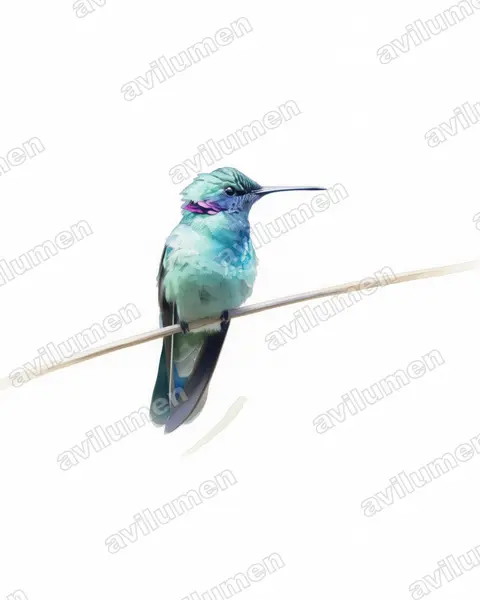
Watercolor 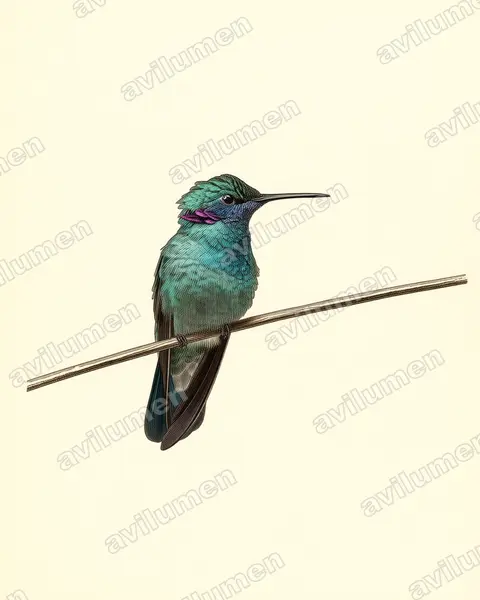
Vintage plate 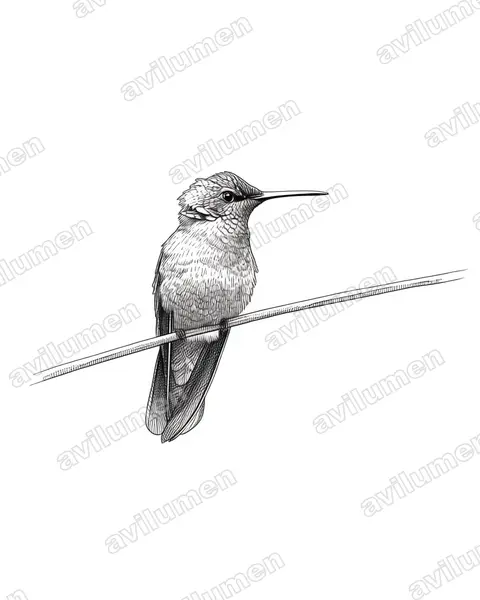
Ink 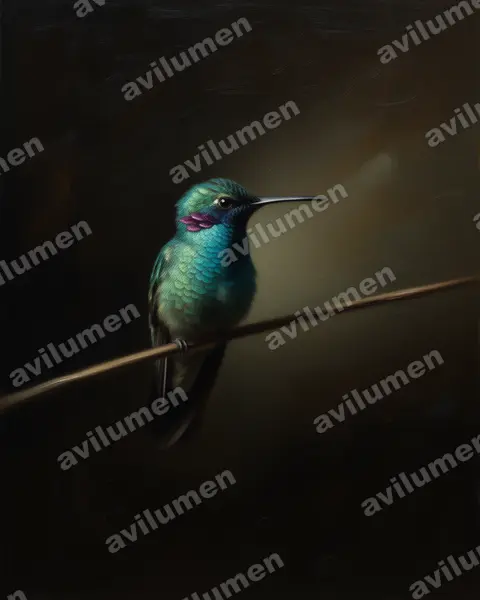
Oil 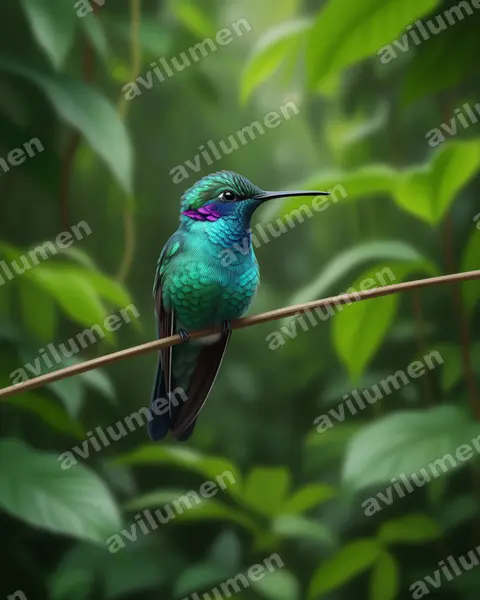
Realistic 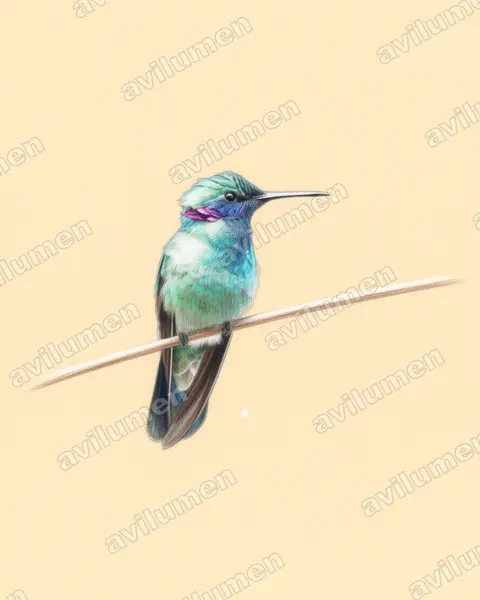
Colored pencil
Illustrations based on the photograph by Rick elis.simpson (CC BY-SA 3.0), from Wikimedia Commons.
Digital editions
HD Digital Art Pack — White-vented violetear
Digital download: 6 high-resolution illustrations of the White-vented violetear (Colibri serrirostris), print-ready. This is a digital file; no animal or physical item is included.
AI Avatar — White-vented violetear
Generate an avatar fusing your face with the White-vented violetear (Colibri serrirostris). Delivered digitally in 8K, watermark-free. Digital product; no animals are sold or brokered.
Instant download. No live birds are sold.
Frequently asked questions
- Is Colibri serrirostris (White-vented violetear) endangered?
- The IUCN Red List places Colibri serrirostris, commonly known as the White-vented violetear, in the «Least concern» category. «Least concern» means it is not currently threatened.
- Where does Colibri serrirostris (White-vented violetear) live?
- Colibri serrirostris (White-vented violetear) is found in Brazil and South America.
- What family does Colibri serrirostris (White-vented violetear) belong to?
- Colibri serrirostris (White-vented violetear) belongs to the family Trochilidae, in the order Apodiformes.
- What colour is Colibri serrirostris (White-vented violetear)?
- The plumage of Colibri serrirostris (White-vented violetear) combines these colours: Green and White.
More from the same family
 Least concern
Emerald-chinned Hummingbird
Abeillia abeillei
The emerald-chinned hummingbird is a species of hummingbird in the "emeralds", tribe Trochilini of subfamily Trochilinae.
from $1.99
 Least concern
Speckled hummingbird
Adelomyia melanogenys
The speckled hummingbird is a species of hummingbird. It is the only member of the genus Adelomyia. It inhabits Neotropical montane cloud forests at elevations of 1,000–2,500 meters and is confined to the Andes of Argentina, Bolivia, Peru, Ecuador, Colombia and Venezuela; as well as to some isolated montane forests in western Ecuador and Venezuela.
from $1.99
 Vulnerable
Purple-backed sunbeam
Aglaeactis aliciae
The purple-backed sunbeam is a bird species in the family Trochilidae. It is found only in Peru.
from $1.99
 Near threatened
White-tufted sunbeam
Aglaeactis castelnaudii
The white-tufted sunbeam is a species of hummingbird in the family Trochilidae. It is found only in Peru. Its natural habitats are subtropical or tropical moist montane forest and subtropical or tropical high-altitude shrubland.
from $1.99