Bay-vented Cotinga
Doliornis sclateri
Avilumen editorial team ·

The bay-vented cotinga is a species of bird in the family Cotingidae. It is endemic to Peru.
The bay-vented cotinga (Doliornis sclateri) is a species of bird in the family Cotingidae. It is endemic to Peru.
Taxonomy and systematics
A few late twentieth century authors merged genus Doliornis into Ampelion but multiple studies since then have confirmed its separation. The bay-vented cotinga is monotypic. It shares genus Doliornis with the chestnut-bellied cotinga (D. remseni) and the two form a superspecies.
Description
The bay-vented cotinga is 20 to 21.5 cm (7.9 to 8.5 in) long and weighs 53 to 69 g (1.9 to 2.4 oz). The sexes have similar plumage. Adult males have a glossy black crown with a partially hidden reddish chestnut crest in the middle. Their upper back is dark grayish that becomes browner on the rump and tail. Their wings are grayish brown. Their face and throat are a paler gray than their upperparts. Their breast and belly are brown; in unworn plumage their breast has buff bars. Their undertail coverts are rufous chestnut. Adult females have a dark gray crown with dusky streaks and a duller red crest. Their back and uppertail coverts are paler than the male's. Both sexes have a gray iris, a black maxilla, a blue-gray mandible with a black tip, and dark gray legs and feet. Juveniles have a gray crown without a crest, and their breast and belly are clay-colored.
Distribution and habitat
The bay-vented cotinga is found on the eastern side of the Peruvian Andes from southern Amazonas and northwestern San Martín departments south to central Junín Department. It is known only from a few locations within that range. It inhabits humid elfin forest at or near tree line. In elevation it ranges between 2,600 and 3,800 m (8,500 and 12,500 ft).
Movement
The bay-vented cotinga is a year-round resident.
Feeding
The bay-vented cotinga feeds mostly on fruits and also includes some insects in its diet, though details are sparse. It usually forages singly or in pairs, mostly in the forest's subcanopy and canopy.
Breeding
The bay-vented cotinga's breeding season includes April to July. Nothing else is known about the species' breeding biology.
Vocalization
The bay-vented cotinga's most common vocalization, which may be either a call or song, is "a mewing, rising rhee or rhee-ah" that is rather loud and scratchy.
Status
The IUCN originally in 1988 assessed the bay-vented cotinga as being of Least Concern; it was relisted as Vulnerable in 2004 and since 2022 as Near Threatened. It has a restricted range and its estimated population of 2380 mature individuals is believed to be decreasing. "The páramo/cloud-forest ecotone habitat favoured by this species is being reduced and degraded owing to the use of fire to maintain pastureland and overgrazing by livestock." It is considered rare and local.
Text adapted from Wikipedia · CC BY-SA 4.0
Where it lives
Plumage colours
Distribution

Taxonomy
- Order
- Passeriformes
- Family
- Cotingidae
- Genus
- Doliornis
- Conservation status
- Near threatened
Listen to its call
No recording yet
Illustration gallery
6 illustrations of Doliornis sclateri (Bay-vented Cotinga) in different styles, true to its real plumage. Shown watermarked; the art pack includes the high-resolution originals, ready to print.
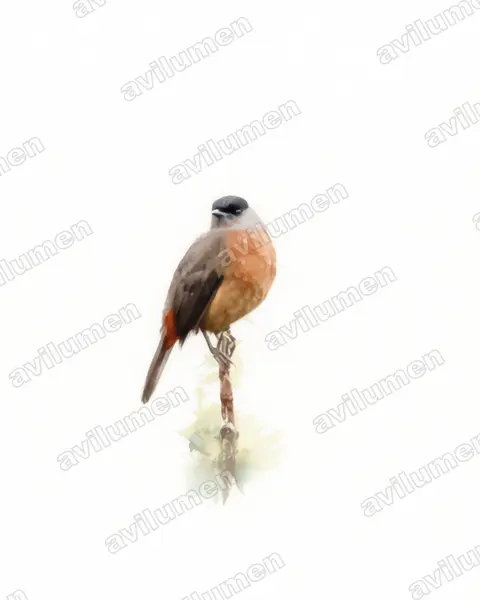
Watercolor 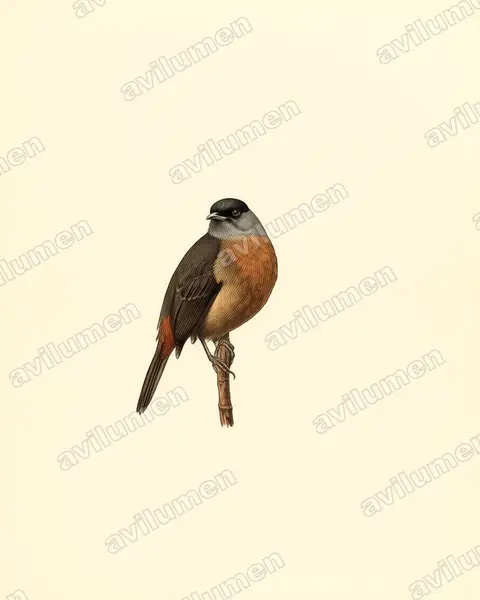
Vintage plate 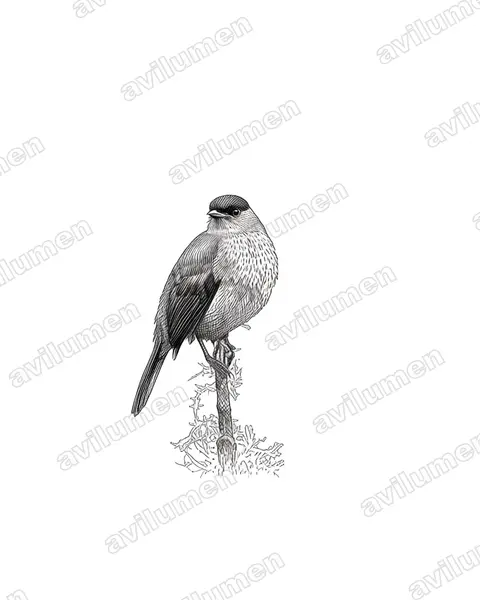
Ink 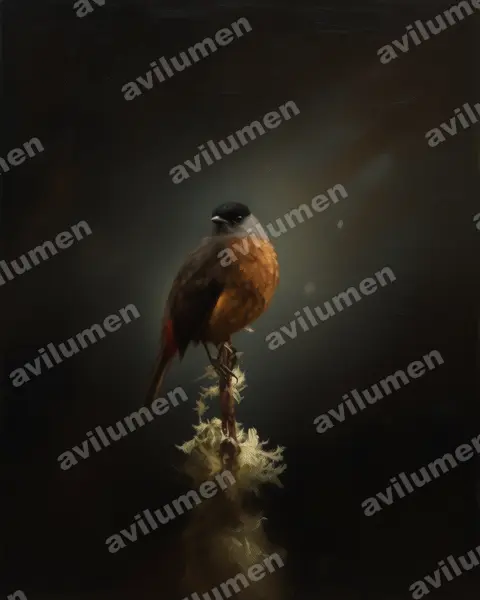
Oil 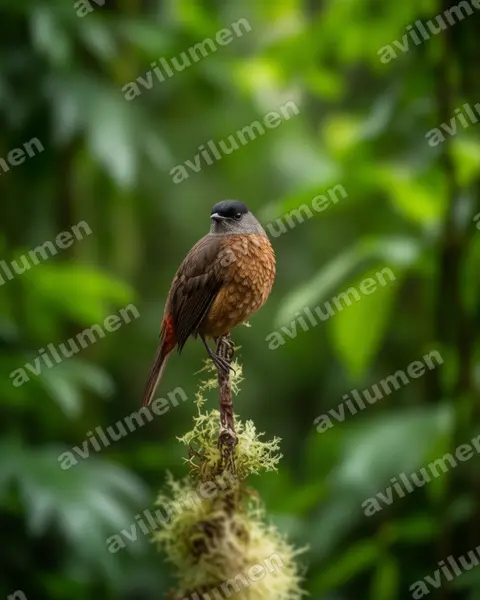
Realistic 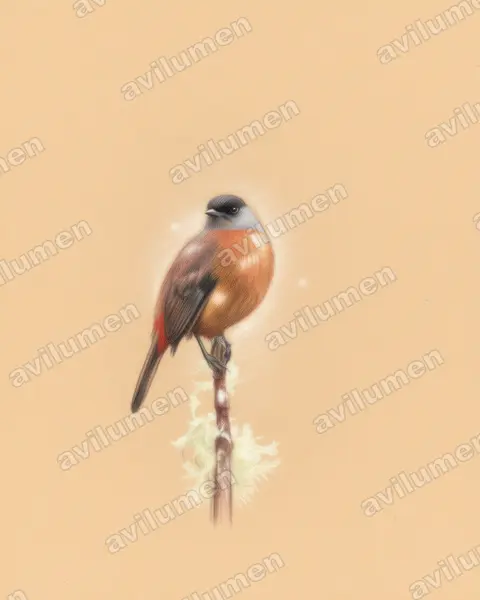
Colored pencil
Illustrations based on the photograph by thibaudaronson (CC BY-SA 4.0), from Wikimedia Commons.
Digital editions
HD Digital Art Pack — Bay-vented Cotinga
Digital download: 6 high-resolution illustrations of the Bay-vented Cotinga (Doliornis sclateri), print-ready. This is a digital file; no animal or physical item is included.
AI Avatar — Bay-vented Cotinga
Generate an avatar fusing your face with the Bay-vented Cotinga (Doliornis sclateri). Delivered digitally in 8K, watermark-free. Digital product; no animals are sold or brokered.
Instant download. No live birds are sold.
Frequently asked questions
- Is Doliornis sclateri (Bay-vented Cotinga) endangered?
- The IUCN Red List places Doliornis sclateri, commonly known as the Bay-vented Cotinga, in the «Near threatened» category. «Near threatened» means it is not threatened yet, but is close to becoming so.
- Where does Doliornis sclateri (Bay-vented Cotinga) live?
- Doliornis sclateri (Bay-vented Cotinga) is found in South America.
- What family does Doliornis sclateri (Bay-vented Cotinga) belong to?
- Doliornis sclateri (Bay-vented Cotinga) belongs to the family Cotingidae, in the order Passeriformes.
- What colour is Doliornis sclateri (Bay-vented Cotinga)?
- The plumage of Doliornis sclateri (Bay-vented Cotinga) combines these colours: Brown.
More from the same family
 Least concern
Scaled Fruiteater
Ampelioides tschudii
The scaled fruiteater is a species of bird in the family Cotingidae. It is the only member of the genus Ampelioides. This bird is found in Bolivia, Colombia, Ecuador, Peru, and Venezuela, where its natural habitat is the high elevation tropical forests of the Andes mountains. The scaled fruiteater is a chunky, short-tailed, flat-headed bird measuring 19–20 cm (7.5–7.9 in) in length.
from $1.99
 Least concern
Red-crested Cotinga
Ampelion rubrocristatus
The red-crested cotinga is a species of bird in the family Cotingidae. It is found in Bolivia, Colombia, Ecuador, Peru, and Venezuela.
from $1.99
 Least concern
Chestnut-crested Cotinga
Ampelion rufaxilla
The chestnut-crested cotinga is a species of bird in the family Cotingidae. It is found in Bolivia, Colombia, Ecuador, and Peru.
from $1.99
 Critically endangered
Kinglet Calyptura
Calyptura cristata
The kinglet calyptura is a small Critically Endangered passerine bird in the family Tyrannidae, the tyrant flycatchers. It is endemic to southeastern Brazil.
from $1.99