Black-billed Sicklebill
Drepanornis albertisi
Avilumen editorial team ·

The black-billed sicklebill, also referred to as the buff-tailed sicklebill, is a species of bird-of-paradise. It, along with its congener, are the only members of the genus Drepanornis.
The black-billed sicklebill (Drepanornis albertisi), also referred to as the buff-tailed sicklebill (resulting in common confusion with the hummingbird of the same name), is a species of bird-of-paradise. It, along with its congener, are the only members of the genus Drepanornis.
Conservation status
Widespread throughout its large range, the black-billed sicklebill is evaluated as being of least concern on the IUCN Red List of Threatened Species. It is listed on Appendix II of CITES.
Etymology
The generic name Drepanornis consists of the words Drepane for "sickle" and ornis for "bird", so the genus name literally means "sickle bird", referring to their sickle-shaped bill; the specific name commemorates the Italian naturalist Luigi Maria d'Albertis, who discovered this species in 1872. The race cervinicauda's subspecific name consists of cervinus for "stag-colored" and "cauda" for tail, geisleri honors Bruno Geisler, a German ornithologist who described this subspecies, and inversus means "overturned".
Subspecies and taxonomy
Though they share similar features and the same English name, the Drepanornis sicklebills are only distantly related to the Epimachus sicklebills. In fact, they are more closely allied with the twelve-wired and standardwing birds-of-paradise. There are two agreeable subspecies, though races geisleri from the Huon Peninsula and inversus from the Weyland Mountains and nearby highlands require more detail to be considered valid subspecies or not.
Drepanornis albertisi albertisi (Sclater, 1873)
Drepanornis albertisi cervinicauda (Sclater, 1884)
Description
The black-billed sicklebill is medium-sized, about 35 cm long, brown. The male has a bare maroon-grey skin around its eye, buff-colored tail, dark-brown iris, yellow mouth and black sickle-like bill. It is adorned with dark, horn-like forecrown feathers, an erectile fan-like bronze neck plumes and elongated purple-tipped flank plumes. The unadorned brown female is smaller, with bill longer than male and dark-barred below.
Biology
Its diet consists mainly of fruit and arthropods. The female lays one to two pale cream eggs with brown and grey spots.
Distribution
The black-billed sicklebill is found in mountainous areas with a scattered range of presence across western, central and eastern New Guinea. The species is mostly distributed in tropical montane forests at altitudes of 1100 to 1900 m above sea level. It overlaps with Drepanornis brujini only barely, but no hybridization has ever been recorded, though it is possible to occur.
Text adapted from Wikipedia · CC BY-SA 4.0
Taxonomy
- Order
- Passeriformes
- Family
- Paradisaeidae
- Genus
- Drepanornis
- Conservation status
- Least concern
Listen to its call
No recording yet
Illustration gallery
6 illustrations of Drepanornis albertisi (Black-billed Sicklebill) in different styles, true to its real plumage. Shown watermarked; the art pack includes the high-resolution originals, ready to print.
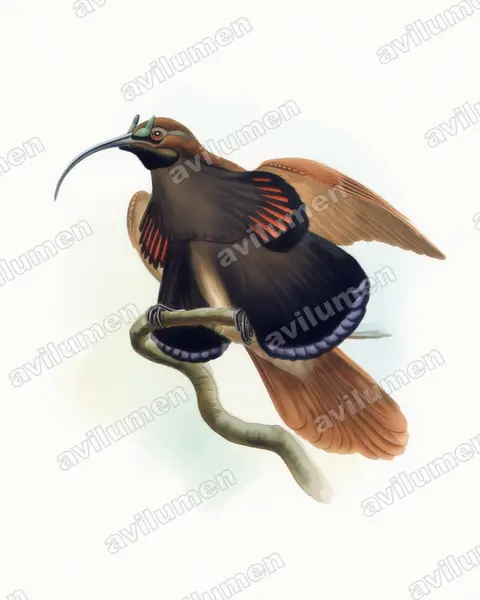
Watercolor 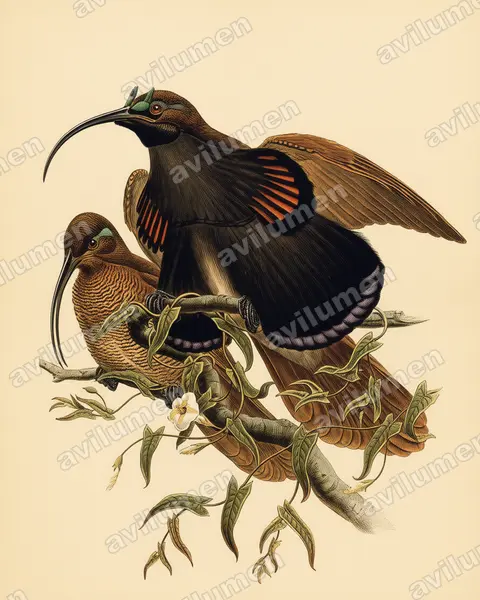
Vintage plate 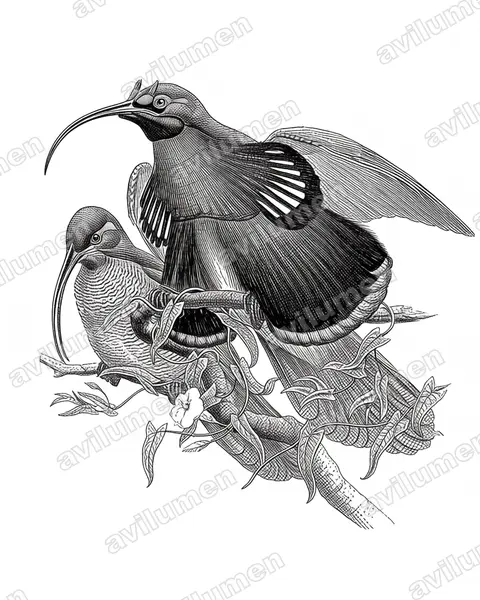
Ink 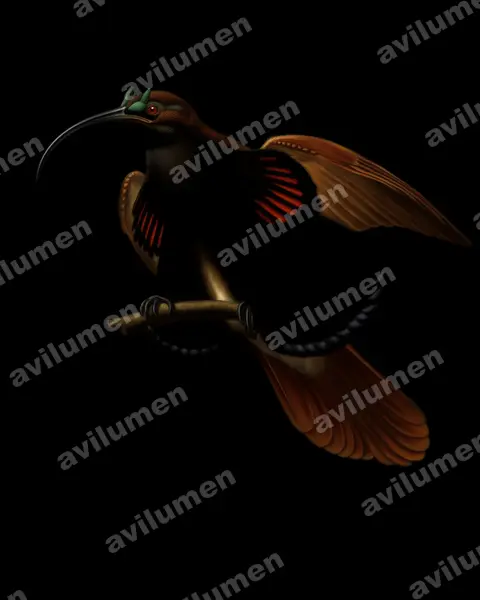
Oil 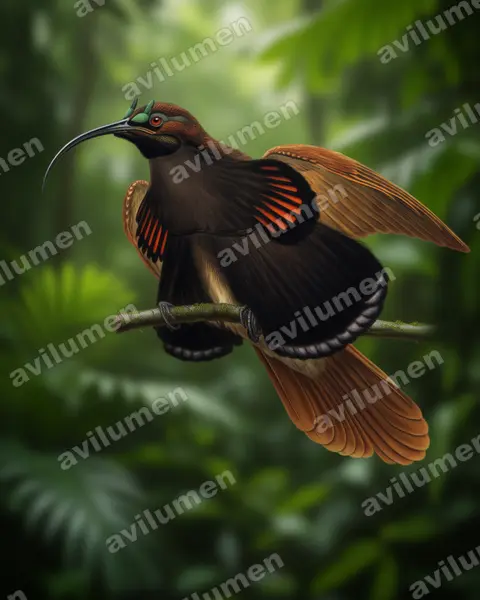
Realistic 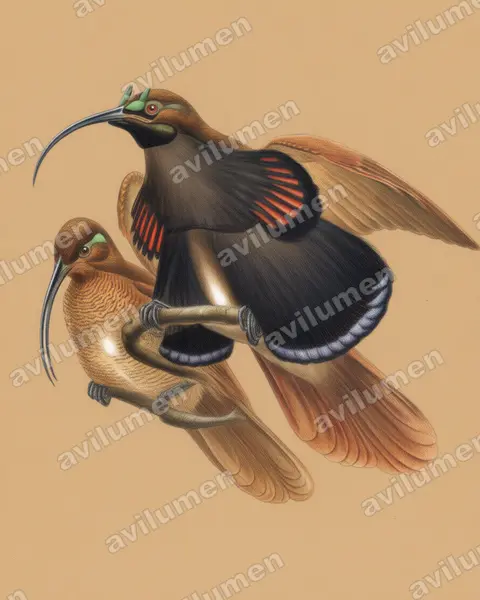
Colored pencil
Illustrations based on the photograph by Richard Bowdler Sharpe (Public domain), from Wikimedia Commons.
Digital editions
HD Digital Art Pack — Black-billed Sicklebill
Digital download: 6 high-resolution illustrations of the Black-billed Sicklebill (Drepanornis albertisi), print-ready. This is a digital file; no animal or physical item is included.
AI Avatar — Black-billed Sicklebill
Generate an avatar fusing your face with the Black-billed Sicklebill (Drepanornis albertisi). Delivered digitally in 8K, watermark-free. Digital product; no animals are sold or brokered.
Instant download. No live birds are sold.
Frequently asked questions
- Is Drepanornis albertisi (Black-billed Sicklebill) endangered?
- The IUCN Red List places Drepanornis albertisi, commonly known as the Black-billed Sicklebill, in the «Least concern» category. «Least concern» means it is not currently threatened.
- Where does Drepanornis albertisi (Black-billed Sicklebill) live?
- Drepanornis albertisi (Black-billed Sicklebill) is found in Indonesia.
- What family does Drepanornis albertisi (Black-billed Sicklebill) belong to?
- Drepanornis albertisi (Black-billed Sicklebill) belongs to the family Paradisaeidae, in the order Passeriformes.
- What colour is Drepanornis albertisi (Black-billed Sicklebill)?
- The plumage of Drepanornis albertisi (Black-billed Sicklebill) combines these colours: Black and Yellow.
More from the same family
 Least concern
Ribbon-tailed Astrapia
Astrapia mayeri
The ribbon-tailed astrapia, also known as Shaw Mayer's astrapia, is a species of bird-of-paradise.
from $1.99
 Least concern
Arfak astrapia
Astrapia nigra
The Arfak astrapia is a species of astrapia, a group of birds found in the birds-of-paradise family Paradiseidae.
from $1.99
 Least concern
Huon Astrapia
Astrapia rothschildi
The Huon astrapia, also known as Rothschild's astrapia, Huon bird-of-paradise, or Lord Rothschild's bird-of-paradise, is a species of bird-of-paradise belonging to the genus Astrapia. Like most of its congeners, A. rothschildi is a rather elusive member of its genus and family.
from $1.99
 Least concern
Splendid Astrapia
Astrapia splendidissima
The splendid astrapia is a species of bird in the family Paradisaeidae, native to the montane forests of New Guinea. Males are known for their iridescent plumage and elaborate courtship displays, including branch-hopping, tail-flicking, and frog-like calls; they may also display in leks.
from $1.99