Garnet Pitta
Erythropitta granatina
Avilumen editorial team ·

The garnet pitta is a species of bird in the family Pittidae. It is found in Brunei, Indonesia, Malaysia, Myanmar, Singapore, and Thailand. Its natural habitat is subtropical or tropical moist lowland forest. It is threatened by habitat loss. The form occurring in the Malaysian state of Sabah has been split as the black-crowned pitta.
The garnet pitta (Erythropitta granatina) is a species of bird in the family Pittidae. It is found in Brunei, Indonesia, Malaysia, Myanmar, Singapore, and Thailand. Its natural habitat is subtropical or tropical moist lowland forest. It is threatened by habitat loss. The form occurring in the Malaysian state of Sabah has been split as the black-crowned pitta (Erythropitta ussheri).
Diet
The garnet pitta is an insectivore, feeding mainly on ants, wood grubs, cockroaches, and beetles.
Characteristics
The Garnet pitta is about 17 cm long. The bird has a black head with a bright blue stripe at the eyebrows and a red cap. The breast is dark blue at the top, and carmine red beneath. The back and wings are bright blue. Juvenile pittas have a mostly brown color (see illustration).
Breeding
Pairs mate between March and August. A pair will lay a clutch of two eggs.
Status
The Garnet pitta is considered as near threatened on the IUCN red list. Its natural habitat is threatened by systematic illegal deforestation and damaging forest fires.
Text adapted from Wikipedia · CC BY-SA 4.0
Taxonomy
- Order
- Passeriformes
- Family
- Pittidae
- Genus
- Erythropitta
- Conservation status
- Near threatened
Listen to its call
No recording yet
Illustration gallery
6 illustrations of Erythropitta granatina (Garnet Pitta) in different styles, true to its real plumage. Shown watermarked; the art pack includes the high-resolution originals, ready to print.
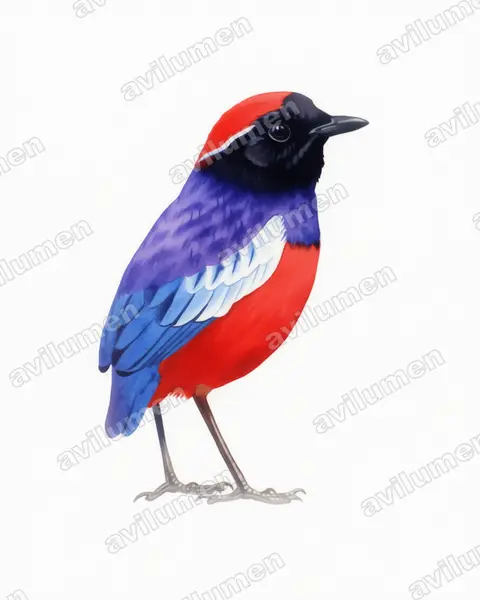
Watercolor 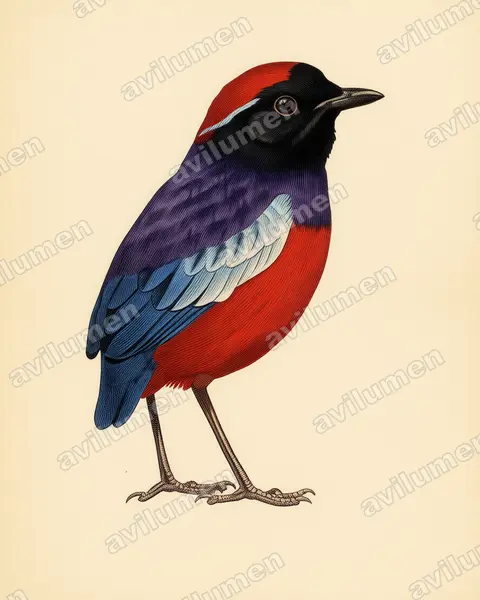
Vintage plate 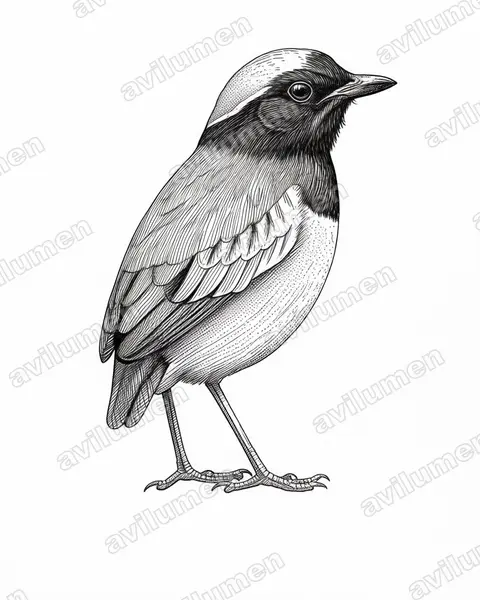
Ink 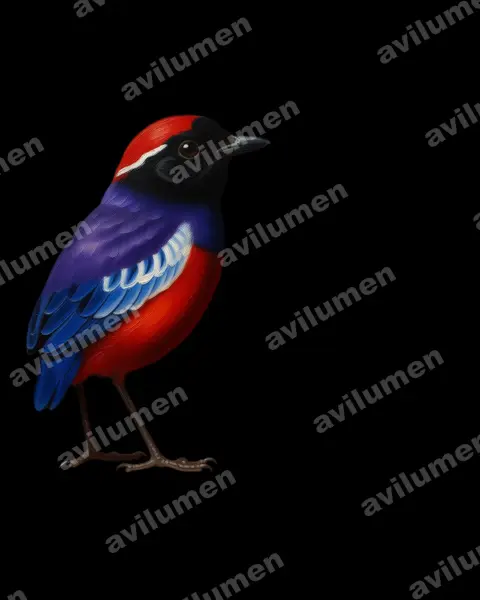
Oil 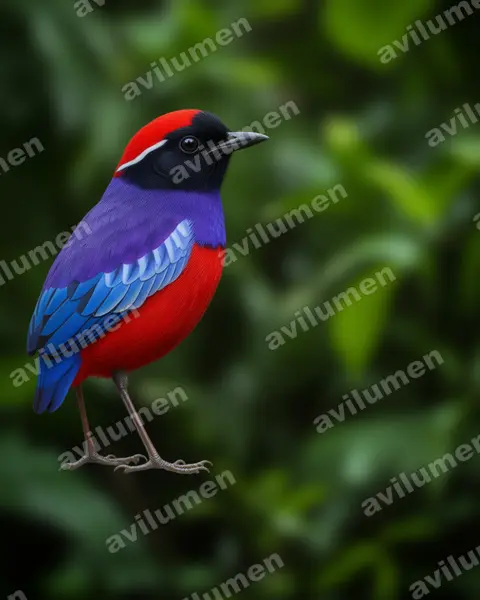
Realistic 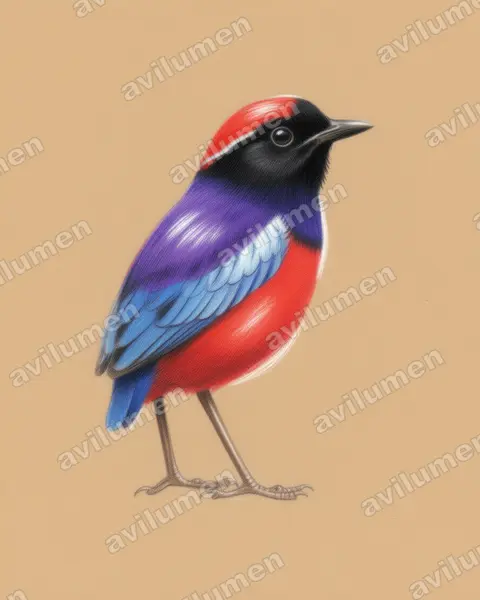
Colored pencil
Illustrations based on the photograph by Kókay Szabolcs (CC BY-SA 3.0), from Wikimedia Commons.
Digital editions
HD Digital Art Pack — Garnet Pitta
Digital download: 6 high-resolution illustrations of the Garnet Pitta (Erythropitta granatina), print-ready. This is a digital file; no animal or physical item is included.
AI Avatar — Garnet Pitta
Generate an avatar fusing your face with the Garnet Pitta (Erythropitta granatina). Delivered digitally in 8K, watermark-free. Digital product; no animals are sold or brokered.
Instant download. No live birds are sold.
Frequently asked questions
- Is Erythropitta granatina (Garnet Pitta) endangered?
- The IUCN Red List places Erythropitta granatina, commonly known as the Garnet Pitta, in the «Near threatened» category. «Near threatened» means it is not threatened yet, but is close to becoming so.
- What family does Erythropitta granatina (Garnet Pitta) belong to?
- Erythropitta granatina (Garnet Pitta) belongs to the family Pittidae, in the order Passeriformes.
- What colour is Erythropitta granatina (Garnet Pitta)?
- The plumage of Erythropitta granatina (Garnet Pitta) combines these colours: Red and Brown.
More from the same family
 Least concern
Blue-banded Pitta
Erythropitta arquata
The blue-banded pitta is a species of bird in the family Pittidae. It is native to lowlands of the Borneo montane rain forests.
from $1.99
 Endangered
Sangihe pitta
Erythropitta caeruleitorques
The Sulawesi pitta is a species of pitta. It was considered a subspecies of the red-bellied pitta. It is endemic to Indonesia where it occurs in Sulawesi, Manterawu, and Togian Islands. Its natural habitat is subtropical or tropical moist lowland forest. It is threatened by habitat loss.
from $1.99
 Least concern
Sulawesi pitta
Erythropitta celebensis
The Sulawesi pitta is a species of pitta. It was considered a subspecies of the red-bellied pitta. It is endemic to Indonesia where it occurs in Sulawesi, Manterawu, and Togian Islands. Its natural habitat is subtropical or tropical moist lowland forest. It is threatened by habitat loss.
from $1.99
 Near threatened
Sula pitta
Erythropitta dohertyi
The Sula pitta is a species of the pitta. It was considered a subspecies of the red-bellied pitta. It is endemic to Indonesia where it occurs in the Sula and Banggai Islands. Its natural habitat is subtropical or tropical moist lowland forests. It is threatened by habitat loss.
from $1.99