White-necked jacobin
Florisuga mellivora
Avilumen editorial team ·

The white-necked jacobin is a medium-sized hummingbird that ranges from Mexico south through Central America and northern South America into Brazil, Peru, and Bolivia. It is also found in Trinidad and Tobago. Its other common names include great jacobin and collared hummingbird.
The white-necked jacobin (Florisuga mellivora) is a medium-sized hummingbird that ranges from Mexico south through Central America and northern South America into Brazil, Peru, and Bolivia. It is also found in Trinidad and Tobago. Its other common names include great jacobin and collared hummingbird.
Taxonomy
In 1743, English naturalist George Edwards included a picture and a description of the white-necked jacobin in his A Natural History of Uncommon Birds. He used the English name "white-belly'd huming bird". Edwards based his etching on a specimen owned by the Duke of Richmond that had been collected in Suriname. When in 1758, Swedish naturalist Carl Linnaeus updated his Systema Naturae for the 10th edition, he placed the white-necked jacobin with the other hummingbirds in the genus Trochilus. Linnaeus included a brief description, coined the binomial name Trochilus mellivorus, and cited Edwards' work. The specific epithet combines the Latin mel and -vorus, meaning "honey eating". The type locality is Suriname. The white-necked jacobin is now placed in the genus Florisuga that was introduced in 1850 by Charles Bonaparte.
Subspecies
Two subspecies are recognised:
*Sometimes referred to as F. m. tobagensis
Description
The white-necked jacobin is 11 to 12 cm (4.3 to 4.7 in) long. Males weigh 7.4 to 9.0 g (0.26 to 0.32 oz) and females 6.0 to 9.2 g (0.21 to 0.32 oz). The male is unmistakable with its dark blue head and chest and white belly and tail; the tail feathers have black tips. A white band on the nape separates the blue head from the bright green back and long uppertail coverts. Females are highly variable, and may resemble adult or immature males. Most females have green upperparts, a blue-green throat and breast with white "scales", a white belly, and a mostly green tail with a blue end. Immature males vary from female-like, but with more white in the tail, to male-like with more black there. Immature females also vary, but usually have less white in the tail and are somewhat bronzy on the throat and chest.
Distribution and habitat
The nominate subspecies of white-necked jacobin, F. m. mellivora, is found from southern Veracruz and northern Oaxaca, Mexico, through southern Belize, northern Guatemala, eastern Honduras and Nicaragua, eastern and western Costa Rica, and Panama into South America. In that continent, it is found in much of Colombia and Ecuador, eastern Peru, northern Bolivia, most of Venezuela, the Guianas, the northwestern half of Brazil, and the island of Trinidad. F. m. flabellifera is found only on the island of Tobago. The nominate has been recorded as a vagrant in Argentina, on the islands of Aruba and Curaçao, and on Isla Contoy off the coast of the Yucatan Peninsula.
The white-necked jacobin inhabits the canopy and edges of humid forest and also semiopen landscapes such as tall secondary forest, gallery forest, and coffee and cacao plantations. It is usually seen high in trees, but comes lower at edges and in clearings. In elevation, it usually ranges from sea level to about 900 m (2,950 ft), but rarely has also been seen as high as 1,500 m (4,920 ft).
Behavior
The white-necked jacobin's movement pattern is not well understood. It apparently moves seasonally as flower abundance changes, but details are lacking.
It feeds on nectar at the flowers of tall trees, epiphytes, shrubs, and Heliconia plants. Several may feed in one tree and are aggressive to each other, but they are otherwise seldom territorial. Both sexes hawk small insects, mostly by hovering, darting, or sallying from perches.
This species breeds in the dry to early wet seasons, which vary across their range. The nest is a shallow cup of plant down and cobweb placed on the upper surface of a leaf where another leaf provides a "roof". It is typically 1 to 3 m (3 to 10 ft) above ground and sometimes near a stream. Males display and chase in the canopy and along edges during the breeding season. Females use a fluttering flight to distract predators.
The white-necked jacobin is not highly vocal. Its song is "a long series of high-pitched, single notes, repeated at rate around 0.7–1.0 notes/second 'tseee....tseee....tseee....tseee....'." Calls include "a short 'tsik', a longer, high-pitched 'sweet', and a descending 'swee-swee-swee-swee' in antagonistic interactions."
Status
The IUCN has assessed the white-necked jacobin as being of least concern. It has an extremely large range, but its population has not been quantified, and its trend is unknown. It is deemed uncommon to common in most of its range. It occurs in many protected areas and appears able to use human-altered landscapes such as tree plantations.
Text adapted from Wikipedia · CC BY-SA 4.0
Where it lives
Distribution

Taxonomy
- Order
- Apodiformes
- Family
- Trochilidae
- Genus
- Florisuga
- Conservation status
- Least concern
Listen to its call
No recording yet
Illustration gallery
6 illustrations of Florisuga mellivora (White-necked jacobin) in different styles, true to its real plumage. Shown watermarked; the art pack includes the high-resolution originals, ready to print.
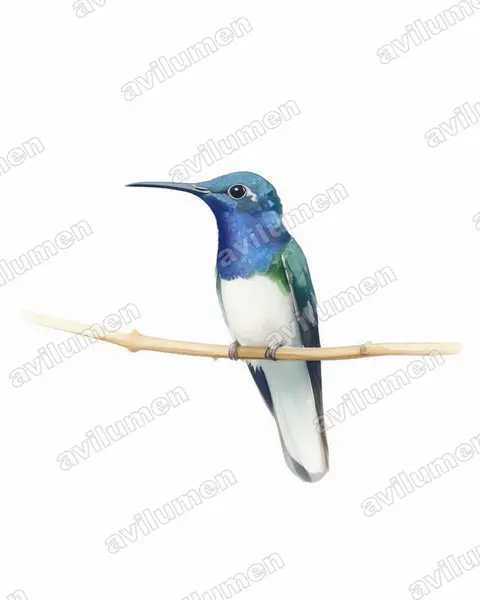
Watercolor 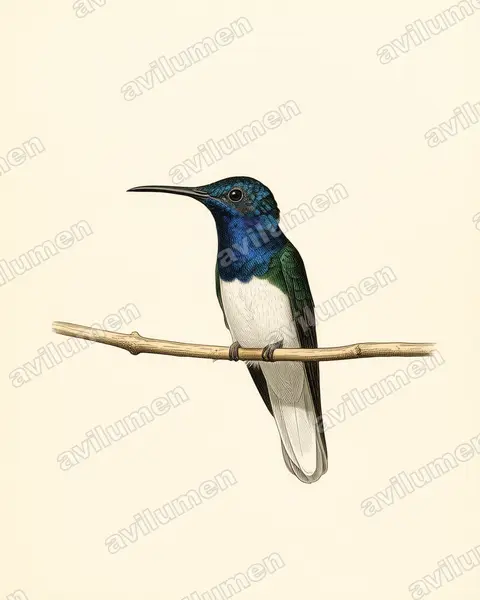
Vintage plate 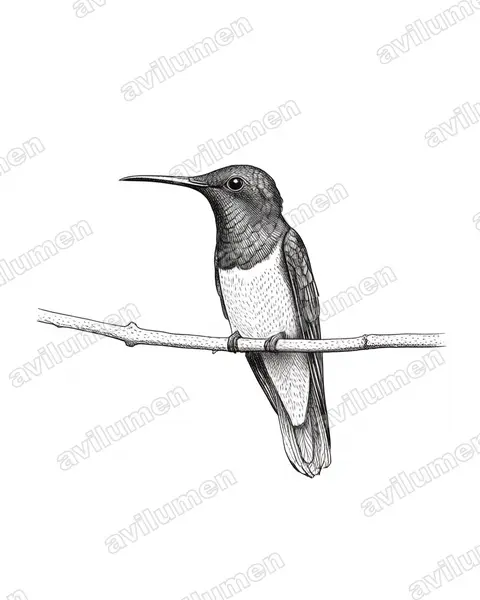
Ink 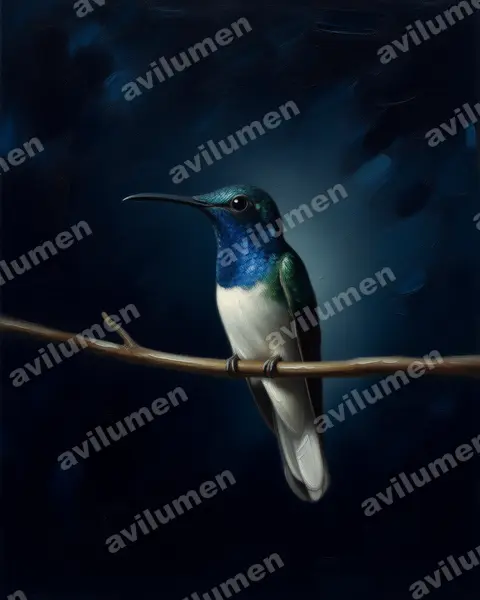
Oil 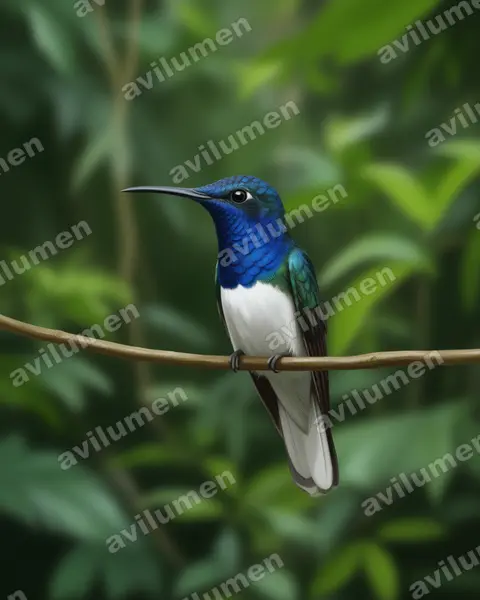
Realistic 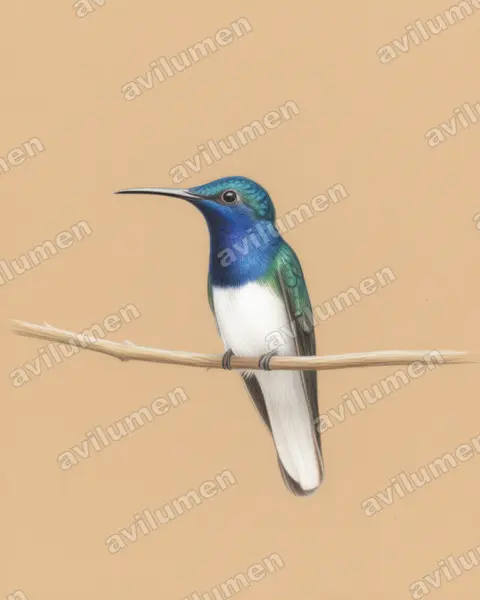
Colored pencil
Illustrations based on the photograph by Charles J. Sharp (CC BY-SA 4.0), from Wikimedia Commons.
Digital editions
HD Digital Art Pack — White-necked jacobin
Digital download: 6 high-resolution illustrations of the White-necked jacobin (Florisuga mellivora), print-ready. This is a digital file; no animal or physical item is included.
AI Avatar — White-necked jacobin
Generate an avatar fusing your face with the White-necked jacobin (Florisuga mellivora). Delivered digitally in 8K, watermark-free. Digital product; no animals are sold or brokered.
Instant download. No live birds are sold.
Frequently asked questions
- Is Florisuga mellivora (White-necked jacobin) endangered?
- The IUCN Red List places Florisuga mellivora, commonly known as the White-necked jacobin, in the «Least concern» category. «Least concern» means it is not currently threatened.
- Where does Florisuga mellivora (White-necked jacobin) live?
- Florisuga mellivora (White-necked jacobin) is found in Brazil and South America.
- What family does Florisuga mellivora (White-necked jacobin) belong to?
- Florisuga mellivora (White-necked jacobin) belongs to the family Trochilidae, in the order Apodiformes.
- What colour is Florisuga mellivora (White-necked jacobin)?
- The plumage of Florisuga mellivora (White-necked jacobin) combines these colours: Green and White.
More from the same family
 Least concern
Emerald-chinned Hummingbird
Abeillia abeillei
The emerald-chinned hummingbird is a species of hummingbird in the "emeralds", tribe Trochilini of subfamily Trochilinae.
from $1.99
 Least concern
Speckled hummingbird
Adelomyia melanogenys
The speckled hummingbird is a species of hummingbird. It is the only member of the genus Adelomyia. It inhabits Neotropical montane cloud forests at elevations of 1,000–2,500 meters and is confined to the Andes of Argentina, Bolivia, Peru, Ecuador, Colombia and Venezuela; as well as to some isolated montane forests in western Ecuador and Venezuela.
from $1.99
 Vulnerable
Purple-backed sunbeam
Aglaeactis aliciae
The purple-backed sunbeam is a bird species in the family Trochilidae. It is found only in Peru.
from $1.99
 Near threatened
White-tufted sunbeam
Aglaeactis castelnaudii
The white-tufted sunbeam is a species of hummingbird in the family Trochilidae. It is found only in Peru. Its natural habitats are subtropical or tropical moist montane forest and subtropical or tropical high-altitude shrubland.
from $1.99