Bare-necked Fruitcrow
Gymnoderus foetidus
Avilumen editorial team ·

The bare-necked fruitcrow is a species of bird in the family Cotingidae, the cotingas. It is found in every mainland South American country except Argentina, Chile, Uruguay, and Paraguay.
The bare-necked fruitcrow (Gymnoderus foetidus) is a species of bird in the family Cotingidae, the cotingas. It is found in every mainland South American country except Argentina, Chile, Uruguay, and Paraguay.
Taxonomy and systematics
The bare-necked fruitcrow was formally described in 1758 by the Swedish naturalist Carl Linnaeus in the tenth edition of his Systema Naturae under the binomial name Gracula foetida. Linnaeus specified the type locality as America but in 1902 the locality was restricted to Surinam. The bare-necked fruitcrow is now the only species placed in the genus Gymnoderus that was introduced in 1809 by the French naturalist Étienne Geoffroy Saint-Hilaire. The genus name combines the Ancient Greek gumnos meaning "bare" or "naked" with dera meaning "neck" or "throat". The specific epithet foetidus is Latin meaning "stinking". The species is monotypic: no subspecies are recognized.
A large molecular phylogenetic study of the suboscines published in 2020 found that the bare-necked fruitcrow was sister to the black-faced cotinga (Conioptilon mcilhennyi).
Description
The bare-necked fruitcrow is 34 to 39 cm (13 to 15 in) long; one individual weighed 220 g (7.8 oz). Both sexes have bare blue or bluish white skin on their lower face and neck; on both the skin drapes in folds though much less so on the female than male. The rest of their heads have short velvety feathers and their flanks have large patches of powder down. Adult males are otherwise mostly black except that most of their wing is silvery gray. Females are smaller than males; adults are mostly slaty gray with a faint paler scaly pattern. Juveniles are mostly white; immatures progress from there to adult plumage over two to three years.
Distribution and habitat
The bare-necked fruitcrow is primarily a bird of the Amazon Basin, although its range skirts much of the Negro River watershed in the northern part of it and also includes the basin of the Orinoco River. One arm of its range extends from far eastern Colombia and southwestern Venezuela across far northern Brazil and the Guianas to the Atlantic and south from there to join the rest of the range. The bulk of its range extends from south-central Colombia, eastern Ecuador, and eastern Peru east through northern Bolivia and north-central Brazil. In Brazil the main range's northern edge is roughly from west-central Amazonas east to Amapá and its southern edge from northern Mato Grosso do Sul northeast to the Atlantic in Maranhão.
The bare-necked fruitcrow inhabits humid forest including várzea and terra firme types. It tends to be most frequent along rivers and around lakes. In elevation it is found below 500 m (1,600 ft) in Colombia, below 300 m (1,000 ft) in Ecuador, below 600 m (2,000 ft) in Peru, and below 150 m (500 ft) in Venezuela.
Movement
The bare-necked fruitcrow is often seen in small flocks along and crossing rivers, but it is not known if this movement is local or represents seasonal migration.
Feeding
The bare-necked fruitcrow feeds mostly on fruit and also includes small and large insects in its diet. It forages singly, in pairs, and in flocks. Atypically among cotingas, it takes much fruit and insects while running or hopping along branches. It takes some insects, for instance flying ants, in mid-air with sallies from atop a tree.
Breeding
The bare-necked fruitcrow's breeding season varies latitudinally, becoming later south to north. The one described nest was a shallow cup made from lichens and thin plant fibers coated with fungus. It was on a horizontal branch at an estimated height of 6 to 10 m (20 to 35 ft) above the ground. Another, not otherwise described, was 40 m (130 ft) up in the crown of a tree. The clutch is believed to be one egg. Nothing else is known about the species' breeding biology.
Vocalization
The bare-necked fruitcrow is described by some as silent or "apparently mute". Nevertheless, its voice has been described as a "deep bellowing oooooooo like a fog-horn". As of October 2025 xeno-canto and Cornell Lab's Macaulay Library each had a single recording.
Status
The IUCN has assessed the bare-necked fruitcrow as being of Least Concern. It has a very large range; its population size is not known and is believed to be decreasing. No immediate threats have been identified. It is considered common in Colombia, Ecuador, and Brazil, fairly common in Peru, and uncommon in Venezuela. It occurs in several protected areas.
Text adapted from Wikipedia · CC BY-SA 4.0
Where it lives
Plumage colours
Distribution

Taxonomy
- Order
- Passeriformes
- Family
- Cotingidae
- Genus
- Gymnoderus
- Conservation status
- Least concern
Listen to its call
No recording yet
Illustration gallery
6 illustrations of Gymnoderus foetidus (Bare-necked Fruitcrow) in different styles, true to its real plumage. Shown watermarked; the art pack includes the high-resolution originals, ready to print.
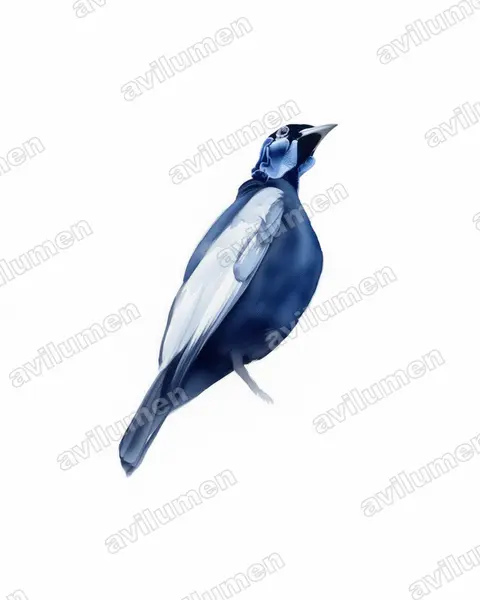
Watercolor 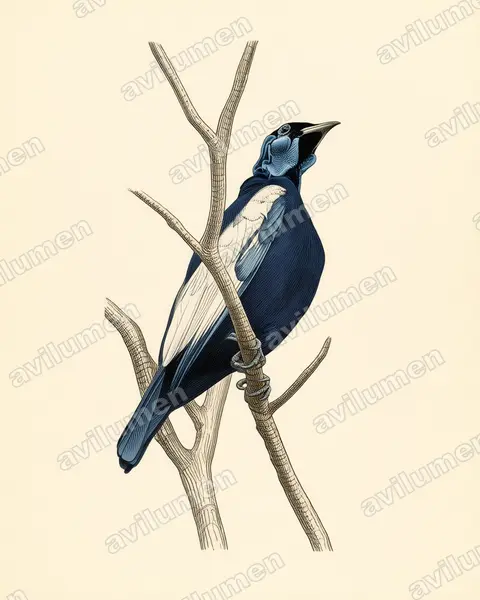
Vintage plate 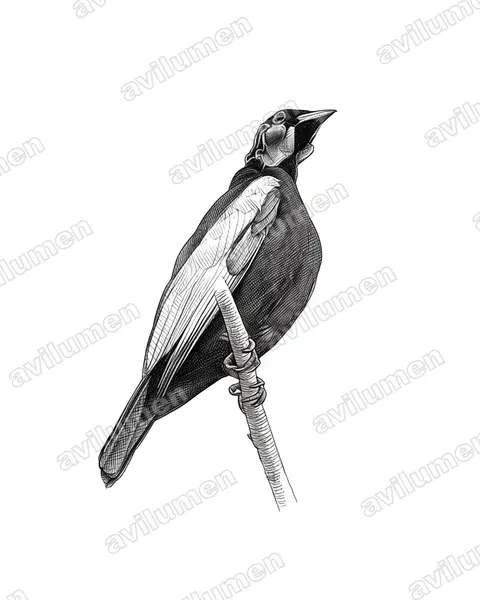
Ink 
Oil 
Realistic 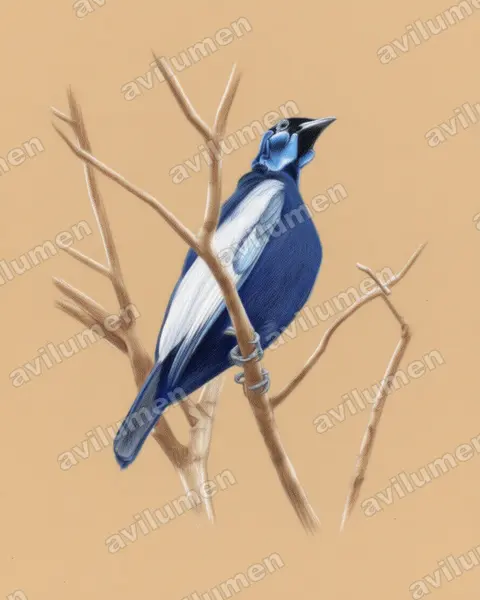
Colored pencil
Illustrations based on the photograph by https://www.flickr.com/photos/jquental/ (CC BY 2.0), from Wikimedia Commons.
Digital editions
HD Digital Art Pack — Bare-necked Fruitcrow
Digital download: 6 high-resolution illustrations of the Bare-necked Fruitcrow (Gymnoderus foetidus), print-ready. This is a digital file; no animal or physical item is included.
AI Avatar — Bare-necked Fruitcrow
Generate an avatar fusing your face with the Bare-necked Fruitcrow (Gymnoderus foetidus). Delivered digitally in 8K, watermark-free. Digital product; no animals are sold or brokered.
Instant download. No live birds are sold.
Frequently asked questions
- Is Gymnoderus foetidus (Bare-necked Fruitcrow) endangered?
- The IUCN Red List places Gymnoderus foetidus, commonly known as the Bare-necked Fruitcrow, in the «Least concern» category. «Least concern» means it is not currently threatened.
- Where does Gymnoderus foetidus (Bare-necked Fruitcrow) live?
- Gymnoderus foetidus (Bare-necked Fruitcrow) is found in Brazil and South America.
- What family does Gymnoderus foetidus (Bare-necked Fruitcrow) belong to?
- Gymnoderus foetidus (Bare-necked Fruitcrow) belongs to the family Cotingidae, in the order Passeriformes.
- What colour is Gymnoderus foetidus (Bare-necked Fruitcrow)?
- The plumage of Gymnoderus foetidus (Bare-necked Fruitcrow) combines these colours: Black.
More from the same family
 Least concern
Scaled Fruiteater
Ampelioides tschudii
The scaled fruiteater is a species of bird in the family Cotingidae. It is the only member of the genus Ampelioides. This bird is found in Bolivia, Colombia, Ecuador, Peru, and Venezuela, where its natural habitat is the high elevation tropical forests of the Andes mountains. The scaled fruiteater is a chunky, short-tailed, flat-headed bird measuring 19–20 cm (7.5–7.9 in) in length.
from $1.99
 Least concern
Red-crested Cotinga
Ampelion rubrocristatus
The red-crested cotinga is a species of bird in the family Cotingidae. It is found in Bolivia, Colombia, Ecuador, Peru, and Venezuela.
from $1.99
 Least concern
Chestnut-crested Cotinga
Ampelion rufaxilla
The chestnut-crested cotinga is a species of bird in the family Cotingidae. It is found in Bolivia, Colombia, Ecuador, and Peru.
from $1.99
 Critically endangered
Kinglet Calyptura
Calyptura cristata
The kinglet calyptura is a small Critically Endangered passerine bird in the family Tyrannidae, the tyrant flycatchers. It is endemic to southeastern Brazil.
from $1.99