Chocolate-backed Kingfisher
Halcyon badia
Avilumen editorial team ·

The chocolate-backed kingfisher is a species of kingfisher in the subfamily Halcyoninae, native to the African tropical rainforest.
The chocolate-backed kingfisher (Halcyon badia) is a species of kingfisher in the subfamily Halcyoninae, native to the African tropical rainforest.
Description
The chocolate-backed kingfisher has the typical stocky kingfisher shape with dark upper parts and pure white underparts. The head and hind neck are very dark brown, the mantle is brownish black, the back is black, the rump a brilliant iridescent blue, the upper tail coverts are black, and the tail is pale blue. The wings are dark, apart from a brilliant azure speculum formed in the outer webs of the secondary feathers. The underparts from the throat to the vent are snowy white, apart from a small blackish flank patch, and are clearly demarcated from the dark upper parts. In flight the brilliant blue rump and speculum are distinctive. The bill is red or reddish brown. Juveniles are similar to adults, except that the breast is scalloped and the bill is blackish with an orange tip.
Voice
A harsh screeching alarm note is given. The song is a high pitched, barely audible introductory "pee" followed by 12-17 long flutelike pure tones which are evenly spaced and far carrying, lasting 5–7 seconds, and sometimes falling away toward the last few notes.
Distribution
The chocolate-backed kingfisher occurs across the African tropical rainforest : west of the Dahomey Gap from Sierra Leone to Ghana, then from southern Nigeria east to southern Central African Republic and western Uganda, south to the Kwango River in northern Angola. It is also found on Bioko.
Habitat
The chocolate-backed kingfisher is not associated with water and is a bird of primary and secondary lowland rain forest.
Habits
The chocolate-backed kingfisher spends much of its time perched quietly quite high up in trees that overlook a clearing. It flies out from this perch to catch prey in the air or drops from the perch onto prey on the ground. It has been recorded attacking columns of driver ants and feeding on either the driver ants themselves or the insects their columns flush. They feed on insects, mainly grasshoppers and beetles, but also many other invertebrates as well as small lizards.
They excavate their nests in the earth nests of the arboreal termites of the genus Nasutitermes. The termites fix their nests to a liana or vine or angled branch at about 4–5 m (13–16 ft) above the forest floor. The kingfishers excavate their nest horizontally from the side and can dig out most of the termite's structure; the termites react by sealing themselves off from the cavity created by the birds. They also sometimes use hanging ant nests.
Text adapted from Wikipedia · CC BY-SA 4.0
Taxonomy
- Order
- Coraciiformes
- Family
- Alcedinidae
- Genus
- Halcyon
- Conservation status
- Least concern
Listen to its call
No recording yet
Illustration gallery
6 illustrations of Halcyon badia (Chocolate-backed Kingfisher) in different styles, true to its real plumage. Shown watermarked; the art pack includes the high-resolution originals, ready to print.
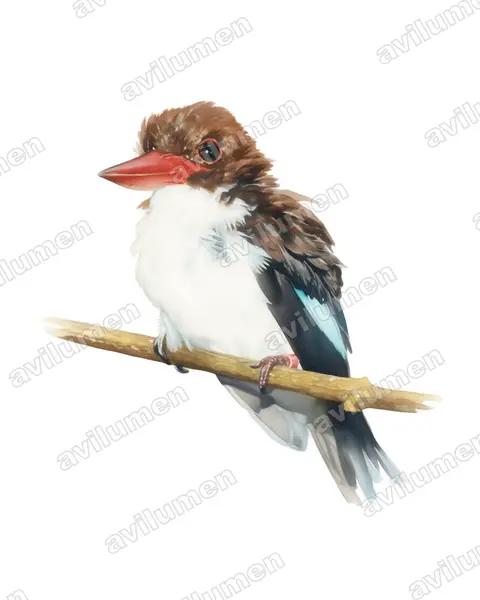
Watercolor 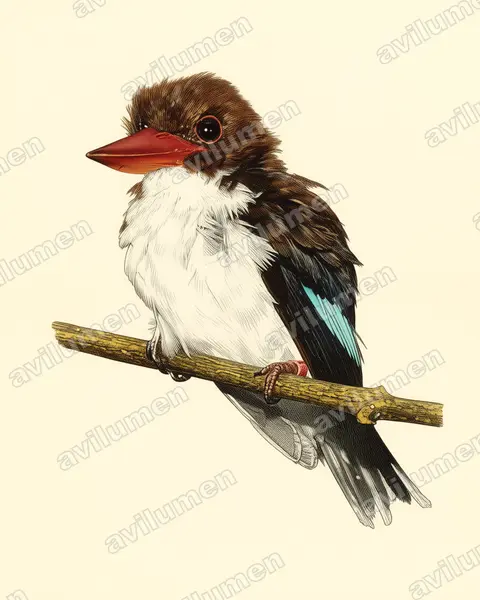
Vintage plate 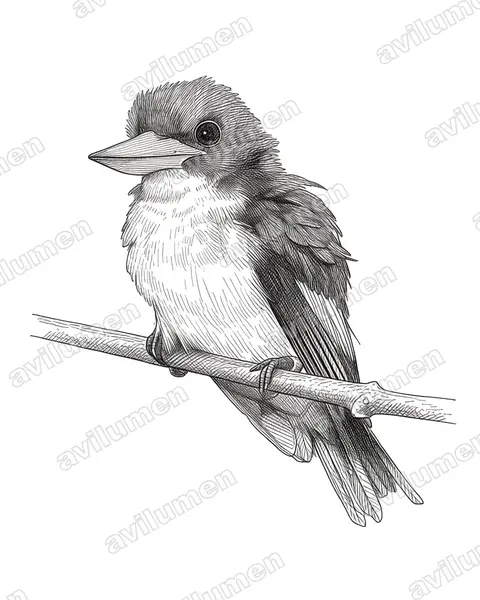
Ink 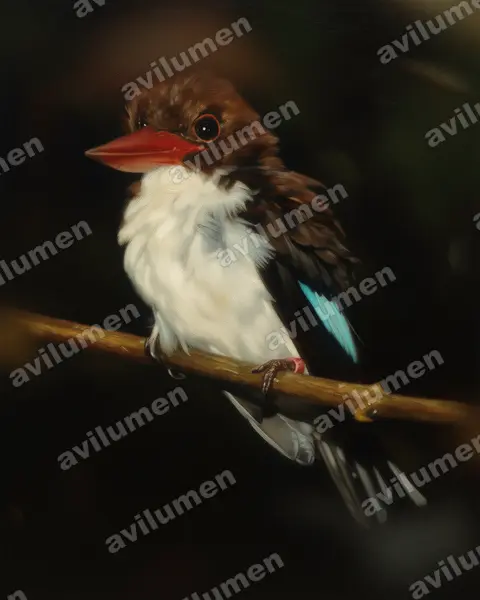
Oil 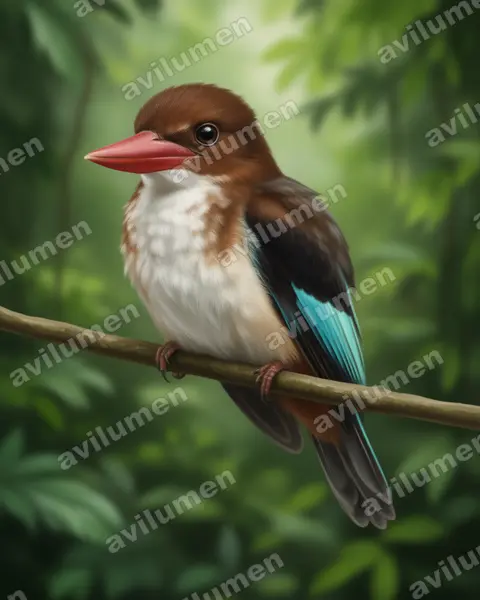
Realistic 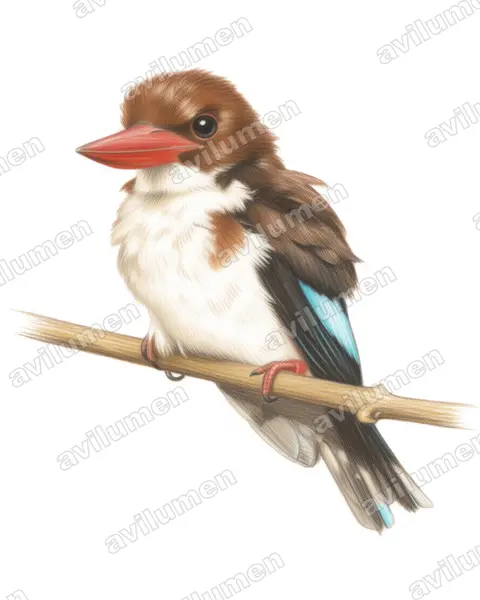
Colored pencil
Illustrations based on the photograph by Walter Jetz (CC BY 2.5), from Wikimedia Commons.
Digital editions
HD Digital Art Pack — Chocolate-backed Kingfisher
Digital download: 6 high-resolution illustrations of the Chocolate-backed Kingfisher (Halcyon badia), print-ready. This is a digital file; no animal or physical item is included.
AI Avatar — Chocolate-backed Kingfisher
Generate an avatar fusing your face with the Chocolate-backed Kingfisher (Halcyon badia). Delivered digitally in 8K, watermark-free. Digital product; no animals are sold or brokered.
Instant download. No live birds are sold.
Frequently asked questions
- Is Halcyon badia (Chocolate-backed Kingfisher) endangered?
- The IUCN Red List places Halcyon badia, commonly known as the Chocolate-backed Kingfisher, in the «Least concern» category. «Least concern» means it is not currently threatened.
- Where does Halcyon badia (Chocolate-backed Kingfisher) live?
- Halcyon badia (Chocolate-backed Kingfisher) is found in Africa.
- What family does Halcyon badia (Chocolate-backed Kingfisher) belong to?
- Halcyon badia (Chocolate-backed Kingfisher) belongs to the family Alcedinidae, in the order Coraciiformes.
- What colour is Halcyon badia (Chocolate-backed Kingfisher)?
- The plumage of Halcyon badia (Chocolate-backed Kingfisher) combines these colours: Brown, Blue, and White.
More from the same family
 Least concern
Moustached Kingfisher
Actenoides bougainvillei
The moustached kingfisher, also called Bougainville moustached kingfisher, is a species of bird in the family Alcedinidae. It is endemic to Bougainville Island in Papua New Guinea. An estimated 1,300–7,000 mature individuals are left.
from $1.99
 Near threatened
Rufous-collared Kingfisher
Actenoides concretus
The rufous-collared kingfisher is a species of bird in the family Alcedinidae. It is found in Brunei, Indonesia, Malaysia, Myanmar, and Thailand. Its natural habitats are subtropical or tropical moist lowland forest and subtropical or tropical moist montane forest. It is threatened by habitat loss.
from $1.99
 Least concern
Hombron's Kingfisher
Actenoides hombroni
The blue-capped kingfisher, also known as Hombron's kingfisher, is a species of bird in the family Alcedinidae endemic to the Philippines and found only on Mindanao. It is one of the most colorful kingfishers in the country having a dark blue cap and wings with rufous spots, a striped rufous belly, white chin and red bill.
from $1.99
 Least concern
Spotted Wood Kingfisher
Actenoides lindsayi
The spotted wood kingfisher or spotted kingfisher is a species of bird in the family Alcedinidae. It is endemic to the Philippines found on the islands of Luzon, Catanduanes, Marinduque, Negros and Panay where its natural habitat is tropical moist lowland forests.
from $1.99