Pictorella mannikin
Heteromunia pectoralis
Avilumen editorial team ·

The pictorella mannikin, pictorella munia, or pictorella finch is small brown and grey finch with a grey bill and distinctive scaly white breast plate which is endemic to northern Australia. It is a seed-eater found in pairs and small flocks in dry savannah and subtropical or tropical dry lowland grassland.
The pictorella mannikin, pictorella munia, or pictorella finch (Heteromunia pectoralis) is small brown and grey finch with a grey bill and distinctive scaly white breast plate which is endemic to northern Australia. It is a seed-eater found in pairs and small flocks in dry savannah and subtropical or tropical dry lowland grassland.
Taxonomy
The pictorella mannikin was formally described in 1841 by English ornithologist John Gould based on a specimen that had been collected in northwestern Australia by John E. Dring who had been a crew member on the third voyage of HMS Beagle. Gould coined the binomial name Amadina pectoralis. When in 1842 Gould described and illustrated the finch in the third volume of his book The Birds of Australia he instead placed the species in the genus Donacola. The pictorella mannikin is now the only species placed in the genus Heteromunia that was introduced by Gregory Mathews in 1913. The genus name combines the Ancient Greek ἑτερος/heteros meaning "different" or "another" with the genus name Munia that had been introduced in 1836 by Brian Houghton Hodgson. The specific epithet pectoralis is Latin meaning "of the breast" or "pectoral". The species is monotypic: no subspecies are recognised.
The common name used in Australia is pictorella mannikin. Gould used the name white-breasted finch in his The Birds of Australia, and it was the common name until 1926 when the Royal Australasian Ornithologists Union (RAOU) Official checklist declared the common name to be "pectorella finch" with no explanation.
The name mannikin is from the Dutch manneken, a diminutive of man. There is no clarity as to why this has been applied to birds in general and particularly to seed eating finches. In 1978 the RAOU checklist committee recommended using "mannikin" for the Australian Lonchura species.
Description
The pictorella mannikin is a grey-billed, buff-brown and grey finch with a distinctive white scaly breast and black face disc. Small white tips on its wing coverts "impart a jewel-like appearance". The bird has a maximum size of 120mm, with a wingspan of 56-63mm, a bill of 12-14mm and weighs between 13 and 15 grams.
Behaviour and ecology
Pictorella mannikins forage on the ground in small flocks or pairs on seeding native grasses and sometimes take small invertebrates. Flocks aggregate around inland water sources particularly at the end of the dry season but disperse away from permanent water when rain falls. In northern Australia they often forage on recently burnt ground, open grassy woodland and fringes of wetland.
They are relatively short tailed with an upright stance. Pictorella mannikin pairs mate for life and lay 4 to 6 white or bluish white eggs in a dome-shaped grass nest in long grass or low bush.
In 2016 the pictorella mannikin's conservation status was listed Least Concern (LC) on the IUCN Red List although the population is marked as decreasing. In 2007, the International Union for Conservation of Nature downgraded its assessment of the species from Near Threatened (NT) to Least Concern (LC) after large flocks of this species were found at several locations. In the Northern Territory and Western Australia the bird's conservation status is listed as Near Threatened (NT) while in Queensland the conservation status listing is Least Concern (LC).
Text adapted from Wikipedia · CC BY-SA 4.0
Taxonomy
- Order
- Passeriformes
- Family
- Estrildidae
- Genus
- Heteromunia
- Conservation status
- Least concern
Listen to its call
No recording yet
Care guide
Canary and Finch Care Guide: Diet, Housing and Breeding
How to care for canaries, zebra finches, Gouldian finches and other finches: diet, flight cage setup, health, song and breeding. A guide for bird keepers.
Read the guide →Illustration gallery
6 illustrations of Heteromunia pectoralis (Pictorella mannikin) in different styles, true to its real plumage. Shown watermarked; the art pack includes the high-resolution originals, ready to print.
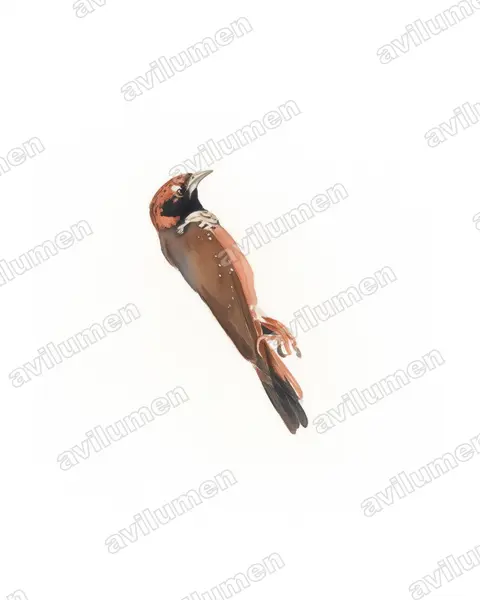
Watercolor 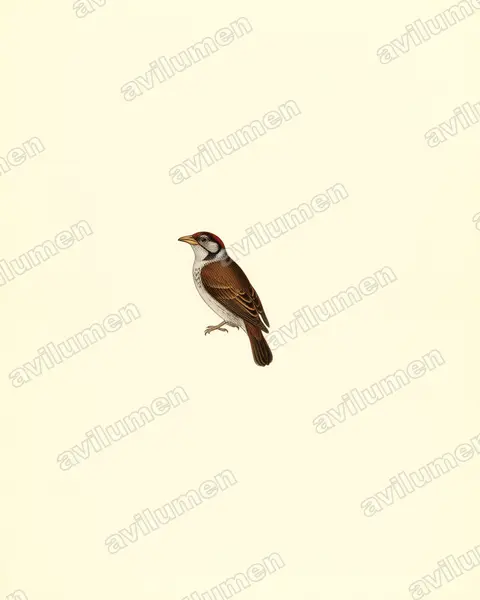
Vintage plate 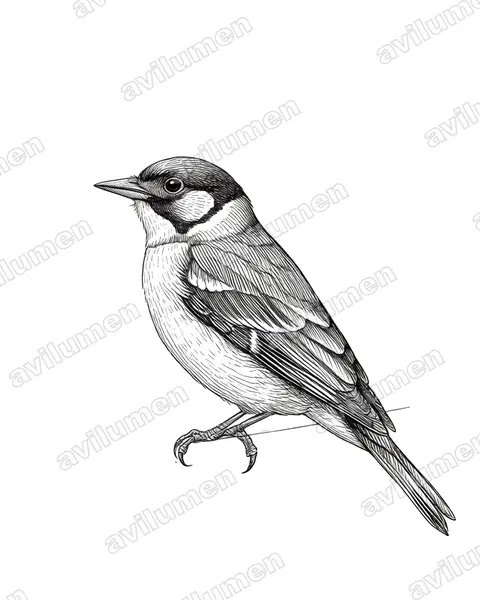
Ink 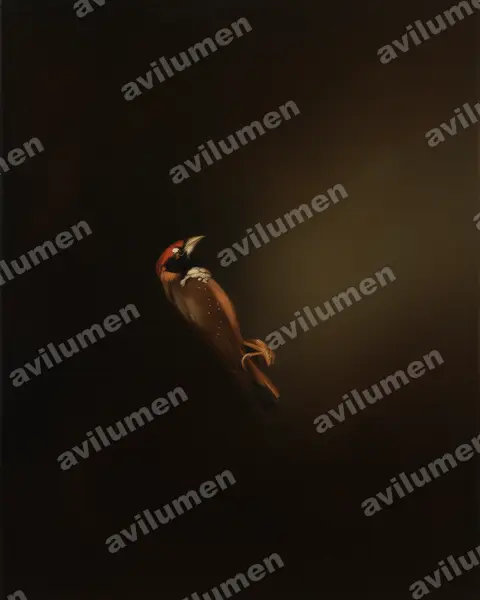
Oil 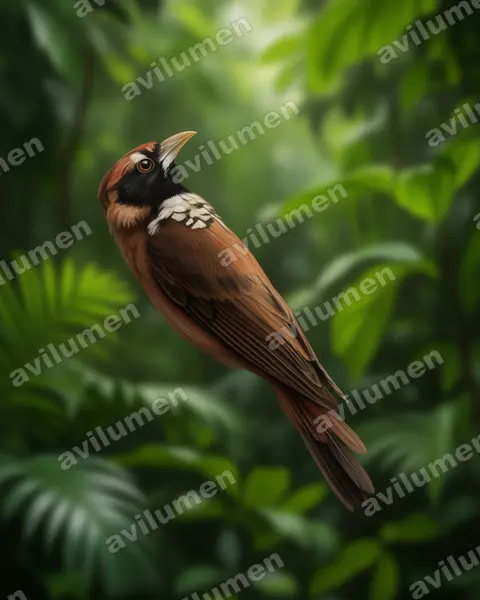
Realistic 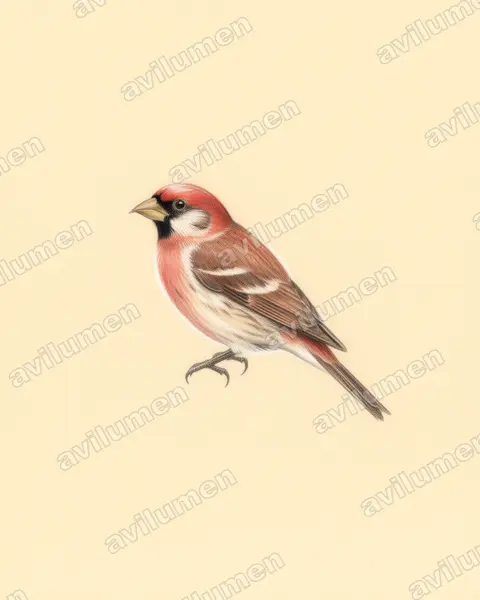
Colored pencil
Illustrations based on the photograph by Gould, 1841 (CC0), from Wikimedia Commons.
Digital editions
HD Digital Art Pack — Pictorella mannikin
Digital download: 6 high-resolution illustrations of the Pictorella mannikin (Heteromunia pectoralis), print-ready. This is a digital file; no animal or physical item is included.
AI Avatar — Pictorella mannikin
Generate an avatar fusing your face with the Pictorella mannikin (Heteromunia pectoralis). Delivered digitally in 8K, watermark-free. Digital product; no animals are sold or brokered.
Instant download. No live birds are sold.
Frequently asked questions
- Is Heteromunia pectoralis (Pictorella mannikin) endangered?
- The IUCN Red List places Heteromunia pectoralis, commonly known as the Pictorella mannikin, in the «Least concern» category. «Least concern» means it is not currently threatened.
- What family does Heteromunia pectoralis (Pictorella mannikin) belong to?
- Heteromunia pectoralis (Pictorella mannikin) belongs to the family Estrildidae, in the order Passeriformes.
- What colour is Heteromunia pectoralis (Pictorella mannikin)?
- The plumage of Heteromunia pectoralis (Pictorella mannikin) combines these colours: Brown and Grey.
More from the same family
 Least concern
Red-headed finch
Amadina erythrocephala
The red-headed finch is a common species of estrildid finch found in Africa. It has an estimated global extent of occurrence of 1,600,000 km2 (620,000 sq mi). It is found in Angola, Botswana, Lesotho, Namibia, South Africa and Zimbabwe.
from $1.99
 Least concern
Cut-throat finch
Amadina fasciata
The cut-throat finch is a common species of estrildid finch found throughout Africa; it is also known as the bearded finch, the ribbon finch, the cut throat, and the weaver finch.
from $1.99
 Least concern
Red avadavat
Amandava amandava
The red avadavat, red munia or strawberry finch, is a sparrow-sized bird of the family Estrildidae. It is found in the open fields and grasslands of tropical Asia and is popular as a cage bird due to the colourful plumage of the males in their breeding season. It breeds in the Indian subcontinent in the monsoon season.
from $1.99
 Vulnerable
Green avadavat
Amandava formosa
The green avadavat or green munia is a species of Estrildid finch with green and yellow on the body, a bright red bill and black "zebra stripes" on the flanks. They are endemic to the Indian subcontinent and were formerly popular as cagebirds. The name "avadavat" is a corruption of the name the city of Ahmedabad in Gujarat, India, which was a centre of bird trade.
from $1.99