Blue-headed sapphire
Hylocharis grayi
Avilumen editorial team ·

The Blue-headed sapphire or Gray's hummingbird is a species of hummingbird in the emerald's tribe Trochilini of subfamily Trochilidae. It is found in Colombia and Ecuador.
The Blue-headed sapphire or Gray's hummingbird (Chrysuronia grayi) is a species of hummingbird in the emerald's tribe Trochilini of subfamily Trochilidae. It is found in Colombia and Ecuador.
Taxonomy and systematics
The blue-headed sapphire was formerly placed in the genera Hylocharis and Amazilia. It was moved by most taxonomic systems to Chrysuronia based on the results of a molecular phylogenetic study published in 2014. However, BirdLife International's Handbook of the Birds of the World (HBW) retains it in Amazilia.
The blue-headed sapphire is monotypic. However, at one time what is now Humboldt's sapphire (C. humboldtii) was treated as a subspecies of it.
Description
The blue-headed sapphire is 9 to 11 cm (3.5 to 4.3 in) long. Males weigh 6.2 to 6.8 g (0.22 to 0.24 oz) and females 4.6 to 5.6 g (0.16 to 0.20 oz). Males have a straightish coral red bill with a black tip. Females' bills have a black maxilla with red at its base and a mostly pinkish mandible with a black tip. Adult males have a deep glittering blue upper throat, face, and crown. Their nape is dark blue-green and the rest of their upperparts metallic green. Their tail is dark steel blue. Their lower throat, breast, and upper belly are glittering emerald-green with a small area of white on the lower belly. Their undertail coverts are metallic green with dark grey edges. Adult females have metallic green to bronze-green upperparts. Their tail's base is dark bronze-green and the rest blue-black with greyish tips on the outer feathers. Their underparts are mostly dull white to greyish white with bronze-green on the sides of the throat and breast and some green flecks on the lower throat. Juvenile males have a dull bluish green face and crown, a bronzy green throat and breast, and a greyish white belly. Juvenile females are similar but duller and more bronzy overall.
Distribution and habitat
The blue-headed sapphire is found in inter-Andean valleys from western Colombia's Valle del Cauca Department south into Ecuador's Pichincha Province. It inhabits dry scrublands, the edges of woodland and taller forest, and cultivated areas. In elevation it mostly ranges between about 500 and 2,000 m (1,600 and 6,600 ft) but can be found as high as 2,600 m (8,500 ft).
Movement
The blue-headed sapphire is reported to make significant seasonal movements, but details are lacking.
Feeding
The blue-headed sapphire forages for nectar at a variety of flowering shrubs and trees. It sometimes defends feeding territories, and when several gather at the crown of a flowering tree they are "notably aggressive". In addition to nectar, it feeds on insects taken by hawking from a perch or by gleaning from vegetation.
Breeding
Blue-headed sapphires in breeding condition have been noted between November and April. No other information on the species' breeding phenology is known and its nest has not been described.
Vocalization
The blue-headed sapphire's song is "a repeated short-warbled phrase that starts with a squeaky 'tee' note, 'tee…teetlitlitsee-chup… teetlitlitsee-chup'." It also makes "short 'chip' notes and a high-pitched descending rattle."
Status
The IUCN has assessed the blue-headed sapphire as being of Least Concern, though its population size is unknown and believed to be decreasing. No specific threats have been identified. It appears "able to use more or less extensively altered, open or cultivated areas" though much of its native habitat has been converted to agriculture.
Text adapted from Wikipedia · CC BY-SA 4.0
Distribution

Taxonomy
- Order
- Apodiformes
- Family
- Trochilidae
- Genus
- Hylocharis
- Conservation status
- Not evaluated
Listen to its call
No recording yet
Illustration gallery
6 illustrations of Hylocharis grayi (Blue-headed sapphire) in different styles, true to its real plumage. Shown watermarked; the art pack includes the high-resolution originals, ready to print.
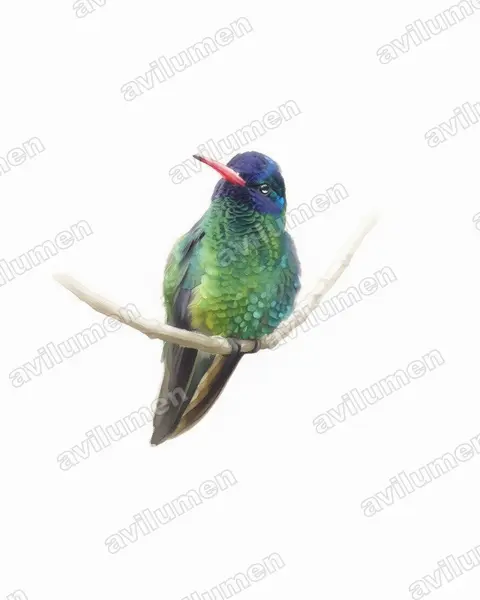
Watercolor 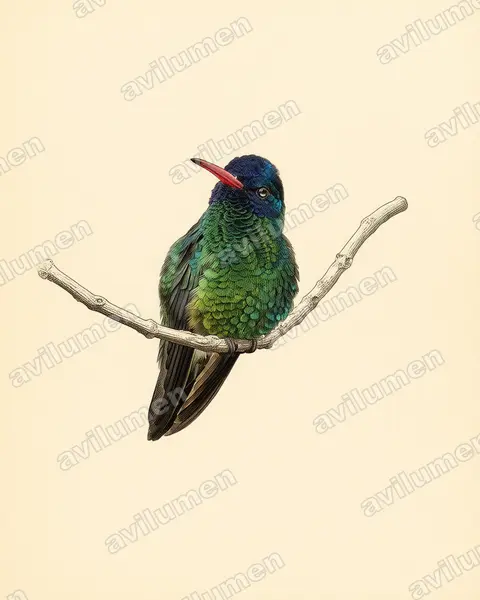
Vintage plate 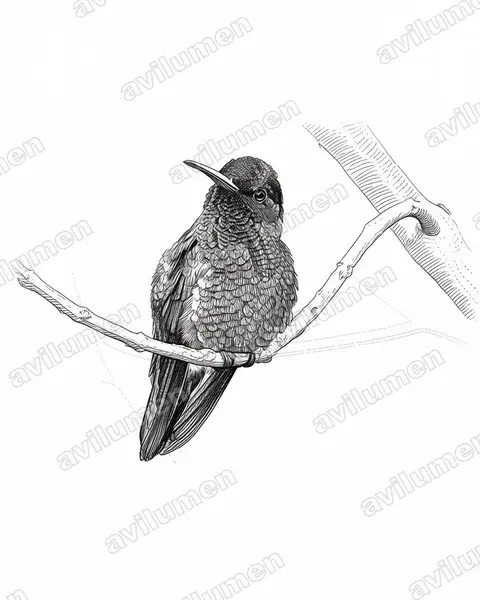
Ink 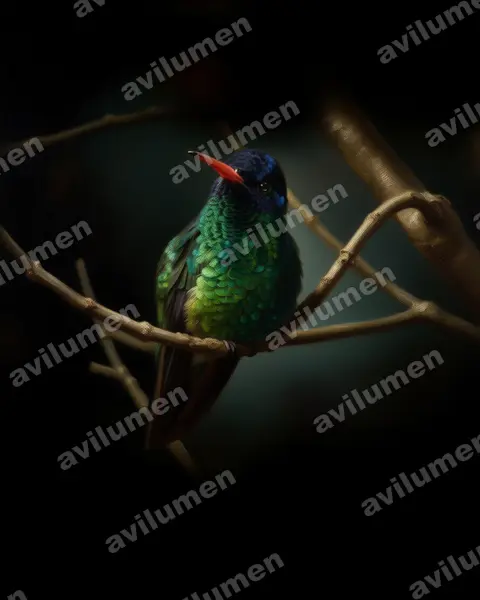
Oil 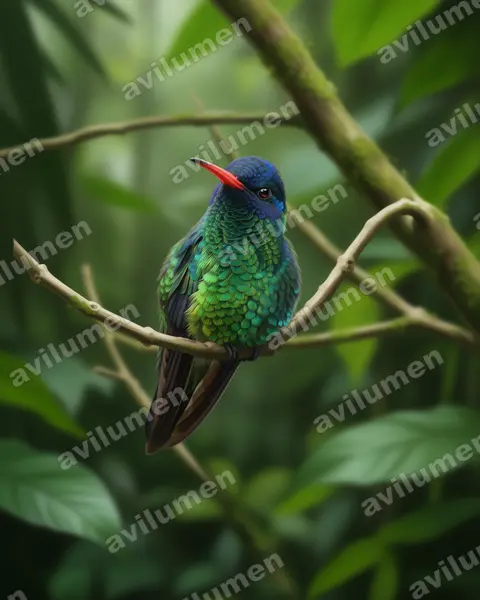
Realistic 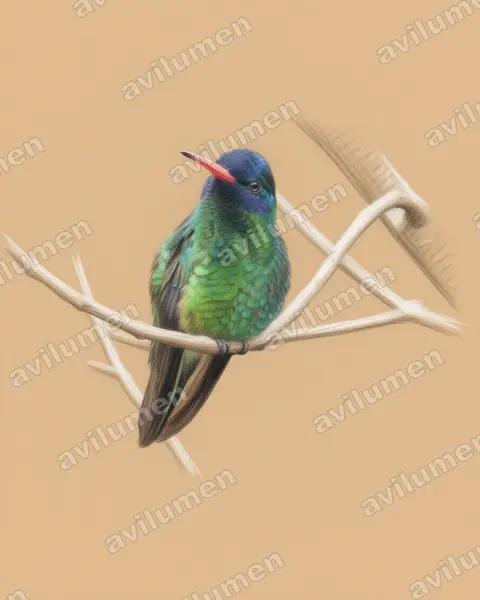
Colored pencil
Illustrations based on the photograph by Mateo.gable (CC BY-SA 4.0), from Wikimedia Commons.
Digital editions
HD Digital Art Pack — Blue-headed sapphire
Digital download: 6 high-resolution illustrations of the Blue-headed sapphire (Hylocharis grayi), print-ready. This is a digital file; no animal or physical item is included.
AI Avatar — Blue-headed sapphire
Generate an avatar fusing your face with the Blue-headed sapphire (Hylocharis grayi). Delivered digitally in 8K, watermark-free. Digital product; no animals are sold or brokered.
Instant download. No live birds are sold.
Frequently asked questions
- Is Hylocharis grayi (Blue-headed sapphire) endangered?
- The IUCN Red List places Hylocharis grayi, commonly known as the Blue-headed sapphire, in the «Not evaluated» category. «Not evaluated» means the IUCN has not yet assessed this species.
- What family does Hylocharis grayi (Blue-headed sapphire) belong to?
- Hylocharis grayi (Blue-headed sapphire) belongs to the family Trochilidae, in the order Apodiformes.
- What colour is Hylocharis grayi (Blue-headed sapphire)?
- The plumage of Hylocharis grayi (Blue-headed sapphire) combines these colours: Blue and Green.
More from the same family
 Least concern
Emerald-chinned Hummingbird
Abeillia abeillei
The emerald-chinned hummingbird is a species of hummingbird in the "emeralds", tribe Trochilini of subfamily Trochilinae.
from $1.99
 Least concern
Speckled hummingbird
Adelomyia melanogenys
The speckled hummingbird is a species of hummingbird. It is the only member of the genus Adelomyia. It inhabits Neotropical montane cloud forests at elevations of 1,000–2,500 meters and is confined to the Andes of Argentina, Bolivia, Peru, Ecuador, Colombia and Venezuela; as well as to some isolated montane forests in western Ecuador and Venezuela.
from $1.99
 Vulnerable
Purple-backed sunbeam
Aglaeactis aliciae
The purple-backed sunbeam is a bird species in the family Trochilidae. It is found only in Peru.
from $1.99
 Near threatened
White-tufted sunbeam
Aglaeactis castelnaudii
The white-tufted sunbeam is a species of hummingbird in the family Trochilidae. It is found only in Peru. Its natural habitats are subtropical or tropical moist montane forest and subtropical or tropical high-altitude shrubland.
from $1.99