Black-and-gold Cotinga
Lipaugus ater
Avilumen editorial team ·

The black-and-gold cotinga is a species of bird in the family Cotingidae. It is endemic to Brazil.
The black-and-gold cotinga (Lipaugus ater) is a species of bird in the family Cotingidae. It is endemic to Brazil.
Taxonomy and systematics
The black-and-gold cotinga was originally described as Tijuca atra. By the late 1900s there were suggestions that genus Tijuca was a sister genus to Lipaugus. A molecular phylogenetic study published in 2014 found that Tijuca was embedded within Lipaugus so taxonomic systems subsumed Tijuca into Lipaugus.
The black-and-gold cotinga is monotypic.
Description
The black-and-gold cotinga is 25 to 28 cm (9.8 to 11 in) long. The sexes are strongly sexually dimorphic. Adult males are entirely black but for a large golden yellow patch on the wing's flight feathers (remiges). They have a reddish brown iris, a bright orange bill with a slight hook on the end, and dark brown legs and feet. Females are overall dull olive-green which is yellower on the edges of the flight feathers and belly. They much resemble the monomorphic grey-winged cotinga (L. condita) and their ranges overlap. Their bill is a duller orange than the male's.
Distribution and habitat
The black-and-gold cotinga is found in southeastern Brazil, ranging intermittently in extreme eastern São Paulo, extreme eastern Minas Gerais, and southern Rio de Janeiro states. It is a bird of the Atlantic Forest biome, where it inhabits humid montane forest at elevations between 1,200 and 2,000 m (3,900 and 6,600 ft).
Movement
The black-and-gold cotinga is mostly a year-round resident but apparently makes some elevational movements.
Feeding
The black-and-gold cotinga's diet has not been detailed but is known to be primarily fruit and also include insects. Fruits of Lauraceae appear to be important. It picks most fruit while perched and occasionally with a short flutter-flight; insects are taken mostly with a short sally to foliage.
Breeding
The black-and-gold cotinga appears to nest between September and November. Nothing else is known about the species' breeding biology.
Vocalization
The black-and-gold cotinga's song is a "curious high, sharp, eerie suuuuuwíii, increasing in strength [and] upslurred midway". Two or more males alternate vocalizing from treetops, producing a continuous sound that carries a long distance.
Status
The IUCN originally in 1994 assessed the black-and-gold cotinga as Near Threatened but since 2019 as being of Least Concern. It has a restricted range; its estimated population of 20,000 to 50,000 mature individuals is believed to be decreasing. "Destruction of its montane Atlantic forest has been much less extensive than in adjacent lowland areas. The species is occasionally hunted for food." Some authors consider the species rare. Others deem it locally common, numerous in several national and state parks, and "reasonably common elsewhere in suitable habitat".
Text adapted from Wikipedia · CC BY-SA 4.0
Where it lives
Plumage colours
Distribution

Taxonomy
- Order
- Passeriformes
- Family
- Cotingidae
- Genus
- Lipaugus
- Conservation status
- Least concern
Listen to its call
No recording yet
Illustration gallery
6 illustrations of Lipaugus ater (Black-and-gold Cotinga) in different styles, true to its real plumage. Shown watermarked; the art pack includes the high-resolution originals, ready to print.
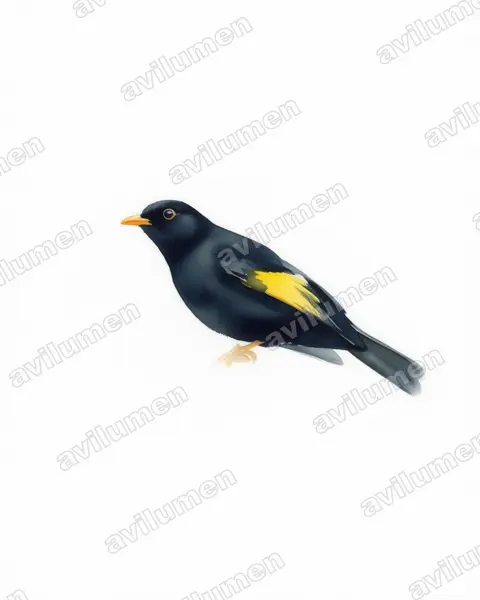
Watercolor 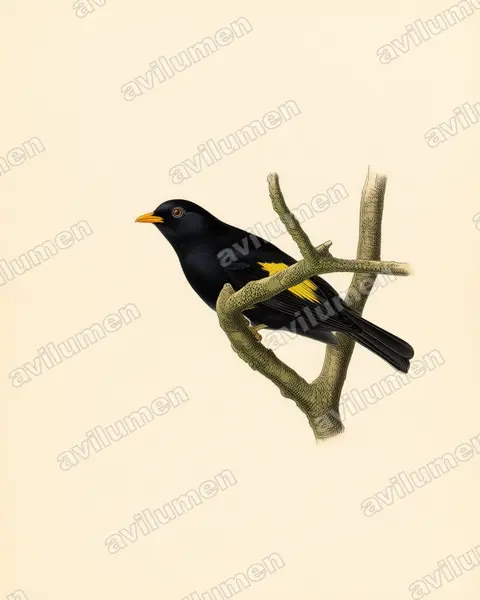
Vintage plate 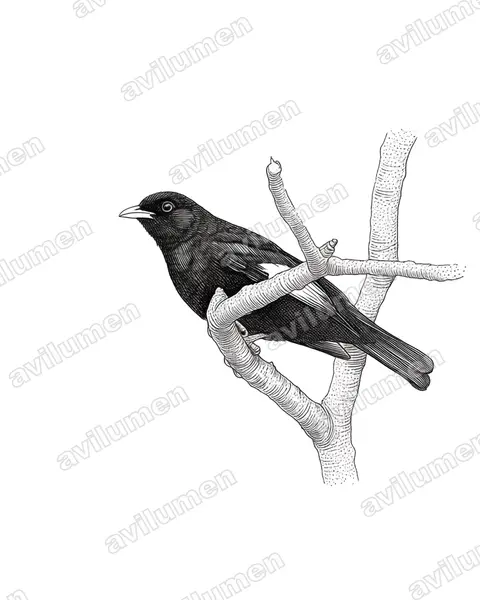
Ink 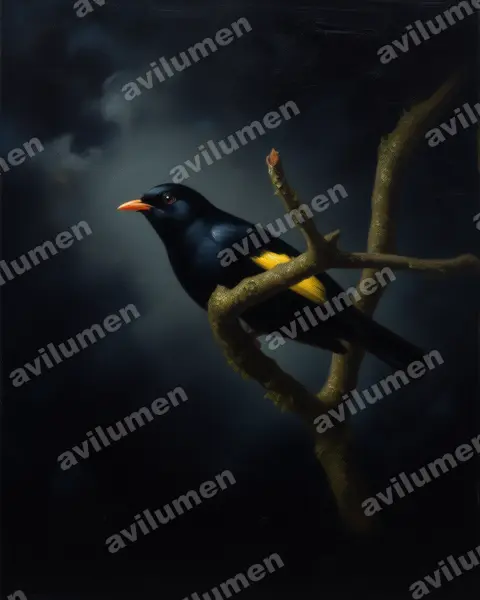
Oil 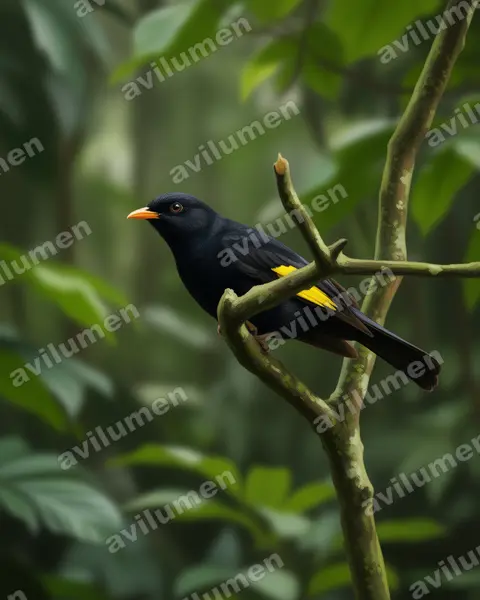
Realistic 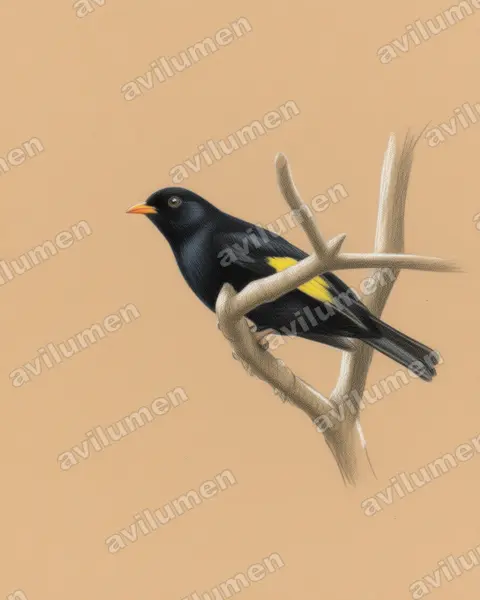
Colored pencil
Illustrations based on the photograph by https://www.flickr.com/photos/jquental (CC BY 2.0), from Wikimedia Commons.
Digital editions
HD Digital Art Pack — Black-and-gold Cotinga
Digital download: 6 high-resolution illustrations of the Black-and-gold Cotinga (Lipaugus ater), print-ready. This is a digital file; no animal or physical item is included.
AI Avatar — Black-and-gold Cotinga
Generate an avatar fusing your face with the Black-and-gold Cotinga (Lipaugus ater). Delivered digitally in 8K, watermark-free. Digital product; no animals are sold or brokered.
Instant download. No live birds are sold.
Frequently asked questions
- Is Lipaugus ater (Black-and-gold Cotinga) endangered?
- The IUCN Red List places Lipaugus ater, commonly known as the Black-and-gold Cotinga, in the «Least concern» category. «Least concern» means it is not currently threatened.
- Where does Lipaugus ater (Black-and-gold Cotinga) live?
- Lipaugus ater (Black-and-gold Cotinga) is found in Brazil and South America.
- What family does Lipaugus ater (Black-and-gold Cotinga) belong to?
- Lipaugus ater (Black-and-gold Cotinga) belongs to the family Cotingidae, in the order Passeriformes.
- What colour is Lipaugus ater (Black-and-gold Cotinga)?
- The plumage of Lipaugus ater (Black-and-gold Cotinga) combines these colours: Black.
More from the same family
 Least concern
Scaled Fruiteater
Ampelioides tschudii
The scaled fruiteater is a species of bird in the family Cotingidae. It is the only member of the genus Ampelioides. This bird is found in Bolivia, Colombia, Ecuador, Peru, and Venezuela, where its natural habitat is the high elevation tropical forests of the Andes mountains. The scaled fruiteater is a chunky, short-tailed, flat-headed bird measuring 19–20 cm (7.5–7.9 in) in length.
from $1.99
 Least concern
Red-crested Cotinga
Ampelion rubrocristatus
The red-crested cotinga is a species of bird in the family Cotingidae. It is found in Bolivia, Colombia, Ecuador, Peru, and Venezuela.
from $1.99
 Least concern
Chestnut-crested Cotinga
Ampelion rufaxilla
The chestnut-crested cotinga is a species of bird in the family Cotingidae. It is found in Bolivia, Colombia, Ecuador, and Peru.
from $1.99
 Critically endangered
Kinglet Calyptura
Calyptura cristata
The kinglet calyptura is a small Critically Endangered passerine bird in the family Tyrannidae, the tyrant flycatchers. It is endemic to southeastern Brazil.
from $1.99