Scimitar-winged Piha
Lipaugus uropygialis
Avilumen editorial team ·

The scimitar-winged piha is a Vulnerable species of bird in the family Cotingidae, the cotingas. It is found in Bolivia and Peru.
The scimitar-winged piha (Lipaugus uropygialis) is a Vulnerable species of bird in the family Cotingidae, the cotingas. It is found in Bolivia and Peru.
Taxonomy and systematics
The scimitar-winged piha was originally described as Lathria uropygialis. Because of the species' unique wing structure, the describing authors suggested that subgenus Chirocylla be used for it. Later authors elevated Chirocylla to a genus for this species alone. By the late twentieth century it had been moved by most authors to genus Lipaugus and a 2014 molecular phylogenetic study confirmed its placement there.
The scimitar-winged piha is monotypic. It and the dusky piha (L. fuscocinereous) are sister species; the chestnut-capped piha (L. weberi) may also belong to that clade.
The scimitar-winged piha's English name refers to the shape of its primaries, about which the original authors wrote, "The structure of the wing of this species is of so remarkable a character that it deserves a more lengthened notice." In males most of them bend outward in an arc like the weapon at their ends. The ends of the first two also narrow abruptly and those of the next four more gradually. Females' primaries are only slightly curved and do not narrow as much as males'.
Description
The scimitar-winged piha is 30 cm (12 in) long; one male weighed 116 g (4.1 oz) and one female 135 g (4.8 oz). The sexes have the same plumage. Adults have mostly medium gray upperparts, a rufous-chestnut rump, and somewhat darker gray wings and tail. Their underparts are mostly paler gray with rufous-chestnut lower flanks and undertail coverts. They have a dark red-brown iris, a blackish maxilla, a horn-colored mandible, and plumbeous legs and feet.
Distribution and habitat
The scimitar-winged piha is found on the eastern slope of the Andes of Peru on the Cuzco-Madre de Dios border and in eastern Puno Department. Its range continues into Bolivia's La Paz and Cochabamba departments. It inhabits the interior and edges of humid montane forest at elevations between 1,800 and 2,750 m (5,900 and 9,000 ft), though it only reaches 2,400 m (7,900 ft) in Peru.
Movement
The scimitar-winged piha is believed to be a year-round resident.
Feeding
The scimitar-winged piha is known to feed on berries and fruit and probably eats insects as well, but details are lacking. It has been observed in groups of three to five and in mixed-species feeding flocks.
Breeding
Nothing is known about the scimitar-winged piha's breeding biology.
Vocal and non-vocal sounds
The scimitar-winged piha sings during a "spiraling, falling" display flight, "a loud, piercing, high tseee'e'e'e'e tsueee? with three mechanically produced fft sounds at the start, middle, and end of [the] vocal phrase". Its calls are "an explosive chorus, loud, squeaky, conversational phrases, for example: PEEKsweeA'WEEK!".
Status
The IUCN originally in 1988 assessed the scimitar-winged piha as being of Least Concern but since 2000 as Vulnerable. It has a limited range and its estimated population of between 600 and 1700 mature individuals is believed to be decreasing. "Road construction, low-intensity agriculture, selective logging and, at lower altitudes, clearance for plantations of tea, coffee and coca affect its habitat, although extensive areas of largely undisturbed forest remain...[c]limate change may cause a rapid reduction in range size within the next few decades." It is considered rare and localized in Peru but is found in several protected areas in Peru and Bolivia.
Text adapted from Wikipedia · CC BY-SA 4.0
Where it lives
Plumage colours
Distribution

Taxonomy
- Order
- Passeriformes
- Family
- Cotingidae
- Genus
- Lipaugus
- Conservation status
- Vulnerable
Listen to its call
No recording yet
Illustration gallery
6 illustrations of Lipaugus uropygialis (Scimitar-winged Piha) in different styles, true to its real plumage. Shown watermarked; the art pack includes the high-resolution originals, ready to print.
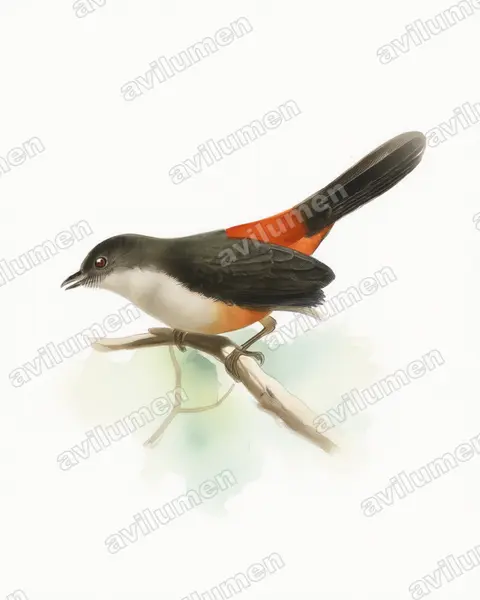
Watercolor 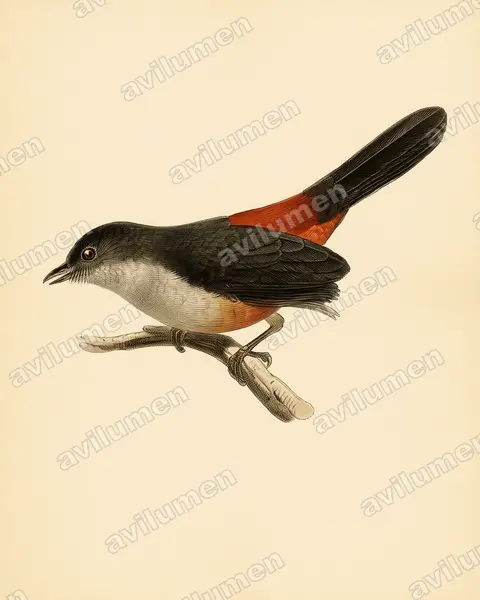
Vintage plate 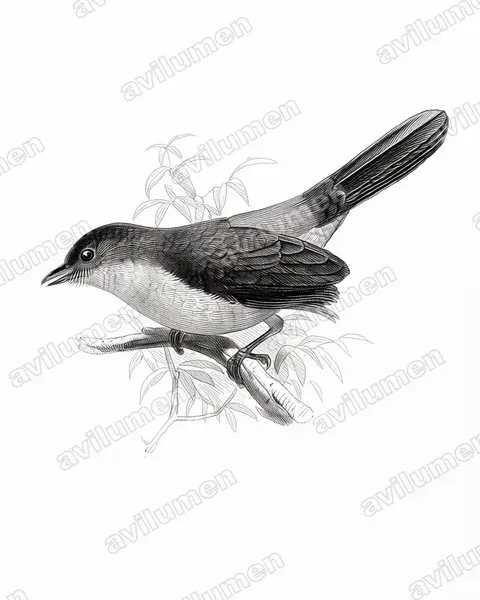
Ink 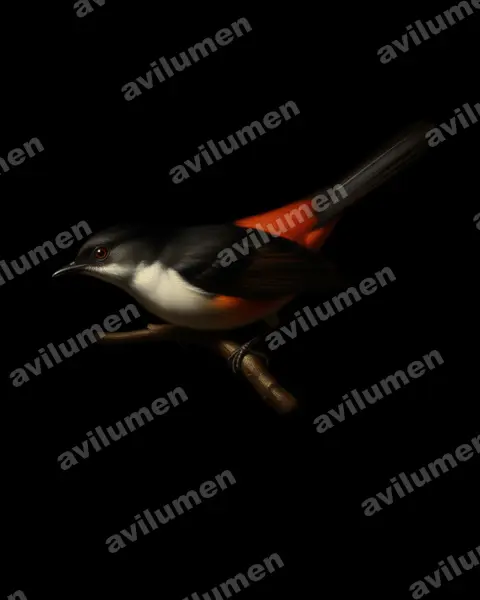
Oil 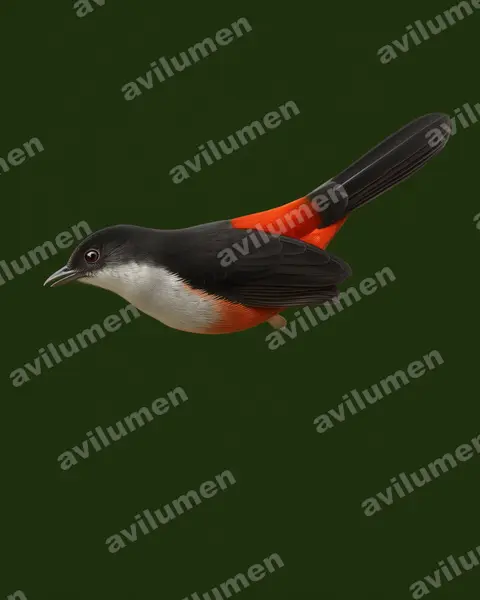
Realistic 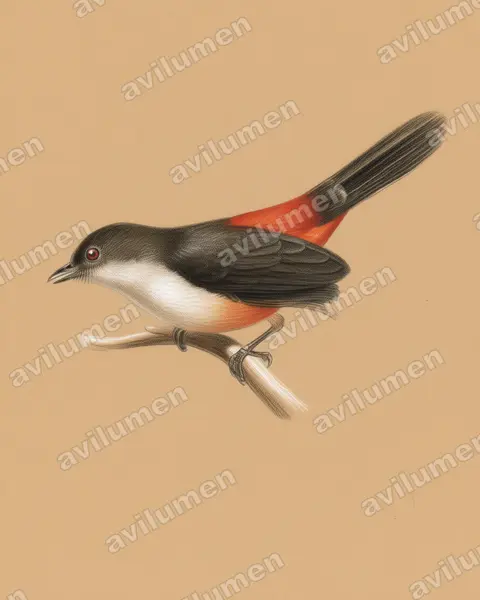
Colored pencil
Illustrations based on the photograph by Joseph Smit (Public domain), from Wikimedia Commons.
Digital editions
HD Digital Art Pack — Scimitar-winged Piha
Digital download: 6 high-resolution illustrations of the Scimitar-winged Piha (Lipaugus uropygialis), print-ready. This is a digital file; no animal or physical item is included.
AI Avatar — Scimitar-winged Piha
Generate an avatar fusing your face with the Scimitar-winged Piha (Lipaugus uropygialis). Delivered digitally in 8K, watermark-free. Digital product; no animals are sold or brokered.
Instant download. No live birds are sold.
Frequently asked questions
- Is Lipaugus uropygialis (Scimitar-winged Piha) endangered?
- The IUCN Red List places Lipaugus uropygialis, commonly known as the Scimitar-winged Piha, in the «Vulnerable» category. «Vulnerable» means it faces a high risk of extinction in the medium term.
- Where does Lipaugus uropygialis (Scimitar-winged Piha) live?
- Lipaugus uropygialis (Scimitar-winged Piha) is found in South America.
- What family does Lipaugus uropygialis (Scimitar-winged Piha) belong to?
- Lipaugus uropygialis (Scimitar-winged Piha) belongs to the family Cotingidae, in the order Passeriformes.
- What colour is Lipaugus uropygialis (Scimitar-winged Piha)?
- The plumage of Lipaugus uropygialis (Scimitar-winged Piha) combines these colours: Black.
More from the same family
 Least concern
Scaled Fruiteater
Ampelioides tschudii
The scaled fruiteater is a species of bird in the family Cotingidae. It is the only member of the genus Ampelioides. This bird is found in Bolivia, Colombia, Ecuador, Peru, and Venezuela, where its natural habitat is the high elevation tropical forests of the Andes mountains. The scaled fruiteater is a chunky, short-tailed, flat-headed bird measuring 19–20 cm (7.5–7.9 in) in length.
from $1.99
 Least concern
Red-crested Cotinga
Ampelion rubrocristatus
The red-crested cotinga is a species of bird in the family Cotingidae. It is found in Bolivia, Colombia, Ecuador, Peru, and Venezuela.
from $1.99
 Least concern
Chestnut-crested Cotinga
Ampelion rufaxilla
The chestnut-crested cotinga is a species of bird in the family Cotingidae. It is found in Bolivia, Colombia, Ecuador, and Peru.
from $1.99
 Critically endangered
Kinglet Calyptura
Calyptura cristata
The kinglet calyptura is a small Critically Endangered passerine bird in the family Tyrannidae, the tyrant flycatchers. It is endemic to southeastern Brazil.
from $1.99