Screaming Piha
Lipaugus vociferans
Avilumen editorial team ·

The screaming piha is a species of passerine bird in the lesser-known family Cotingidae, the cotingas. It is found in every mainland South American country except for these four countries: Argentina, Chile, Paraguay, and Uruguay.
The screaming piha (Lipaugus vociferans) is a species of passerine bird in the lesser-known family Cotingidae, the cotingas. It is found in every mainland South American country except for these four countries: Argentina, Chile, Paraguay, and Uruguay.
Taxonomy and systematics
The screaming piha has a complicated taxonomic history. It was originally described as Ampelis cinerea but that binomial was already in use for the pompadour cotinga (now named Xipholena punicea). The oldest available name was Muscicapa vociferans, with which Weid mistakenly placed it in the Old World flycatcher family. It was moved to genus Lipaugus in 1828 by Boie who erected that genus for it (but spelled it Lipangus because of mis-reading the name's Greek origin).
The screaming piha is monotypic.
Description
The screaming piha is 24 to 26 cm (9.4 to 10 in) long and weighs 68 to 87 g (2.4 to 3.1 oz). The sexes have the same plumage. Adults have medium gray upperparts. Their tail and their wings' flight feathers and greater coverts are browner or duskier. Their underparts are a paler gray that is palest on the throat. They have a brown, grayish brown, or gray iris, a black maxilla and a dusky mandible with a pinkish dusky base. Their legs and feet are highly variable with colors that include dark shades of green, brown, gray, and black. Juveniles resemble adults but with cinnamon rufous wing coverts and tips of the tail feathers.
Distribution and habitat
The screaming piha has a disjunct distribution: widespread throughout the Amazon rainforest, as well as the Atlantic Forest (Pernambuco and Bahia coastal forests).
The screaming piha inhabits lowland evergreen forest, primarily terra firme but also locally igapó and várzea flooded forest. In elevation it ranges from sea level to 500 m (1,600 ft) in Brazil. It reaches 1,400 m (4,600 ft) in Venezuela though most records there are below 900 m (3,000 ft). It reaches 600 m (2,000 ft) in Colombia, 500 m (1,600 ft) in Ecuador, and 1,150 m (3,800 ft) in Peru.
Movement
The screaming piha is a year-round resident.
Feeding
Despite its abundance and very large range, the screaming piha's diet is poorly known. It feeds on fruit and insects whose relative proportions are thought to vary seasonally. It has been observed feeding on many species of Ficus figs, on members of several other plant families, on Lepidoptera caterpillars, Orthoptera, and other insects, and once on a small lizard. It regurgitates large fruit seeds. The species typically forages singly in the forest's mid-story, taking fruit with a sally from a perch. It occasionally joins mixed-species feeding flocks.
Breeding
The screaming piha's breeding season has not been determined. Males gather at leks to attract females; typically up to about 10 males are present but leks with 30 have been observed. They apparently court females only vocally, as no physical displays have been observed. The species' nests are "untidy collections of thin twigs, tendrils, or vine" typically found about 7 or 8 m (23 or 26 ft) above the ground.
Vocalization
"[The] Screaming Piha is famous for its characteristic qui, qui, yo call, which is audible through up to 400 m of rainforest" and is preceded by two or three fainter groo notes. The song exceeds 110 decibels at one meter, which "translated for human ears [has] a value of loudness between 'discomfort' and 'pain' ". This loudness is thought to be second only to that of the white bellbird (Procnias albus) among birds. The screaming piha has additional vocalizations including "loud mewing TOWW notes, often in a series, and various random piercing squeaks, whistles, and moans". It vocalizes year-round, usually from a perch in the forest's understory to mid-story, and often shifts perches between bouts. During the song the male tips vigorously forward and back.
Status
The IUCN has assessed the screaming piha as being of Least Concern. It has an extremely large range; its population size is not known and is believed to be decreasing. No immediate threats have been identified. "The Screaming Piha is considered highly vulnerable to human disturbance" and the "Atlantic Forest subpopulations may be at greater risk" than those in Amazonia.
Text adapted from Wikipedia · CC BY-SA 4.0
Where it lives
Plumage colours
Distribution

Taxonomy
- Order
- Passeriformes
- Family
- Cotingidae
- Genus
- Lipaugus
- Conservation status
- Least concern
Listen to its call
No recording yet
Illustration gallery
6 illustrations of Lipaugus vociferans (Screaming Piha) in different styles, true to its real plumage. Shown watermarked; the art pack includes the high-resolution originals, ready to print.
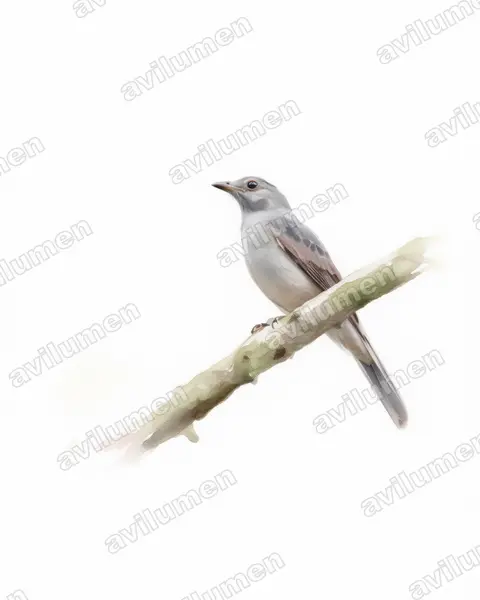
Watercolor 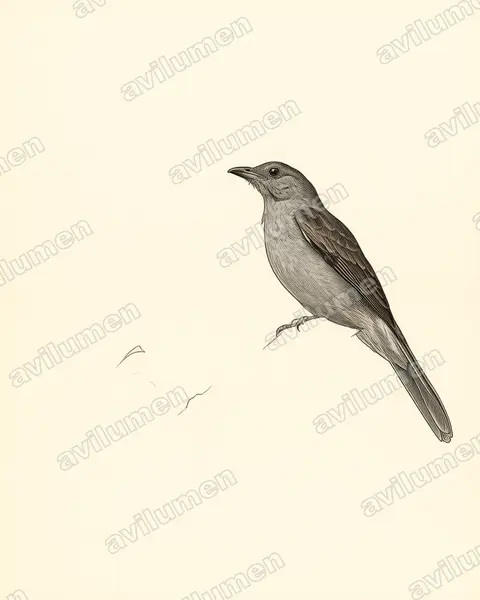
Vintage plate 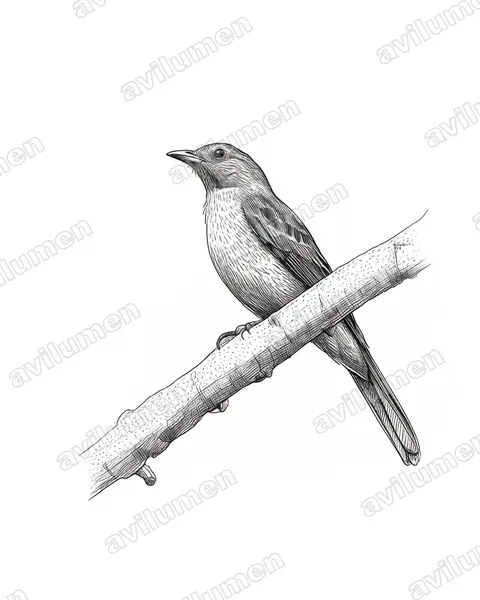
Ink 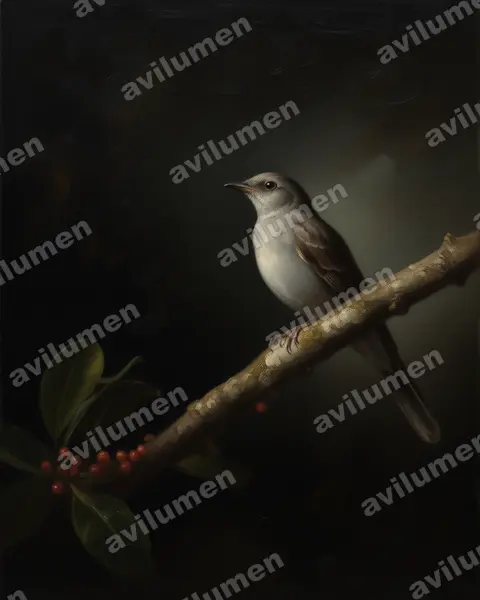
Oil 
Realistic 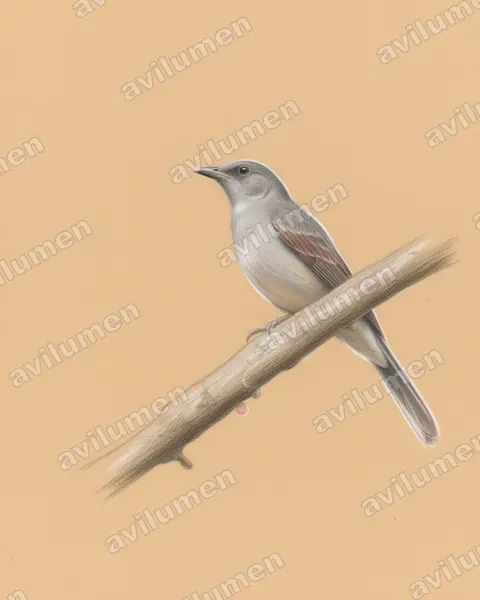
Colored pencil
Illustrations based on the photograph by Hector Bottai (CC BY-SA 4.0), from Wikimedia Commons.
Digital editions
HD Digital Art Pack — Screaming Piha
Digital download: 6 high-resolution illustrations of the Screaming Piha (Lipaugus vociferans), print-ready. This is a digital file; no animal or physical item is included.
AI Avatar — Screaming Piha
Generate an avatar fusing your face with the Screaming Piha (Lipaugus vociferans). Delivered digitally in 8K, watermark-free. Digital product; no animals are sold or brokered.
Instant download. No live birds are sold.
Frequently asked questions
- Is Lipaugus vociferans (Screaming Piha) endangered?
- The IUCN Red List places Lipaugus vociferans, commonly known as the Screaming Piha, in the «Least concern» category. «Least concern» means it is not currently threatened.
- Where does Lipaugus vociferans (Screaming Piha) live?
- Lipaugus vociferans (Screaming Piha) is found in Brazil and South America.
- What family does Lipaugus vociferans (Screaming Piha) belong to?
- Lipaugus vociferans (Screaming Piha) belongs to the family Cotingidae, in the order Passeriformes.
- What colour is Lipaugus vociferans (Screaming Piha)?
- The plumage of Lipaugus vociferans (Screaming Piha) combines these colours: Brown.
More from the same family
 Least concern
Scaled Fruiteater
Ampelioides tschudii
The scaled fruiteater is a species of bird in the family Cotingidae. It is the only member of the genus Ampelioides. This bird is found in Bolivia, Colombia, Ecuador, Peru, and Venezuela, where its natural habitat is the high elevation tropical forests of the Andes mountains. The scaled fruiteater is a chunky, short-tailed, flat-headed bird measuring 19–20 cm (7.5–7.9 in) in length.
from $1.99
 Least concern
Red-crested Cotinga
Ampelion rubrocristatus
The red-crested cotinga is a species of bird in the family Cotingidae. It is found in Bolivia, Colombia, Ecuador, Peru, and Venezuela.
from $1.99
 Least concern
Chestnut-crested Cotinga
Ampelion rufaxilla
The chestnut-crested cotinga is a species of bird in the family Cotingidae. It is found in Bolivia, Colombia, Ecuador, and Peru.
from $1.99
 Critically endangered
Kinglet Calyptura
Calyptura cristata
The kinglet calyptura is a small Critically Endangered passerine bird in the family Tyrannidae, the tyrant flycatchers. It is endemic to southeastern Brazil.
from $1.99