Black-faced munia
Lonchura molucca
Avilumen editorial team ·

The black-faced munia is a species of estrildid finch found in Indonesia and East Timor. It occurs in a wide range of habitats including artificial landscapes, forest, grassland and savannah. It was first described by the Swedish naturalist Carl Linnaeus in the twelfth edition of his Systema Naturae in 1766. The IUCN has evaluated the status of this bird as being of least concern.
The black-faced munia (Lonchura molucca) is a species of estrildid finch found in Indonesia and East Timor. It occurs in a wide range of habitats including artificial landscapes (e.g. parks and gardens), forest, grassland and savannah. It was first described by the Swedish naturalist Carl Linnaeus in the twelfth edition of his Systema Naturae in 1766. The IUCN has evaluated the status of this bird as being of least concern.
Taxonomy
In 1760 the French zoologist Mathurin Jacques Brisson included a description of the black-faced munia in his Ornithologie based on a specimen collected from the Maluku Islands. He used the French name Le gros-bec de Moluques and the Latin Coccothraustes Moluccensis. Although Brisson coined Latin names, these do not conform to the binomial system and are not recognised by the International Commission on Zoological Nomenclature. When in 1766 the Swedish naturalist Carl Linnaeus updated his Systema Naturae for the twelfth edition, he added 240 species that had been previously described by Brisson. One of these was the black-faced munia. Linnaeus included a brief description, coined the binomial name Loxia molucca and cited Brisson's work. The specific name molucca denotes the Moluccas islands. This species is now placed in the genus Lonchura that was introduced by the English naturalist William Henry Sykes in 1832.
There are two subspecies:
L. m. molucca (Linnaeus, 1766) – Sulawesi and nearby islands, most of the Moluccas, Gag and Kofiau Islands
L. m. propinqua (Sharpe, 1890) – Kangean Islands, Lesser Sundas east to the Tanimbar Islands
Description
The black-faced munia has a black face, throat, and upper breast. The nape and back are dark brown, and the wings and tail are black. The underparts and rump are white with fine black speckling or barring. The bill is thick and bicoloured, with a dark upper mandible and blue-gray lower mandible, and the legs are dark.
Distribution
The black-faced munia is native to Indonesia including the island group of Wallacea. It is also present in East Timor. It is a seed-eating bird and is found in small flocks in grassy areas.
Status
The black-faced munia has a wide range and is said to be abundant in some places and common in many others. The population in Indonesia has not been evaluated but the population trend seems to be steady. The bird is facing few identified threats and the International Union for Conservation of Nature has assessed its conservation status as being of "least concern".
Text adapted from Wikipedia · CC BY-SA 4.0
Taxonomy
- Order
- Passeriformes
- Family
- Estrildidae
- Genus
- Lonchura
- Conservation status
- Least concern
Listen to its call
No recording yet
Care guide
Canary and Finch Care Guide: Diet, Housing and Breeding
How to care for canaries, zebra finches, Gouldian finches and other finches: diet, flight cage setup, health, song and breeding. A guide for bird keepers.
Read the guide →Illustration gallery
6 illustrations of Lonchura molucca (Black-faced munia) in different styles, true to its real plumage. Shown watermarked; the art pack includes the high-resolution originals, ready to print.
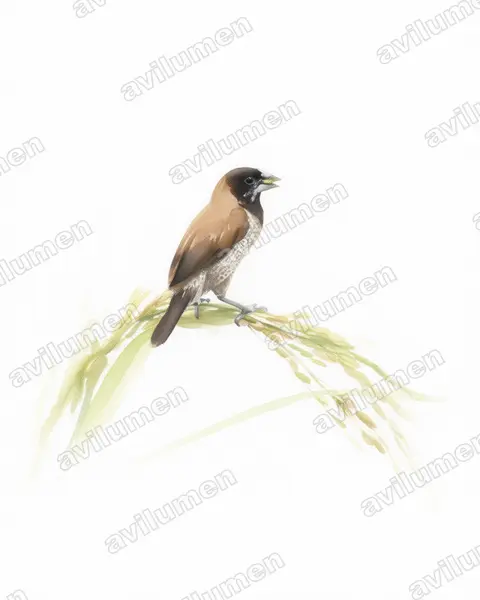
Watercolor 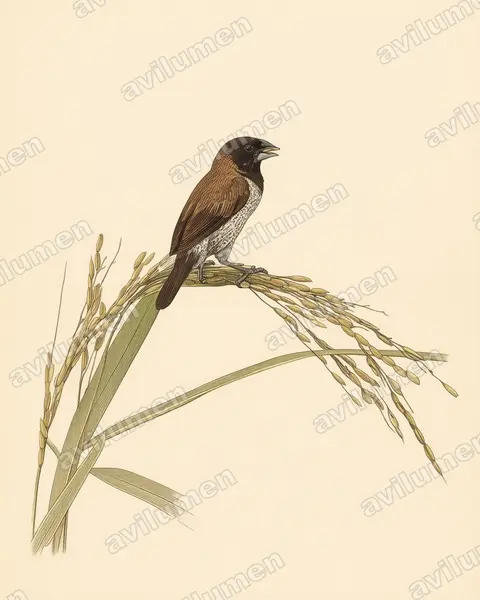
Vintage plate 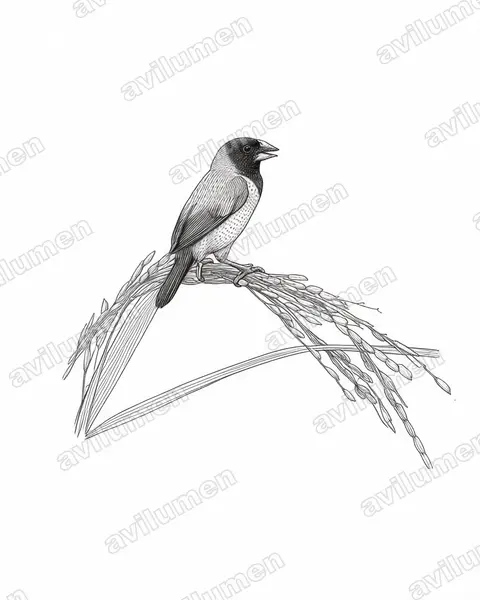
Ink 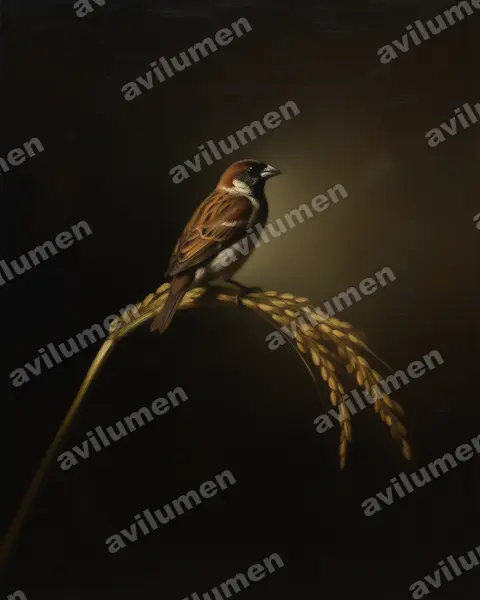
Oil 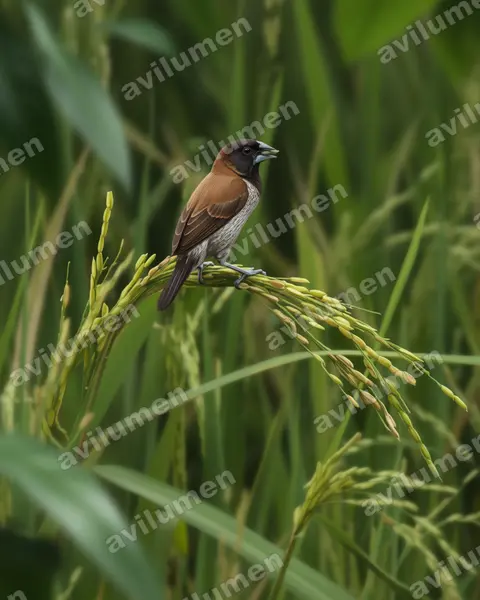
Realistic 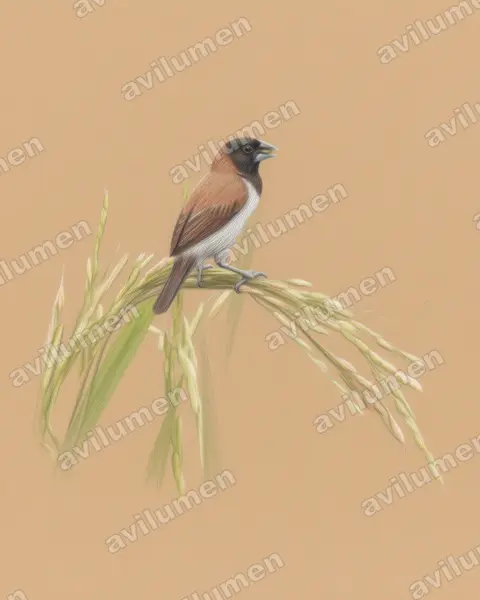
Colored pencil
Illustrations based on the photograph by Francesco Veronesi from Italy (CC BY-SA 2.0), from Wikimedia Commons.
Digital editions
HD Digital Art Pack — Black-faced munia
Digital download: 6 high-resolution illustrations of the Black-faced munia (Lonchura molucca), print-ready. This is a digital file; no animal or physical item is included.
AI Avatar — Black-faced munia
Generate an avatar fusing your face with the Black-faced munia (Lonchura molucca). Delivered digitally in 8K, watermark-free. Digital product; no animals are sold or brokered.
Instant download. No live birds are sold.
Frequently asked questions
- Is Lonchura molucca (Black-faced munia) endangered?
- The IUCN Red List places Lonchura molucca, commonly known as the Black-faced munia, in the «Least concern» category. «Least concern» means it is not currently threatened.
- Where does Lonchura molucca (Black-faced munia) live?
- Lonchura molucca (Black-faced munia) is found in Indonesia.
- What family does Lonchura molucca (Black-faced munia) belong to?
- Lonchura molucca (Black-faced munia) belongs to the family Estrildidae, in the order Passeriformes.
- What colour is Lonchura molucca (Black-faced munia)?
- The plumage of Lonchura molucca (Black-faced munia) combines these colours: Black.
More from the same family
 Least concern
Red-headed finch
Amadina erythrocephala
The red-headed finch is a common species of estrildid finch found in Africa. It has an estimated global extent of occurrence of 1,600,000 km2 (620,000 sq mi). It is found in Angola, Botswana, Lesotho, Namibia, South Africa and Zimbabwe.
from $1.99
 Least concern
Cut-throat finch
Amadina fasciata
The cut-throat finch is a common species of estrildid finch found throughout Africa; it is also known as the bearded finch, the ribbon finch, the cut throat, and the weaver finch.
from $1.99
 Least concern
Red avadavat
Amandava amandava
The red avadavat, red munia or strawberry finch, is a sparrow-sized bird of the family Estrildidae. It is found in the open fields and grasslands of tropical Asia and is popular as a cage bird due to the colourful plumage of the males in their breeding season. It breeds in the Indian subcontinent in the monsoon season.
from $1.99
 Vulnerable
Green avadavat
Amandava formosa
The green avadavat or green munia is a species of Estrildid finch with green and yellow on the body, a bright red bill and black "zebra stripes" on the flanks. They are endemic to the Indian subcontinent and were formerly popular as cagebirds. The name "avadavat" is a corruption of the name the city of Ahmedabad in Gujarat, India, which was a centre of bird trade.
from $1.99