Sangihe Hanging Parrot
Loriculus catamene
Avilumen editorial team ·

The Sangihe hanging parrot is a small parrot endemic to the small island of Sangihe, north of Sulawesi, Indonesia.
The Sangihe hanging parrot (Loriculus catamene) is a small (length: 12–13.5 cm) parrot endemic to the small island of Sangihe, north of Sulawesi, Indonesia.
This is an arboreal parrot. It is predominantly green, with a red throat patch, rump, elongated uppertail-coverts and tip of tail.
In 2009 this parrot was downlisted from Endangered to Near Threatened because although it has a very small range within which there has been extensive forest loss and fragmentation, it apparently remains common in degraded and cultivated habitats and there is no evidence of a continuing decline. The current population is estimated at between 10,000 and 46,000 individuals.
Text adapted from Wikipedia · CC BY-SA 4.0
Taxonomy
- Order
- Psittaciformes
- Family
- Psittaculidae
- Genus
- Loriculus
- Conservation status
- Near threatened
Listen to its call
No recording yet
Illustration gallery
6 illustrations of Loriculus catamene (Sangihe Hanging Parrot) in different styles, true to its real plumage. Shown watermarked; the art pack includes the high-resolution originals, ready to print.
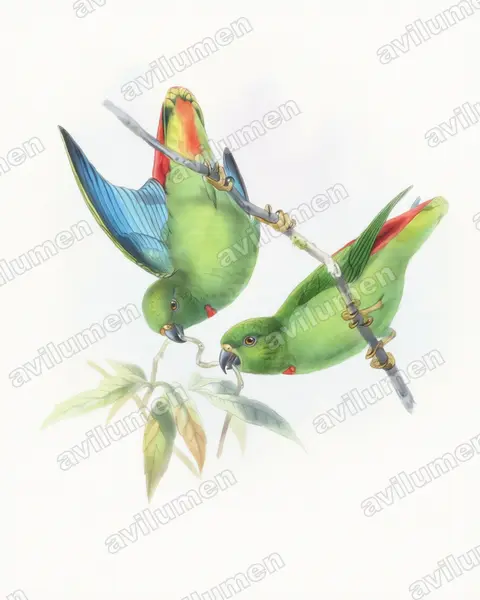
Watercolor 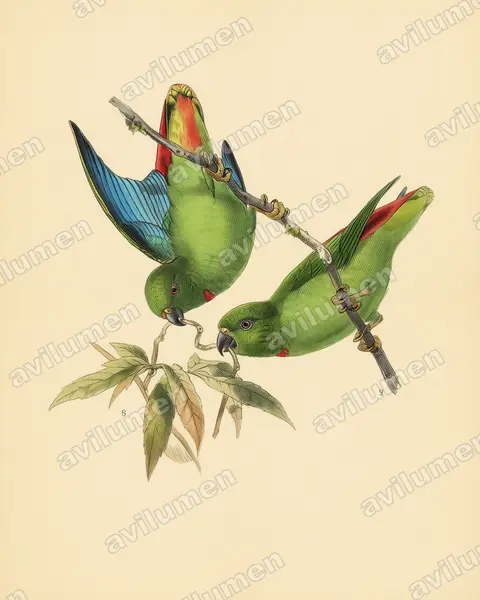
Vintage plate 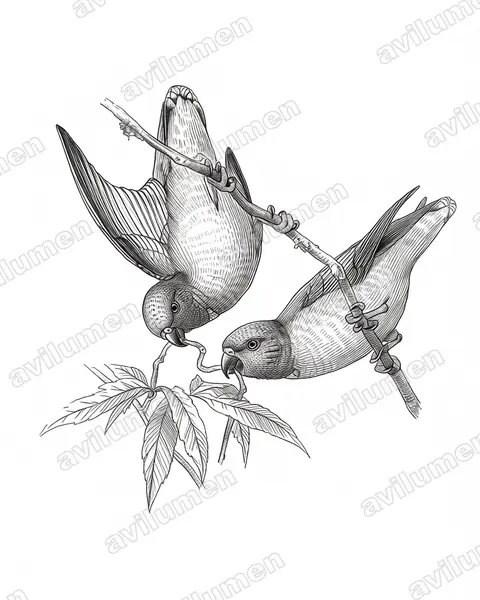
Ink 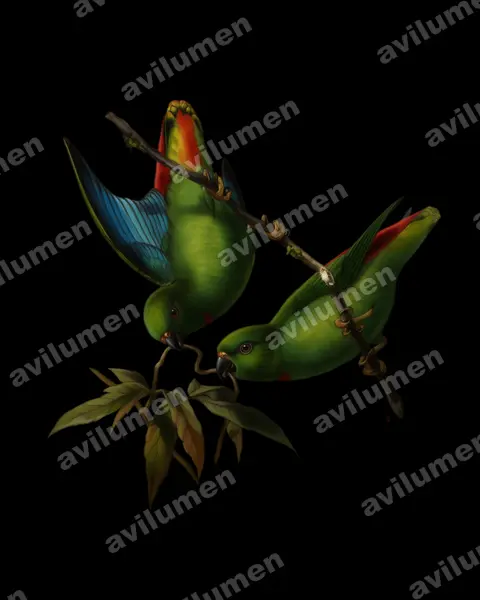
Oil 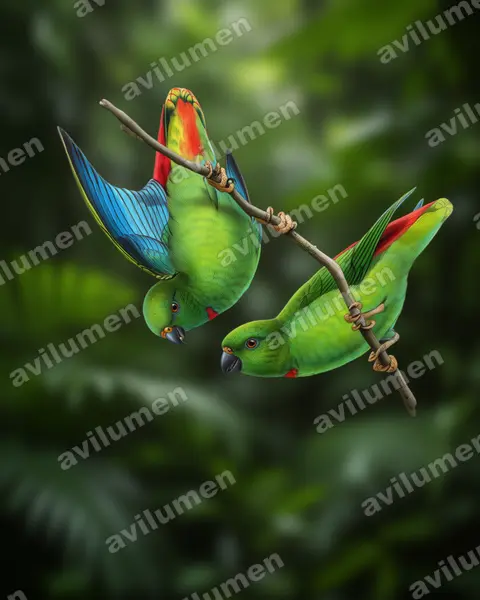
Realistic 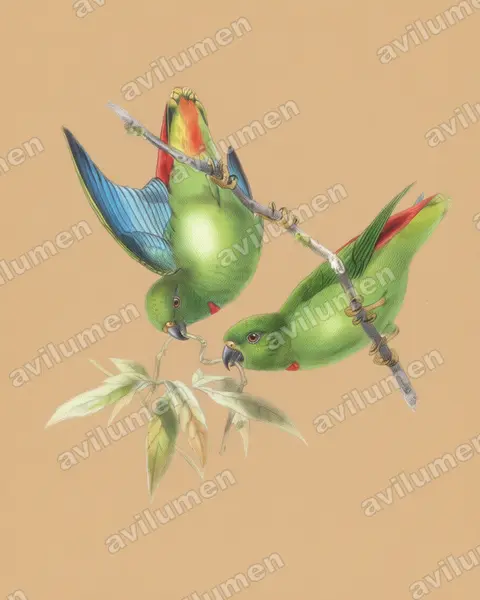
Colored pencil
Illustrations based on the photograph by John Gerrard Keulemans (Public domain), from Wikimedia Commons.
Digital editions
HD Digital Art Pack — Sangihe Hanging Parrot
Digital download: 6 high-resolution illustrations of the Sangihe Hanging Parrot (Loriculus catamene), print-ready. This is a digital file; no animal or physical item is included.
AI Avatar — Sangihe Hanging Parrot
Generate an avatar fusing your face with the Sangihe Hanging Parrot (Loriculus catamene). Delivered digitally in 8K, watermark-free. Digital product; no animals are sold or brokered.
Instant download. No live birds are sold.
Frequently asked questions
- Is Loriculus catamene (Sangihe Hanging Parrot) endangered?
- The IUCN Red List places Loriculus catamene, commonly known as the Sangihe Hanging Parrot, in the «Near threatened» category. «Near threatened» means it is not threatened yet, but is close to becoming so.
- Where does Loriculus catamene (Sangihe Hanging Parrot) live?
- Loriculus catamene (Sangihe Hanging Parrot) is found in Indonesia.
- What family does Loriculus catamene (Sangihe Hanging Parrot) belong to?
- Loriculus catamene (Sangihe Hanging Parrot) belongs to the family Psittaculidae, in the order Psittaciformes.
- What colour is Loriculus catamene (Sangihe Hanging Parrot)?
- The plumage of Loriculus catamene (Sangihe Hanging Parrot) combines these colours: Green and Red.
More from the same family
 Least concern
Grey-headed Lovebird
Agapornis canus
The gray-headed lovebird or Madagascar lovebird is a small species of parrot of the lovebird genus. It is a mainly green parrot. The species is sexually dimorphic and only the adult male has grey on its upper body. They are native on the island of Madagascar and are the only lovebird species which are not native on the African continent. They are the smallest of the lovebird species.
from $1.99
 Near threatened
Fischer's Lovebird
Agapornis fischeri
Fischer's lovebird is a small parrot species of the genus Agapornis. They were originally discovered in the late 19th century. They are named after the 19th century German explorer of East Africa Gustav Fischer.
from $1.99
 Near threatened
Lilian's Lovebird
Agapornis lilianae
Lilian's lovebird, also known as the Nyasa lovebird, is a small African parrot species of the lovebird genus. It is mainly green and has orange on its upper chest and head. It is 13 cm (5 inches) long and is the smallest parrot on mainland Africa. In captivity, it is uncommon and difficult to breed.
from $1.99
 Extinct
Agapornis longipes
Agapornis longipes
Agapornis longipes is an extinct species of lovebird that lived in what is now Gauteng, South Africa during the Early Pleistocene epoch, about 2.5–1.38 million years ago. The fossilized remains of this bird were first discovered in the Kromdraai fossil site and reported in 1969 by T.N. Pocock, though the species would not be named until decades later in 2024.
from $4.99