Northern Carmine Bee-eater
Merops nubicus
Avilumen editorial team ·

The northern carmine bee-eater is a brightly-coloured bird in the bee-eater family, Meropidae. It is found across northern tropical Africa, from Senegal eastwards to Somalia, Ethiopia and Kenya. It was formerly considered to be conspecific with the southern carmine bee-eater which has a carmine coloured throat rather than the blue throat of the northern species.
The northern carmine bee-eater (Merops nubicus) is a brightly-coloured bird in the bee-eater family, Meropidae. It is found across northern tropical Africa, from Senegal eastwards to Somalia, Ethiopia and Kenya. It was formerly considered to be conspecific with the southern carmine bee-eater which has a carmine coloured throat rather than the blue throat of the northern species.
Taxonomy
The northern carmine bee-eater was formally described in 1788 by the German naturalist Johann Friedrich Gmelin in his revised and expanded edition of Carl Linnaeus's Systema Naturae. He placed it with the other bee-eaters in the genus Merops and coined the binomial name Merops nubicus. Gmelin based his description on "Le guépier rouge à tête bleu" or "Guépier de Nubie" that had been described and illustrated in 1779 by French polymath Comte de Buffon in his multi-volume book Histoire Naturelle des Oiseaux. Buffon had been provided with a picture drawn by the Scottish traveller and writer James Bruce who had visited Nubia in 1770–1771. It is monotypic: no subspecies are recognised. The northern carmine bee-eater was formerly treated as conspecific with the southern carmine bee-eater (Merops nubicoides).
Description
This species, like other bee-eaters, is a richly colored, slender bird, predominantly carmine in color, except for a greenish blue head and throat and distinctive black mask. This species has red eyes, a black, pointed, decurved beak, and elongated central tail feathers.
The sexes are similar in appearance, and the juveniles can be distinguished from adults by their lack of elongated central tail feathers and the pinkish brown coloration of their mantle, chest to belly, and flanks.
The call is a deep, throaty tunk in flight; a series of rik notes when perched.
Distribution
It is native to Benin, Burkina Faso, Cameroon, the Central African Republic, Chad, the Democratic Republic of the Congo, Côte d'Ivoire, Eritrea, Ethiopia, Gambia, Ghana, Guinea, Guinea-Bissau, Kenya, Liberia, Mali, Mauritania, Niger, Nigeria, Senegal, Sierra Leone, Somalia, Sudan, Tanzania, Togo and Uganda. It occurs as a vagrant in Burundi.
Sue McLaren and colleagues have suggested that the distribution of the northern carmine bee-eater is tightly linked to the presence of secondary loess deposits throughout Africa.
Breeding
They nest in large colonies in cliffs, usually near river banks, where they use their bills to dig long horizontal nesting tunnels, often eight feet or more in length. Some colonies may consist of just a few nests while others accommodate hundreds of breeding birds. The same site may be used for several years and then the colony may all move to another location. Occupied nests accumulate a black litter of insect remains and smell strongly of ammonia. Three to five eggs are laid per clutch.
Feeding
Their diet is made up primarily of bees and other flying insects, such as flying ants, grasshoppers and locusts. The main hunting strategy of bee-eaters is to keep watch for flying insects from a perch, and then snatch them out of the air using their beaks, before returning to the perch.
Relationship with humans
The Northern carmine bee-eater once was on the banknote of 25 Dalasi in Gambia.
Text adapted from Wikipedia · CC BY-SA 4.0
Where it lives
Taxonomy
- Order
- Coraciiformes
- Family
- Meropidae
- Genus
- Merops
- Conservation status
- Least concern
Listen to its call
No recording yet
Illustration gallery
6 illustrations of Merops nubicus (Northern Carmine Bee-eater) in different styles, true to its real plumage. Shown watermarked; the art pack includes the high-resolution originals, ready to print.
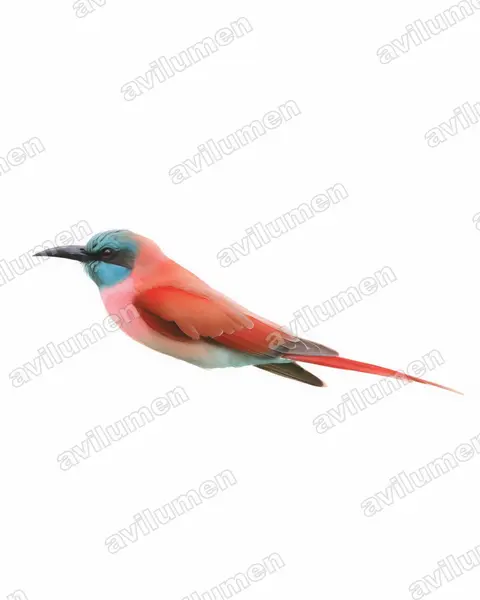
Watercolor 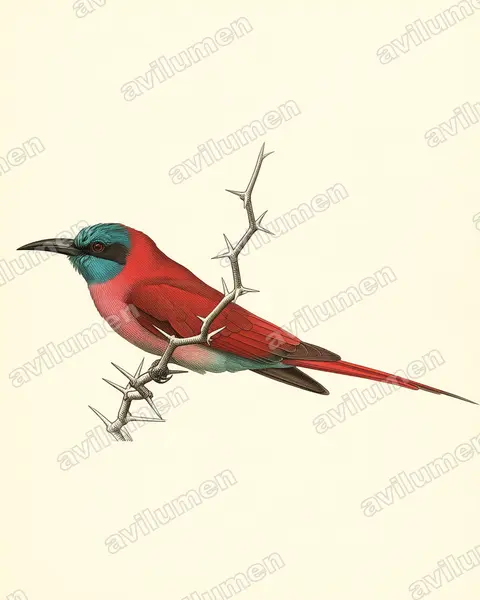
Vintage plate 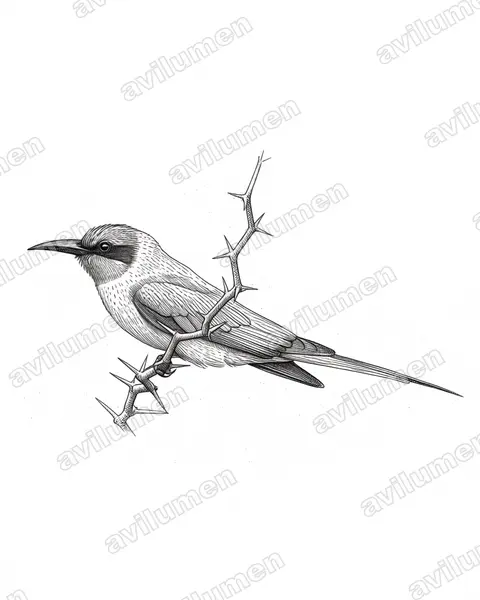
Ink 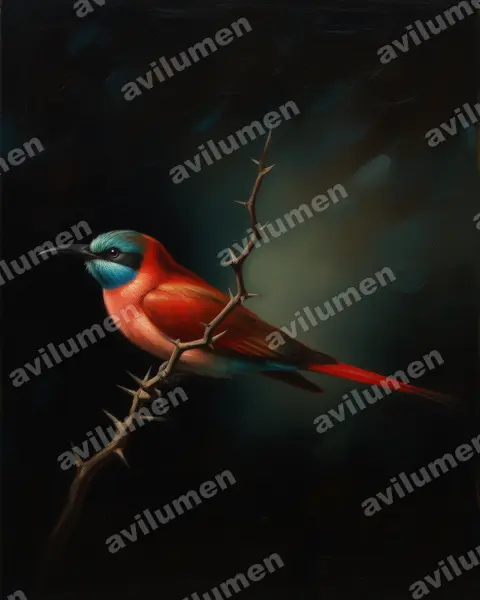
Oil 
Realistic 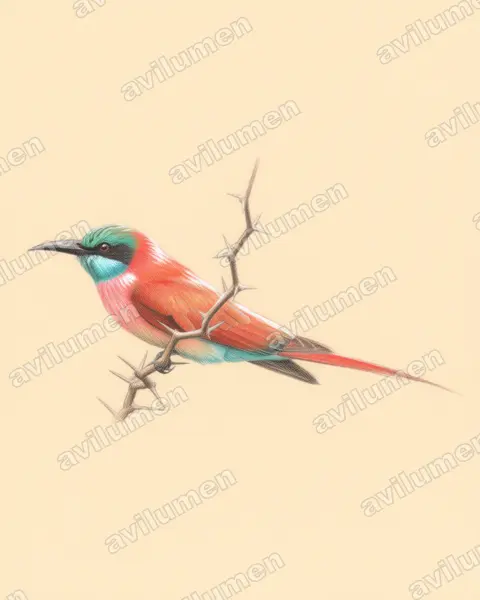
Colored pencil
Illustrations based on the photograph by Steve Garvie from Dunfermline, Fife, Scotland (CC BY-SA 2.0), from Wikimedia Commons.
Digital editions
HD Digital Art Pack — Northern Carmine Bee-eater
Digital download: 6 high-resolution illustrations of the Northern Carmine Bee-eater (Merops nubicus), print-ready. This is a digital file; no animal or physical item is included.
AI Avatar — Northern Carmine Bee-eater
Generate an avatar fusing your face with the Northern Carmine Bee-eater (Merops nubicus). Delivered digitally in 8K, watermark-free. Digital product; no animals are sold or brokered.
Instant download. No live birds are sold.
Frequently asked questions
- Is Merops nubicus (Northern Carmine Bee-eater) endangered?
- The IUCN Red List places Merops nubicus, commonly known as the Northern Carmine Bee-eater, in the «Least concern» category. «Least concern» means it is not currently threatened.
- Where does Merops nubicus (Northern Carmine Bee-eater) live?
- Merops nubicus (Northern Carmine Bee-eater) is found in Africa and Burkina Faso.
- What family does Merops nubicus (Northern Carmine Bee-eater) belong to?
- Merops nubicus (Northern Carmine Bee-eater) belongs to the family Meropidae, in the order Coraciiformes.
- What colour is Merops nubicus (Northern Carmine Bee-eater)?
- The plumage of Merops nubicus (Northern Carmine Bee-eater) combines these colours: Red and Blue.
More from the same family
 Least concern
Purple-bearded Bee-eater
Meropogon forsteni
The purple-bearded bee-eater or Celebes bee-eater is a species of bee-eater endemic to the island of Sulawesi, Indonesia. This species is often seen in clearings inside dense forest.
from $1.99
 Least concern
White-throated Bee-eater
Merops albicollis
The white-throated bee-eater is a species of bee-eater that breeds in semi-desert along the southern edge of the Sahara. The white-throated bee-eater is migratory, wintering in a completely different habitat in the equatorial rain forests of Africa from southern Senegal to Uganda.
from $1.99
 Least concern
European Bee-eater
Merops apiaster
The European bee-eater is a bird species in the bee-eater family, Meropidae. It has the largest range of any the bee-eater species. It breeds in southern and central Europe, northern and southern Africa, and western Asia. Except for the resident southern African population, the species is strongly migratory, wintering in tropical Africa.
from $1.99
 Least concern
Böhm's Bee-eater
Merops boehmi
Böhm's bee-eater is a species of bird in the family Meropidae. It is found in Democratic Republic of the Congo, Malawi, Mozambique, Tanzania, and Zambia.
from $1.99