Olive Bee-eater
Merops superciliosus
Avilumen editorial team ·

The olive bee-eater or Madagascar bee-eater is a bee-eater species in the genus Merops. It is native to the southern half of Africa where it is present in Angola; Botswana; Burundi; Comoros; Democratic Republic of the Congo; Djibouti; Eritrea; Ethiopia; Kenya; Madagascar; Malawi; Mayotte; Mozambique; Namibia; Rwanda; Somalia; South Sudan; Sudan; Tanzania; Uganda; Zambia; Zimbabwe.
The olive bee-eater or Madagascar bee-eater (Merops superciliosus) is a bee-eater species in the genus Merops. It is native to the southern half of Africa where it is present in Angola; Botswana; Burundi; Comoros; Democratic Republic of the Congo; Djibouti; Eritrea; Ethiopia; Kenya; Madagascar; Malawi; Mayotte; Mozambique; Namibia; Rwanda; Somalia; South Sudan; Sudan; Tanzania; Uganda; Zambia; Zimbabwe. It is a common species with a wide range so the International Union for Conservation of Nature has rated their conservation status as "least concern".
Taxonomy
In 1760 the French zoologist Mathurin Jacques Brisson included a description of the olive bee-eater in his Ornithologie based on a specimen collected on the island of Madagascar. He used the French name Le guespier de Madagascar and the Latin Apiaster Madagascariensis. Although Brisson coined Latin names, these do not conform to the binomial system and are not recognised by the International Commission on Zoological Nomenclature. When in 1766 the Swedish naturalist Carl Linnaeus updated his Systema Naturae for the twelfth edition, he added 240 species that had been previously described by Brisson. One of these was the olive bee-eater. Linnaeus included a brief description, coined the current binomial name Merops superciliosus and cited Brisson's work. The specific name superciliosus is Latin for "supercilious", "haughty" or "eye-browed".
Two subspecies are recognised:
M. s. superciliosus Linnaeus, 1766 – east Africa, Madagascar and the Comoro Islands
M. s. alternans Clancey, 1971 – west Angola and northwest Namibia
Description
The olive bee-eater grows to a length of 23 to 26 cm (9.1 to 10.2 in) with its tail streamers adding up to 7 cm (2.8 in). The sexes are similar, and adults have bronzy-green plumage with an olive cap and white forehead, eyebrows, chin and cheeks. The rump and tail are blue, apart from the streamers, which are black.
Distribution
The olive bee-eater is found in the grassland and coastal mountain forests of East Africa and Madagascar, and an isolated population can be found in coastal Angola. There are two subspecies; M. s. superciliosus occurs in eastern Ethiopia, Somalia and Kenya, and southwards through East Africa to southern Mozambique and the Zambezi Valley, as well as the Comoro Islands and Madagascar; M. s. alternans occurs in western Angola and northwestern Namibia.
Ecology
They are partially migratory, and usually breed only in the southern portion of their range, moving north for the dry season in southern Africa. It lays four eggs in a burrow nest at the beginning of the southern African wet season, and the chicks usually hatch at the beginning of December. Unlike most bee-eaters, the species does not practice cooperative breeding and post-fledging dependence is only around 19 days, which is typical of temperate zone passerines and about half that of most Meropidae species.
Text adapted from Wikipedia · CC BY-SA 4.0
Taxonomy
- Order
- Coraciiformes
- Family
- Meropidae
- Genus
- Merops
- Conservation status
- Least concern
Listen to its call
No recording yet
Illustration gallery
6 illustrations of Merops superciliosus (Olive Bee-eater) in different styles, true to its real plumage. Shown watermarked; the art pack includes the high-resolution originals, ready to print.
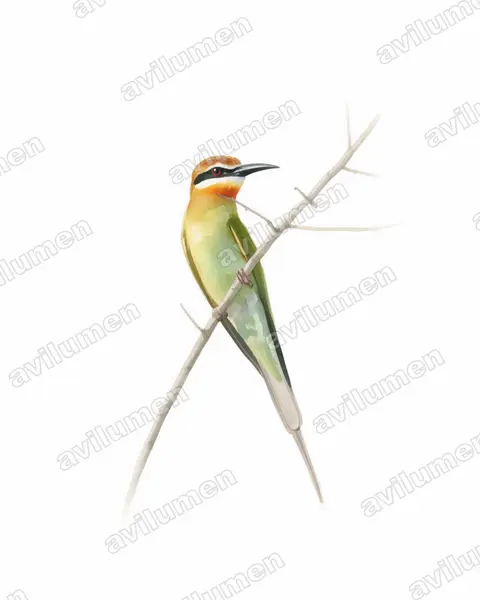
Watercolor 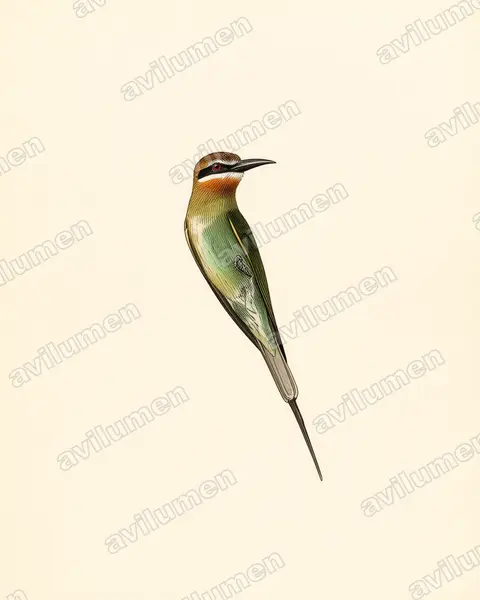
Vintage plate 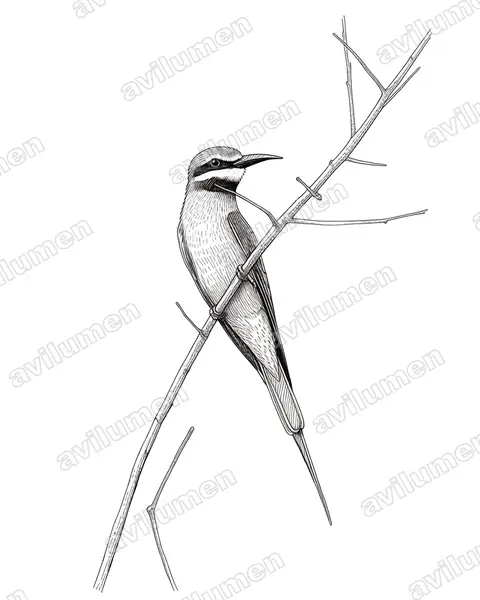
Ink 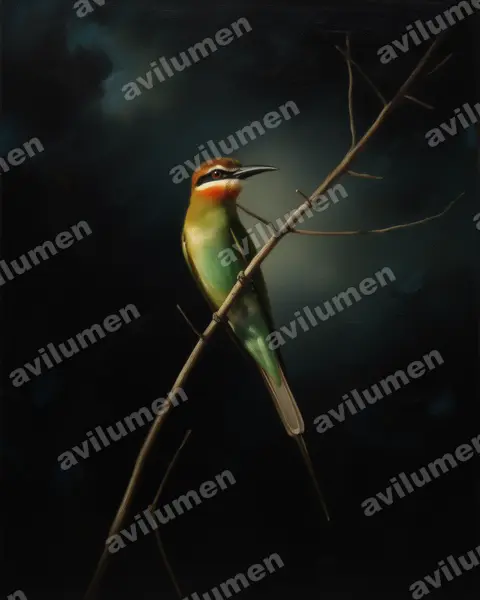
Oil 
Realistic 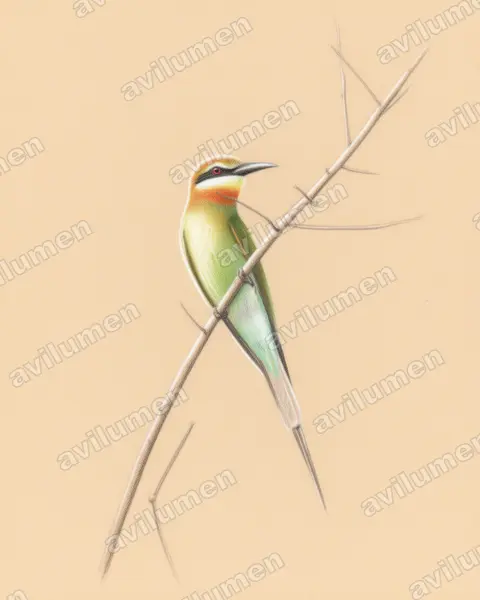
Colored pencil
Illustrations based on the photograph by Diego Delso (CC BY-SA 4.0), from Wikimedia Commons.
Digital editions
HD Digital Art Pack — Olive Bee-eater
Digital download: 6 high-resolution illustrations of the Olive Bee-eater (Merops superciliosus), print-ready. This is a digital file; no animal or physical item is included.
AI Avatar — Olive Bee-eater
Generate an avatar fusing your face with the Olive Bee-eater (Merops superciliosus). Delivered digitally in 8K, watermark-free. Digital product; no animals are sold or brokered.
Instant download. No live birds are sold.
Frequently asked questions
- Is Merops superciliosus (Olive Bee-eater) endangered?
- The IUCN Red List places Merops superciliosus, commonly known as the Olive Bee-eater, in the «Least concern» category. «Least concern» means it is not currently threatened.
- Where does Merops superciliosus (Olive Bee-eater) live?
- Merops superciliosus (Olive Bee-eater) is found in Africa.
- What family does Merops superciliosus (Olive Bee-eater) belong to?
- Merops superciliosus (Olive Bee-eater) belongs to the family Meropidae, in the order Coraciiformes.
- What colour is Merops superciliosus (Olive Bee-eater)?
- The plumage of Merops superciliosus (Olive Bee-eater) combines these colours: Green and Brown.
More from the same family
 Least concern
Purple-bearded Bee-eater
Meropogon forsteni
The purple-bearded bee-eater or Celebes bee-eater is a species of bee-eater endemic to the island of Sulawesi, Indonesia. This species is often seen in clearings inside dense forest.
from $1.99
 Least concern
White-throated Bee-eater
Merops albicollis
The white-throated bee-eater is a species of bee-eater that breeds in semi-desert along the southern edge of the Sahara. The white-throated bee-eater is migratory, wintering in a completely different habitat in the equatorial rain forests of Africa from southern Senegal to Uganda.
from $1.99
 Least concern
European Bee-eater
Merops apiaster
The European bee-eater is a bird species in the bee-eater family, Meropidae. It has the largest range of any the bee-eater species. It breeds in southern and central Europe, northern and southern Africa, and western Asia. Except for the resident southern African population, the species is strongly migratory, wintering in tropical Africa.
from $1.99
 Least concern
Böhm's Bee-eater
Merops boehmi
Böhm's bee-eater is a species of bird in the family Meropidae. It is found in Democratic Republic of the Congo, Malawi, Mozambique, Tanzania, and Zambia.
from $1.99