Finsch's Pygmy Parrot
Micropsitta finschii
Avilumen editorial team ·

Finsch's pygmy parrot, also known as the emerald pygmy parrot and green pygmy parrot, is a member of parrot family Psittaculidae inhabiting tropical rainforest regions of islands in Papua New Guinea, the Solomon Islands, and the Bismarck Archipelago.
Finsch's pygmy parrot (Micropsitta finschii), also known as the emerald pygmy parrot and green pygmy parrot, is a member of parrot family Psittaculidae inhabiting tropical rainforest regions of islands in Papua New Guinea, the Solomon Islands, and the Bismarck Archipelago.
The common name and scientific name commemorate the German ethnographer, naturalist, and colonial explorer Friedrich Hermann Otto Finsch .
Description
Finsch's pygmy parrot is characterized by a green head and neck (which is unique among species of the genus Micropsitta). The typical length of a green pygmy parrot is 9.5 cm (3.7 in) with an average weight of 12 g (0.42 oz). Male and female individuals can be identified by slight differences in coloration. For example, in one subspecies, males possess a blue patch around the lower section of the beak, whereas the female's patch is pink. The five recognized subspecies each inhabit a different range within the overall distribution of the species and each has different characteristics between sexes.
Taxonomy
Finsch's pygmy parrot is a member of the genus Micropsitta (pygmy parrots). Genus Micropsitta is included in the subfamily Psittacinae (true parrots and allies) of the family Psittacidae (true parrots). The species, Micropsitta finschii, is further divided into five subspecies
M. f. aolae is found in Guadalcanal, Malaita, Florida (island, not state), and Russell (central Solomon Islands). Adults have a darker green upper body and have a blue patch on the crown.
M. f. finschii is found in Ugi, San Cristobal, and Rennell (southern Solomon Islands). Males have blue around the lower mandible (beak) and an orange patch in the center of the abdomen. Females lack the orange patch, and have pink feathers around the lower mandible.
M. f. nanina is found in Santa Isabel, Bugotu, and Choiseul (northern Solomon Islands), as well as in Bougainville Island. Adults have a blue patch on the crown.
M. f. tristrami is found in Vella Lavella, Gizo, Kolombangara, New Georgia, Rubiana, and Rendova (in the western Solomon Islands). Adults have no blue patches or orange abdominal patches.
M. f. viridifrons is found in Lihir and Tabar, New Hanover, New Ireland, and in the Bismarck Archipelago (in eastern Papua New Guinea). Adults have a large blue patch on the crown, as well as blue around the sides of the face.
Habitat
The parrots are found in tropical rainforests (up to an elevation of 900 m (3,000 ft)). The birds are most often observed in the forest interior and in river edge vegetation. They are arboreal and have been observed nesting in old arboreal ant/termite mounds. The birds construct a tunnel into the mound, which is used also as a roost. The birds are described as being abundant in their habitats.
Diet
The birds find food by climbing tree bark vertically or by climbing along the bottom of branches while hanging upside-down. While foraging and feeding, the tail feathers are used as a prop against the tree surface. The parrot feeds on fungi and lichens found on the tree bark, as well as the seeds of the casuarina tree in which it is commonly found. Some birds apparently associate with slow-moving mixed bird flocks.
Vocalizations
The song of Finsch's pygmy parrot is a series of repeated whistles. Each whistle consists of a "tweet-tweet" sound, where the second "tweet" is prolonged and is higher in pitch. Other sounds produced include shrill squawking and chattering.
Reproduction
Finsch's pygmy parrots are often found in pairs or small groups (three to six individuals). The groups often include socially monogamous (for up to a year) mating pairs. The breeding season is from March to May, and a typical clutch has one or two eggs. Both parents provide care for the altricial offspring, and parent-offspring interactions are often prolonged. Information on specific incubation times and chick-rearing times is unavailable, as captive individuals have a low survival rate.
Text adapted from Wikipedia · CC BY-SA 4.0
Plumage colours
Distribution

Taxonomy
- Order
- Psittaciformes
- Family
- Psittacidae
- Genus
- Micropsitta
- Conservation status
- Least concern
Listen to its call
No recording yet
Illustration gallery
6 illustrations of Micropsitta finschii (Finsch's Pygmy Parrot) in different styles, true to its real plumage. Shown watermarked; the art pack includes the high-resolution originals, ready to print.
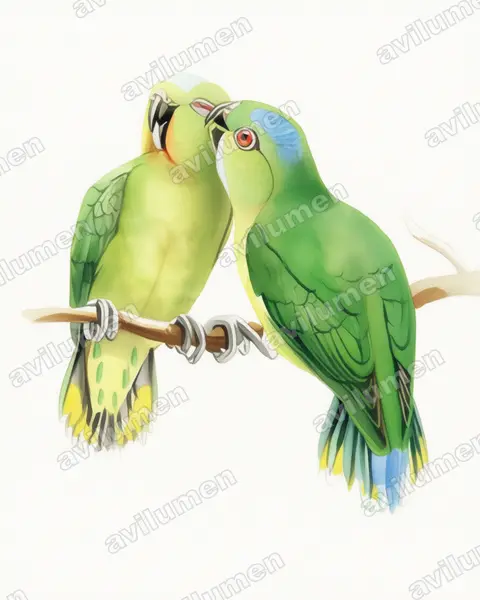
Watercolor 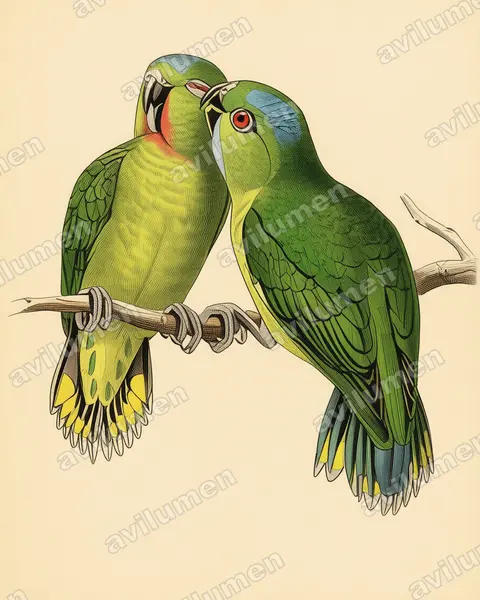
Vintage plate 
Ink 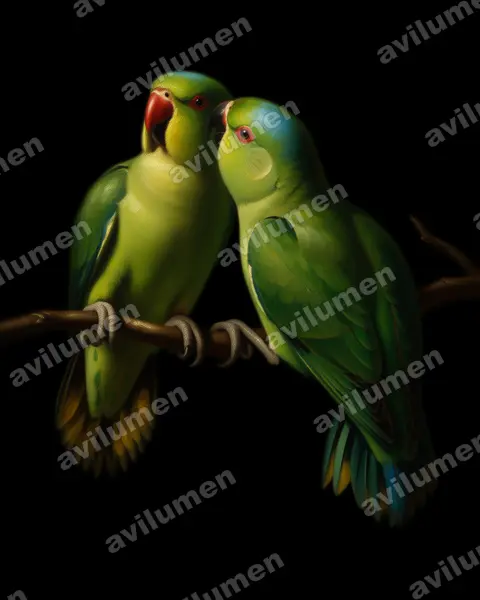
Oil 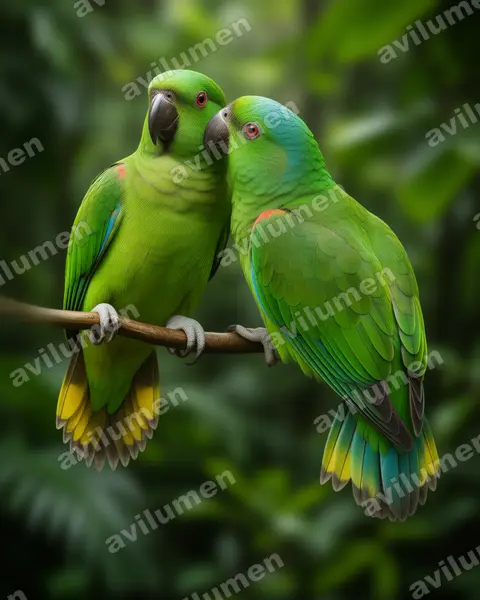
Realistic 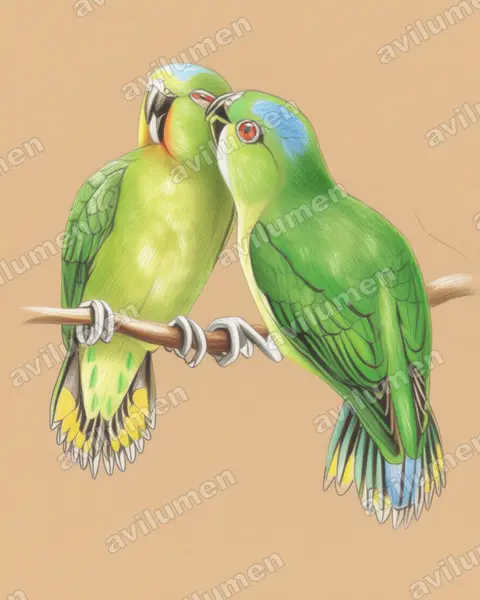
Colored pencil
Illustrations based on the photograph by William Matthew Hart (1830-1908) was an Irish-born English bird illustrator and lithographer who worked for John Gould. (Public domain), from Wikimedia Commons.
Digital editions
HD Digital Art Pack — Finsch's Pygmy Parrot
Digital download: 6 high-resolution illustrations of the Finsch's Pygmy Parrot (Micropsitta finschii), print-ready. This is a digital file; no animal or physical item is included.
AI Avatar — Finsch's Pygmy Parrot
Generate an avatar fusing your face with the Finsch's Pygmy Parrot (Micropsitta finschii). Delivered digitally in 8K, watermark-free. Digital product; no animals are sold or brokered.
Instant download. No live birds are sold.
Frequently asked questions
- Is Micropsitta finschii (Finsch's Pygmy Parrot) endangered?
- The IUCN Red List places Micropsitta finschii, commonly known as the Finsch's Pygmy Parrot, in the «Least concern» category. «Least concern» means it is not currently threatened.
- What family does Micropsitta finschii (Finsch's Pygmy Parrot) belong to?
- Micropsitta finschii (Finsch's Pygmy Parrot) belongs to the family Psittacidae, in the order Psittaciformes.
- What colour is Micropsitta finschii (Finsch's Pygmy Parrot)?
- The plumage of Micropsitta finschii (Finsch's Pygmy Parrot) combines these colours: Green.
More from the same family
 Near threatened
Yellow-faced Parrot
Alipiopsitta xanthops
The yellow-faced parrot, formerly also known as the yellow-faced amazon, is the only species of the genus Alipiopsitta. It is a Neotropical parrot, and was classified in the genus Amazona for many years. It is a predominantly green and yellow-plumaged bird with a yellow head. It is a semi-nomadic species found in the cerrado region of Brazil and adjacent Bolivia.
from $1.99
 Least concern
Moluccan King Parrot
Alisterus amboinensis
The Moluccan king parrot is a parrot endemic to Peleng Island, Maluku, and West Papua in Indonesia. It is sometimes referred to as the Ambon king parrot or Amboina king parrot, but this is potentially misleading, as it is found on numerous other islands than Ambon. The male and female are similar in appearance, with a predominantly red head and underparts, green wings, and blue back and tail.
from $1.99
 Least concern
Papuan King Parrot
Alisterus chloropterus
The Papuan king parrot, also known as the green-winged king parrot, is a species of parrot in the family Psittaculidae found in New Guinea. Its natural habitats are subtropical or tropical moist lowland forest and subtropical or tropical moist montane forest.
from $1.99
 Least concern
Australian King Parrot
Alisterus scapularis
The Australian king parrot is a species of parrot endemic to eastern Australia ranging from Cooktown in Queensland to Port Campbell in Victoria. Found in humid and heavily forested upland regions of the eastern portion of the continent, including eucalyptus wooded areas in and directly adjacent to subtropical and temperate rainforest. They feed on fruits and seeds gathered from trees or on the ground.
from $1.99