Rufous-booted Racket-tail
Ocreatus addae
Avilumen editorial team ·

The rufous-booted racket-tail is a species of hummingbird in the "brilliants", tribe Heliantheini in subfamily Lesbiinae. It is found in Bolivia and Peru.
The rufous-booted racket-tail (Ocreatus addae) is a species of hummingbird in the "brilliants", tribe Heliantheini in subfamily Lesbiinae. It is found in Bolivia and Peru.
Taxonomy and systematics
The rufous-booted racket-tail, as defined by the International Ornithological Committee (IOC) and the Clements taxonomy, is one of three species in genus Ocreatus. However, BirdLife International's Handbook of the Birds of the World (HBW) treats the taxon as one of eight subspecies of booted racket-tail (O. underwoodii). The IOC and Clements call underwoodii "white-booted racket-tail" and assign five subspecies to it. HBW splits the Peruvian population from O. underwoodii addae as O. underwoodii annae, leaving the former as a Bolivian endemic subspecies. The South American Classification Committee of the American Ornithological Society (SACC) follows the eight-subspecies model of booted racket-tail but has requested a proposal to elevate O. addae, O. annae, and another subspecies to species status.
The specific epithet addae honors Mrs. Adda Wilson.
Description
All racket-tails have pronounced sexual dimorphism. Only the male has elongated outer rectrices (tail feathers) that have bare shafts with terminal flags. On both the annae and addae racket-tails, those feathers are decurved and cross; the flags are asymmetric ellipses. Male rufous-booted racket-tails are 11 to 15 cm (4.3 to 5.9 in) long including the 5.5 to 6 cm (2.2 to 2.4 in) long outer tail feathers, and weigh 2.5 to 2.7 g (0.088 to 0.095 oz). Females are 7.6 to 9 cm (3.0 to 3.5 in) long and weigh 2.6 to 3.2 g (0.092 to 0.11 oz). Both sexes of annae and addae have greenish upperparts without a glittering forehead, both have a white spot behind the eye, and both have buff leg puffs. Males of annae have a greenish gray throat and a solid green belly. Their tail flags are dark bronzy purple. Females have a white throat and breast heavily spotted with green. Males of addae have a mostly white throat with some green and a white belly with green spots. Their tail flags are greenish black. Like annae, females have a white throat and breast heavily spotted with green.
Distribution and habitat
The annae rufous-booted racket-tail is found on the east slope of the Andes of central and southern Peru. The addae rufous-booted racket-tail is found on the east slope of the Bolivian Andes. The species favors the edges of humid to wet forest but is also found in the forest interior and in more open secondary forest. It is most numerous at elevations between 1,600 and 2,200 m (5,200 and 7,200 ft) but is found as low as 600 m (2,000 ft) and as high as 4,000 m (13,000 ft).
Movement
The rufous-booted racket-tail makes seasonal elevational movements after breeding.
Feeding
The rufous-booted racket-tail typically forages between 6 and 18 m (20 and 60 ft) above the ground. It takes nectar from a variety of plants such as those of genera Palicourea, Clusia, Inga, and Cavendishia. Often several birds will feed close together. In addition to feeding on nectar it captures small insects by hawking from a perch.
Breeding
The rufous-booted racket-tail's breeding season has not been studied but might include most of the year. It makes a tiny cup nest of plant fiber and lichen, typically on a horizontal twig 6 to 8 m (20 to 30 ft) above the ground. The female incubates the clutch of two eggs for 16 to 17 days; fledging occurs 19 to 22 days after hatch.
Vocalization
Both male and female rufous-booted racket-tails give "a diagnostic, descending, thin sweet trill, 'ti-tlee-ee-ee' [and] single 'tsit' and 'trrt' notes."
Status
The IUCN follows HBW taxonomy and so recognizes only one species of Ocreatus as the booted racket-tail. It has assessed the species as being of Least Concern. It has a large range, and though its population size is not known it is believed to be stable. No immediate threats are known. The racket-tail complex as a whole is very common and occurs in several protected areas.
Text adapted from Wikipedia · CC BY-SA 4.0
Distribution

Taxonomy
- Order
- Apodiformes
- Family
- Trochilidae
- Genus
- Ocreatus
- Conservation status
- Not evaluated
Listen to its call
No recording yet
Illustration gallery
6 illustrations of Ocreatus addae (Rufous-booted Racket-tail) in different styles, true to its real plumage. Shown watermarked; the art pack includes the high-resolution originals, ready to print.
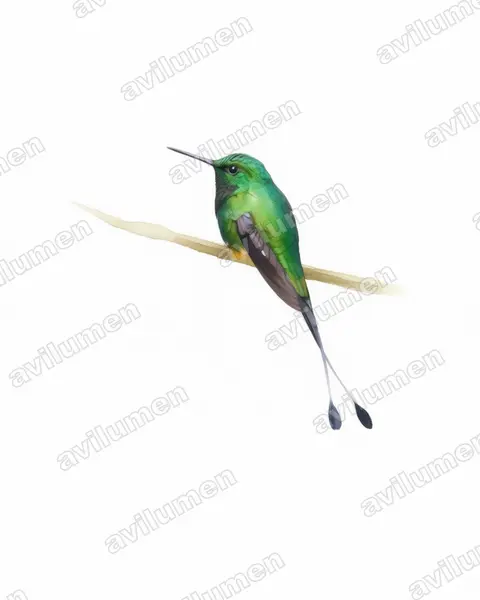
Watercolor 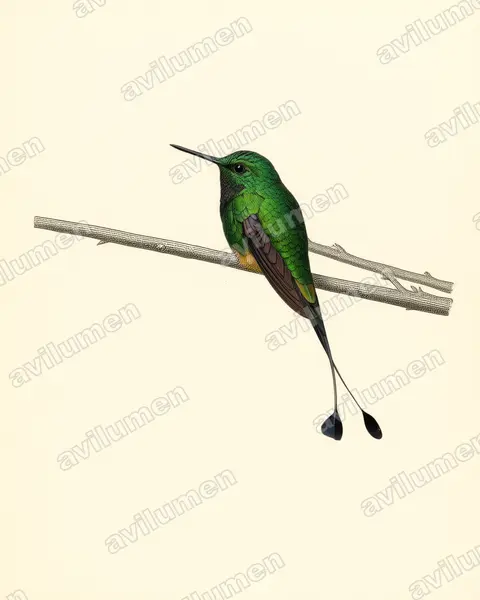
Vintage plate 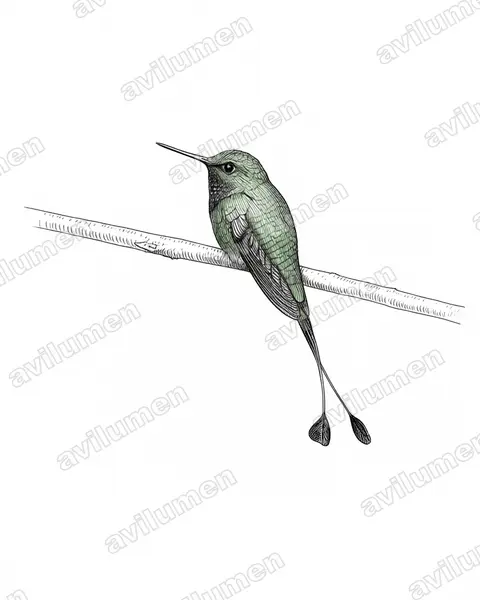
Ink 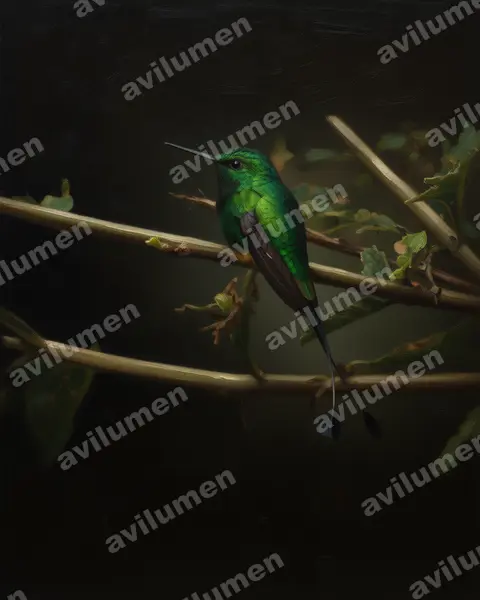
Oil 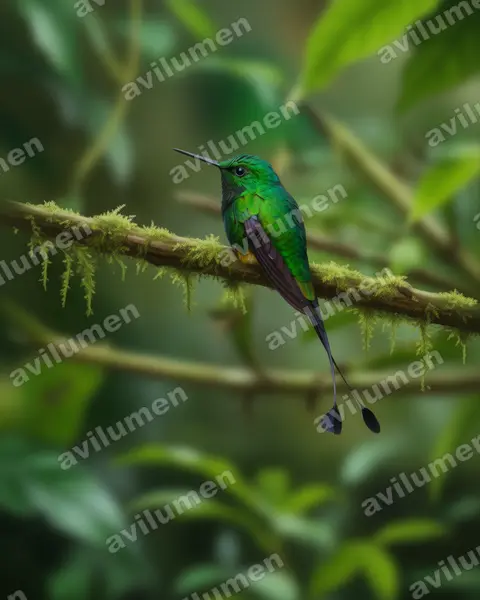
Realistic 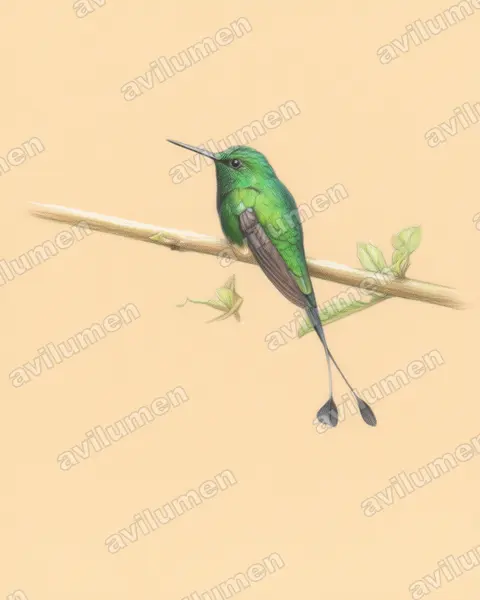
Colored pencil
Illustrations based on the photograph by Joao Quental (CC BY 2.0), from Wikimedia Commons.
Digital editions
HD Digital Art Pack — Rufous-booted Racket-tail
Digital download: 6 high-resolution illustrations of the Rufous-booted Racket-tail (Ocreatus addae), print-ready. This is a digital file; no animal or physical item is included.
AI Avatar — Rufous-booted Racket-tail
Generate an avatar fusing your face with the Rufous-booted Racket-tail (Ocreatus addae). Delivered digitally in 8K, watermark-free. Digital product; no animals are sold or brokered.
Instant download. No live birds are sold.
Frequently asked questions
- Is Ocreatus addae (Rufous-booted Racket-tail) endangered?
- The IUCN Red List places Ocreatus addae, commonly known as the Rufous-booted Racket-tail, in the «Not evaluated» category. «Not evaluated» means the IUCN has not yet assessed this species.
- What family does Ocreatus addae (Rufous-booted Racket-tail) belong to?
- Ocreatus addae (Rufous-booted Racket-tail) belongs to the family Trochilidae, in the order Apodiformes.
- What colour is Ocreatus addae (Rufous-booted Racket-tail)?
- The plumage of Ocreatus addae (Rufous-booted Racket-tail) combines these colours: Green and Red.
More from the same family
 Least concern
Emerald-chinned Hummingbird
Abeillia abeillei
The emerald-chinned hummingbird is a species of hummingbird in the "emeralds", tribe Trochilini of subfamily Trochilinae.
from $1.99
 Least concern
Speckled hummingbird
Adelomyia melanogenys
The speckled hummingbird is a species of hummingbird. It is the only member of the genus Adelomyia. It inhabits Neotropical montane cloud forests at elevations of 1,000–2,500 meters and is confined to the Andes of Argentina, Bolivia, Peru, Ecuador, Colombia and Venezuela; as well as to some isolated montane forests in western Ecuador and Venezuela.
from $1.99
 Vulnerable
Purple-backed sunbeam
Aglaeactis aliciae
The purple-backed sunbeam is a bird species in the family Trochilidae. It is found only in Peru.
from $1.99
 Near threatened
White-tufted sunbeam
Aglaeactis castelnaudii
The white-tufted sunbeam is a species of hummingbird in the family Trochilidae. It is found only in Peru. Its natural habitats are subtropical or tropical moist montane forest and subtropical or tropical high-altitude shrubland.
from $1.99