Rufous-vented Chachalaca
Ortalis ruficauda
Avilumen editorial team ·

The rufous-vented chachalaca is a member of an ancient group of birds of the family Cracidae, which are related to the Australasian mound builders. It inhabits northeast Colombia and northern Venezuela where it is called guacharaca, and the island of Tobago in Trinidad and Tobago where it is known as the cocrico and is one of the country's two national birds.
The rufous-vented chachalaca (Ortalis ruficauda) is a member of an ancient group of birds of the family Cracidae, which are related to the Australasian mound builders. It inhabits northeast Colombia and northern Venezuela where it is called guacharaca, and the island of Tobago in Trinidad and Tobago where it is known as the cocrico and is one of the country's two national birds (being featured on the country's coat of arms). It is also found on Bequia and Union Island in the Grenadines where it may have been introduced.
Habitat
The rufous-vented chachalaca is a largely arboreal species found in forest and woodland, but it is also found in more open dry scrubby areas. This combined with relatively low hunting pressure, make it far less vulnerable than larger members of the family, notably curassows.
Description
These are medium-sized birds, similar in general appearance to turkeys, with small heads, long strong legs and a long broad tail. They are typically 53–58 cm long; the female weighs 540g and the larger male 640g. They have fairly dull plumage, dark brown above and paler below. The head is grey, and the brown tail is tipped rufous or white depending on race.
Call
As other chachalacas, the rufous-vented chachalaca is a very noisy species, preferring to execute their vocal feats at dawn. The male's call is a loud low ka-ka-rooki-rooki-ka, answered by the female's high-pitched watch-a-lak, which they often repeat several times in a row, in precise synchronization.
Breeding and behaviour
The species is a social bird, often seen in family groups. It walks along branches seeking the fruit (such as mangoes, berries and those from the Euterpe palm), leaves and seeds on which it feeds. It is an able flyer that can even take off and fly vertically, but does not usually fly long distances. The twig nest is built low in a tree, and three or four large white eggs are laid. The female incubates them alone.
Subspecies
There are two subspecies:
O. r. ruficauda (Jardine, 1847) - northeast Colombia to northern Venezuela, also Tobago and Isla Margarita
O. r. ruficrissa (Sclater and Salvin, 1870) - northern Colombia and northwest Venezuela
Text adapted from Wikipedia · CC BY-SA 4.0
Where it lives
Distribution

Taxonomy
- Order
- Galliformes
- Family
- Cracidae
- Genus
- Ortalis
- Conservation status
- Least concern
Listen to its call
No recording yet
Illustration gallery
6 illustrations of Ortalis ruficauda (Rufous-vented Chachalaca) in different styles, true to its real plumage. Shown watermarked; the art pack includes the high-resolution originals, ready to print.
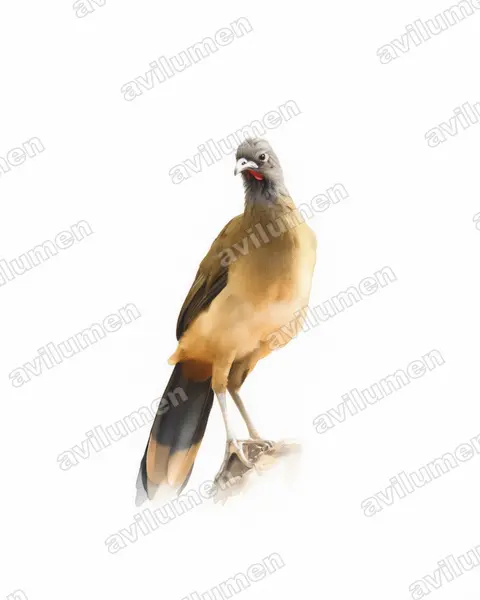
Watercolor 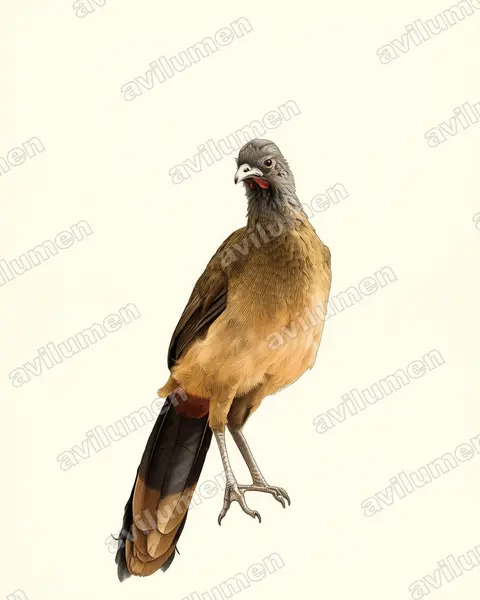
Vintage plate 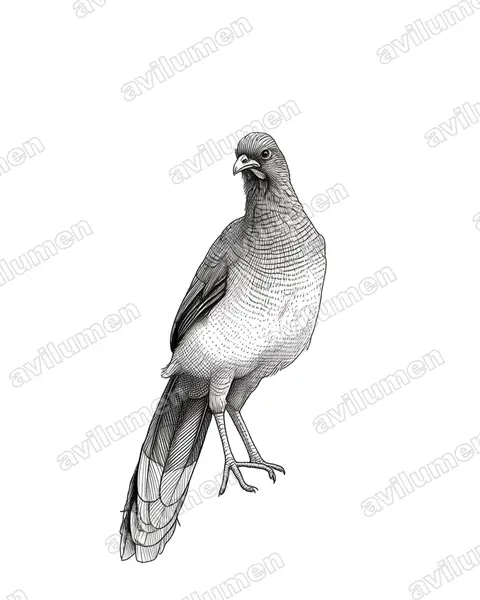
Ink 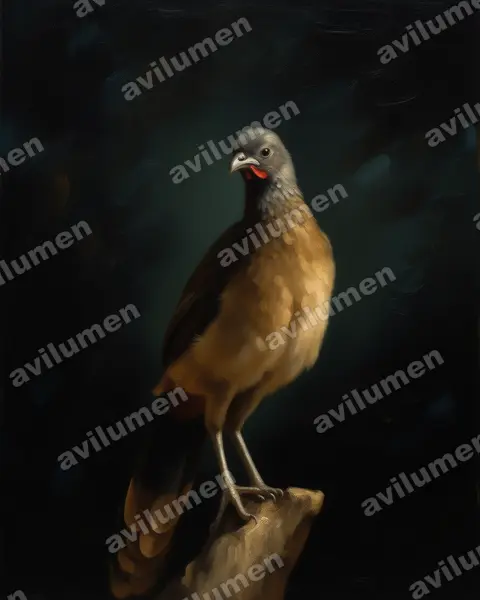
Oil 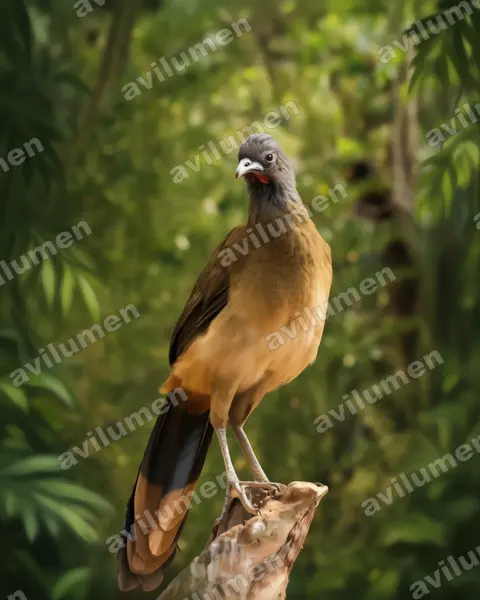
Realistic 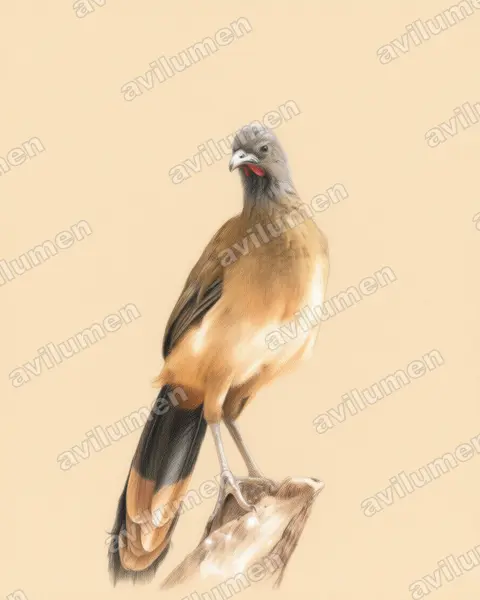
Colored pencil
Illustrations based on the photograph by Fernando Flores from Caracas, Venezuela (CC BY-SA 2.0), from Wikimedia Commons.
Digital editions
HD Digital Art Pack — Rufous-vented Chachalaca
Digital download: 6 high-resolution illustrations of the Rufous-vented Chachalaca (Ortalis ruficauda), print-ready. This is a digital file; no animal or physical item is included.
AI Avatar — Rufous-vented Chachalaca
Generate an avatar fusing your face with the Rufous-vented Chachalaca (Ortalis ruficauda). Delivered digitally in 8K, watermark-free. Digital product; no animals are sold or brokered.
Instant download. No live birds are sold.
Frequently asked questions
- Is Ortalis ruficauda (Rufous-vented Chachalaca) endangered?
- The IUCN Red List places Ortalis ruficauda, commonly known as the Rufous-vented Chachalaca, in the «Least concern» category. «Least concern» means it is not currently threatened.
- Where does Ortalis ruficauda (Rufous-vented Chachalaca) live?
- Ortalis ruficauda (Rufous-vented Chachalaca) is found in South America.
- What family does Ortalis ruficauda (Rufous-vented Chachalaca) belong to?
- Ortalis ruficauda (Rufous-vented Chachalaca) belongs to the family Cracidae, in the order Galliformes.
- What colour is Ortalis ruficauda (Rufous-vented Chachalaca)?
- The plumage of Ortalis ruficauda (Rufous-vented Chachalaca) combines these colours: Brown and Red.
More from the same family
 Least concern
Wattled Guan
Aburria aburri
The wattled guan is a species of bird in the family Cracidae. It is a fairly large black cracid with blue-based, black-tipped beak and a long, red-and-yellow wattle.
from $1.99
 Least concern
Sickle-winged Guan
Chamaepetes goudotii
The sickle-winged guan is a species of bird in the chachalaca, guan, and curassow family Cracidae. It is found in Bolivia, Colombia, Ecuador, and Peru.
from $1.99
 Least concern
Black Guan
Chamaepetes unicolor
The black guan is a species of bird in the chachalaca, guan, and curassow family Cracidae. It is found in Costa Rica and Panama.
from $1.99
 Critically endangered
Blue-billed Curassow
Crax alberti
The blue-billed curassow is a species of bird in the family Cracidae, the chachalacas, guans, and curassows. It is endemic to Colombia.
from $1.99