White-bearded helmetcrest
Oxypogon lindenii
Avilumen editorial team ·

The white-bearded helmetcrest is a species of hummingbird in the "coquettes", tribe Lesbiini of subfamily Lesbiinae. It is endemic to northwestern Venezuela.
The white-bearded helmetcrest (Oxypogon lindenii) is a species of hummingbird in the "coquettes", tribe Lesbiini of subfamily Lesbiinae. It is endemic to northwestern Venezuela.
Taxonomy and systematics
The white-bearded helmetcrest was formerly considered to be a subspecies of what was known as the bearded helmetcrest (Oxypogon guerinii). The white-bearded helmetcrest was promoted to species status when the bearded helmetcrest was split into four species based on a study of biometric and plumage data published in 2013. The nominate subspecies was renamed the green-bearded helmetcrest. The white-bearded helmetcrest is monotypic.
Description
The white-bearded helmetcrest is about 11.5 cm (4.5 in) long and weighs about 4.8 g (0.17 oz). It has a short straight bill. The adult male has a long black and white crest and a mostly black face with a wide white "collar". Its upperparts are bronzy green with a slight gray scaly appearance. It has a long thin white "beard". The rest of the underparts are dingy gray with green spots. The tail is moderately long and forked. The upper side of its central feathers are olive green and the rest dusky; the underside of the feathers are maroon with white shafts and some narrow white at the base. The adult female is similar to the male but lacks the crest and beard, and its underparts are dull white with dense greenish brown spots. Juveniles are not well studied but are believed to resemble the adult female.
Distribution and habitat
The white-bearded helmetcrest is found only in the Andes of northwestern Venezuela, in Mérida and Trujillo states. It inhabits humid páramo, especially that with Espeletia vegetation. It also sometimes occurs at the edge of Polylepis woodlands. Females often occur in gorges while males tend to remain in more open landscapes. In elevation the species ranges between 3,600 and 4,500 m (11,800 and 14,800 ft) though there is at least one record as low as 2,800 m (9,200 ft).
Movement
The white-bearded helmetcrest migrates from the high páramo in the wet season to lower elevations in the dry.
Feeding
The white-bearded helmetcrest feeds on nectar; it especially favors Espeletia schultzii and Castilleja fissifolia. It nectars by clinging to flowers rather than hovering. It also feeds on insects and their larvae. It catches insects on the ground or by jumping or hawking from the ground or a perch. It picks larvae from vegetation.
Breeding
The white-bearded helmetcrest's breeding season is tied to the flowering of Espeletia and is usually between June and November. It makes a large nest of Espeletia fibers in cavities or below overhangs where it is protected from sun and rain. The clutch size it two eggs; the female incubates for 21 to 23 days and fledging occurs 35 to 38 days after hatch.
Vocalization
The white-bearded helmetcrest's song is "a repeated, high-pitched, slightly buzzy, single note 'tzee' or 'peek'" that it sings repeatedly from a perch on a small shrub during the breeding season.
Status
The IUCN has assessed the white-bearded helmetcrest as being of Least Concern. It has a very small range and its population size is not known and believed to be decreasing. Thought it is considered very common and occurs in two national parks, overgrazing is a problem even in them.
Text adapted from Wikipedia · CC BY-SA 4.0
Where it lives
Distribution

Taxonomy
- Order
- Apodiformes
- Family
- Trochilidae
- Genus
- Oxypogon
- Conservation status
- Least concern
Listen to its call
No recording yet
Illustration gallery
6 illustrations of Oxypogon lindenii (White-bearded helmetcrest) in different styles, true to its real plumage. Shown watermarked; the art pack includes the high-resolution originals, ready to print.

Watercolor 
Vintage plate 
Ink 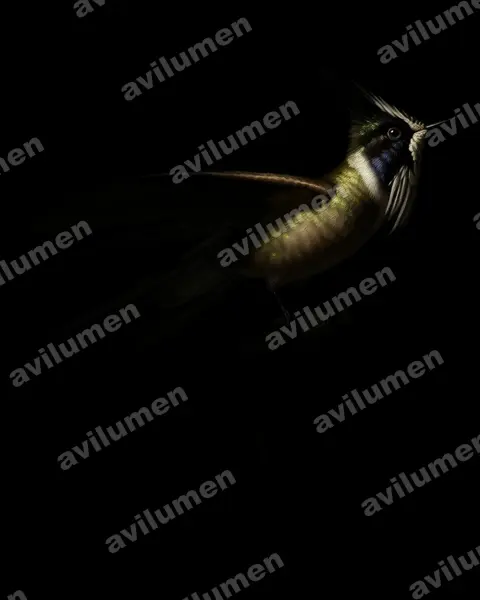
Oil 
Realistic 
Colored pencil
Illustrations based on the photograph by Charles Parzudaki (Public domain), from Wikimedia Commons.
Digital editions
HD Digital Art Pack — White-bearded helmetcrest
Digital download: 6 high-resolution illustrations of the White-bearded helmetcrest (Oxypogon lindenii), print-ready. This is a digital file; no animal or physical item is included.
AI Avatar — White-bearded helmetcrest
Generate an avatar fusing your face with the White-bearded helmetcrest (Oxypogon lindenii). Delivered digitally in 8K, watermark-free. Digital product; no animals are sold or brokered.
Instant download. No live birds are sold.
Frequently asked questions
- Is Oxypogon lindenii (White-bearded helmetcrest) endangered?
- The IUCN Red List places Oxypogon lindenii, commonly known as the White-bearded helmetcrest, in the «Least concern» category. «Least concern» means it is not currently threatened.
- Where does Oxypogon lindenii (White-bearded helmetcrest) live?
- Oxypogon lindenii (White-bearded helmetcrest) is found in South America.
- What family does Oxypogon lindenii (White-bearded helmetcrest) belong to?
- Oxypogon lindenii (White-bearded helmetcrest) belongs to the family Trochilidae, in the order Apodiformes.
- What colour is Oxypogon lindenii (White-bearded helmetcrest)?
- The plumage of Oxypogon lindenii (White-bearded helmetcrest) combines these colours: White and Green.
More from the same family
 Least concern
Emerald-chinned Hummingbird
Abeillia abeillei
The emerald-chinned hummingbird is a species of hummingbird in the "emeralds", tribe Trochilini of subfamily Trochilinae.
from $1.99
 Least concern
Speckled hummingbird
Adelomyia melanogenys
The speckled hummingbird is a species of hummingbird. It is the only member of the genus Adelomyia. It inhabits Neotropical montane cloud forests at elevations of 1,000–2,500 meters and is confined to the Andes of Argentina, Bolivia, Peru, Ecuador, Colombia and Venezuela; as well as to some isolated montane forests in western Ecuador and Venezuela.
from $1.99
 Vulnerable
Purple-backed sunbeam
Aglaeactis aliciae
The purple-backed sunbeam is a bird species in the family Trochilidae. It is found only in Peru.
from $1.99
 Near threatened
White-tufted sunbeam
Aglaeactis castelnaudii
The white-tufted sunbeam is a species of hummingbird in the family Trochilidae. It is found only in Peru. Its natural habitats are subtropical or tropical moist montane forest and subtropical or tropical high-altitude shrubland.
from $1.99