Rufous-tailed Plantcutter
Phytotoma rara
Avilumen editorial team ·

The rufous-tailed plantcutter, sometimes called the Chilean plantcutter, is a passerine bird of southern South America, now placed in the cotinga family. It is a medium-sized bird about 19 centimetres (7.5 in) long with a long black tail with a red base. Males have greyish-brown upper parts, a chestnut crown and breast, and dark facial markings.
The rufous-tailed plantcutter (Phytotoma rara), sometimes called the Chilean plantcutter, is a passerine bird of southern South America, now placed in the cotinga family. It is a medium-sized bird about 19 centimetres (7.5 in) long with a long black tail with a red base. Males have greyish-brown upper parts, a chestnut crown and breast, and dark facial markings. Females are similar but lack the chestnut crown and have streaked, buff underparts. There is a wing bar which is white in the male and buff in the female. This is a fairly common species with a wide range, and the International Union for Conservation of Nature has rated its conservation status as being of "least concern".
Description
It is a stocky bird, 18-20 centimetres in length, with short wings and a red eye. The longish tail is black with a reddish base. The upperparts of the male are grey-brown with dark streaks while the crown and underparts are chestnut-coloured. There is a white bar on the wing and a pattern of dark and pale areas on the face. Females have buff underparts with brown streaks and have buff rather than white in the wings. They do not have the males' chestnut crown but may show a cinnamon wash to the forehead and throat. The song is a series of stuttering notes followed by a rasping trill similar to the noise made by a fishing reel.
The finch-like bill is short and thick with serrated edges and is used for stripping off buds, leaves and fruits. Insects are eaten on occasions and are fed to the chicks.
Distribution and habitat
The rufous-tailed plantcutter is found further south than any other cotinga, inhabiting scrub, forest edge and river valleys in Chile and western Argentina. The range extends from Magallanes region north to Atacama in Chile and from Santa Cruz north to Mendoza in Argentina. Birds breeding in southern or high-altitude regions move northwards or towards the lowlands in winter. It has been recorded as a vagrant to the Falkland Islands. Birds are often seen in gardens, farmland and orchards and are sometimes considered to be a pest. The nest is a cup of root fibres and twigs built in a fork in a shrub or tree. Two to four eggs are laid, they are blue-green with dark spots concentrated at the larger end.
Status
This bird has a very wide range and though not particularly common, is presumed to have a large total population. The population trend is thought to be stable and the International Union for Conservation of Nature has rated the bird's conservation status as being of "least concern".
Text adapted from Wikipedia · CC BY-SA 4.0
Where it lives
Distribution

Taxonomy
- Order
- Passeriformes
- Family
- Cotingidae
- Genus
- Phytotoma
- Conservation status
- Least concern
Listen to its call
No recording yet
Illustration gallery
6 illustrations of Phytotoma rara (Rufous-tailed Plantcutter) in different styles, true to its real plumage. Shown watermarked; the art pack includes the high-resolution originals, ready to print.
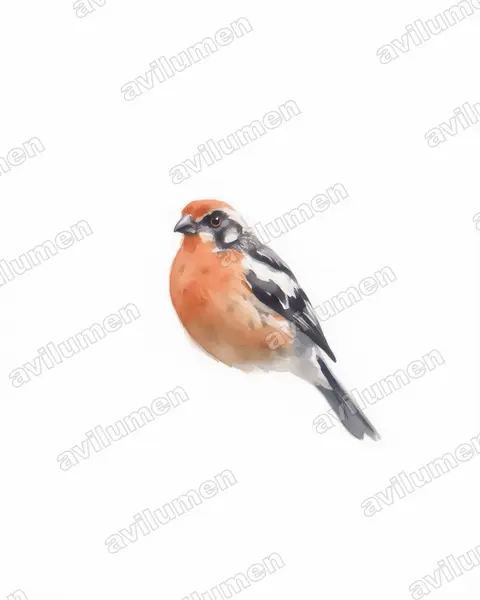
Watercolor 
Vintage plate 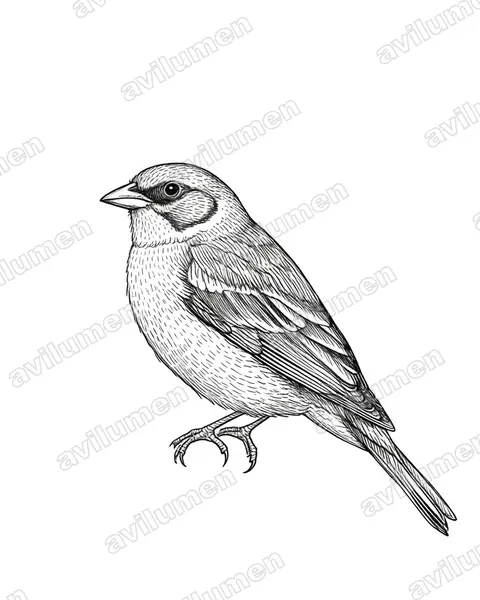
Ink 
Oil 
Realistic 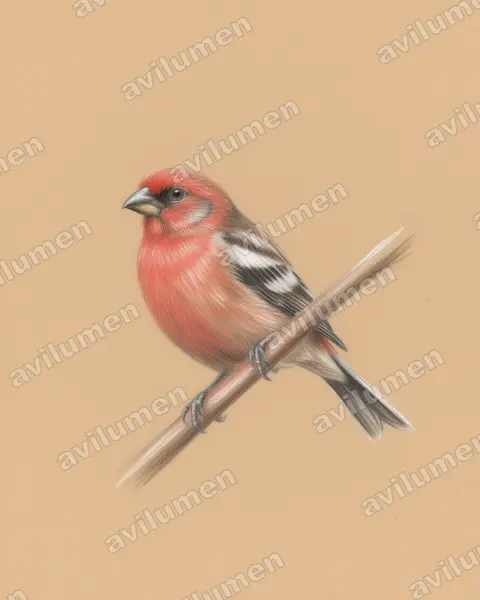
Colored pencil
Illustrations based on the photograph by dfaulder (CC BY 2.0), from Wikimedia Commons.
Digital editions
HD Digital Art Pack — Rufous-tailed Plantcutter
Digital download: 6 high-resolution illustrations of the Rufous-tailed Plantcutter (Phytotoma rara), print-ready. This is a digital file; no animal or physical item is included.
AI Avatar — Rufous-tailed Plantcutter
Generate an avatar fusing your face with the Rufous-tailed Plantcutter (Phytotoma rara). Delivered digitally in 8K, watermark-free. Digital product; no animals are sold or brokered.
Instant download. No live birds are sold.
Frequently asked questions
- Is Phytotoma rara (Rufous-tailed Plantcutter) endangered?
- The IUCN Red List places Phytotoma rara, commonly known as the Rufous-tailed Plantcutter, in the «Least concern» category. «Least concern» means it is not currently threatened.
- Where does Phytotoma rara (Rufous-tailed Plantcutter) live?
- Phytotoma rara (Rufous-tailed Plantcutter) is found in South America.
- What family does Phytotoma rara (Rufous-tailed Plantcutter) belong to?
- Phytotoma rara (Rufous-tailed Plantcutter) belongs to the family Cotingidae, in the order Passeriformes.
- What colour is Phytotoma rara (Rufous-tailed Plantcutter)?
- The plumage of Phytotoma rara (Rufous-tailed Plantcutter) combines these colours: Brown and Grey.
More from the same family
 Least concern
Scaled Fruiteater
Ampelioides tschudii
The scaled fruiteater is a species of bird in the family Cotingidae. It is the only member of the genus Ampelioides. This bird is found in Bolivia, Colombia, Ecuador, Peru, and Venezuela, where its natural habitat is the high elevation tropical forests of the Andes mountains. The scaled fruiteater is a chunky, short-tailed, flat-headed bird measuring 19–20 cm (7.5–7.9 in) in length.
from $1.99
 Least concern
Red-crested Cotinga
Ampelion rubrocristatus
The red-crested cotinga is a species of bird in the family Cotingidae. It is found in Bolivia, Colombia, Ecuador, Peru, and Venezuela.
from $1.99
 Least concern
Chestnut-crested Cotinga
Ampelion rufaxilla
The chestnut-crested cotinga is a species of bird in the family Cotingidae. It is found in Bolivia, Colombia, Ecuador, and Peru.
from $1.99
 Critically endangered
Kinglet Calyptura
Calyptura cristata
The kinglet calyptura is a small Critically Endangered passerine bird in the family Tyrannidae, the tyrant flycatchers. It is endemic to southeastern Brazil.
from $1.99