Scarlet-breasted Fruiteater
Pipreola frontalis
Avilumen editorial team ·

The scarlet-breasted fruiteater is a species of bird in the family Cotingidae. It is found in Bolivia, Ecuador, and Peru where its natural habitat is subtropical and tropical moist montane forests. Two subspecies are recognised though some researchers consider these should be regarded as distinct species. It is a plump green bird with a black head, the males having red throats and the females yellow.
The scarlet-breasted fruiteater (Pipreola frontalis) is a species of bird in the family Cotingidae.
It is found in Bolivia, Ecuador, and Peru where its natural habitat is subtropical and tropical moist montane forests. Two subspecies are recognised though some researchers consider these should be regarded as distinct species. It is a plump green bird with a black head, the males having red throats and the females yellow. It is a relatively common species with a wide range, and the International Union for Conservation of Nature has rated its conservation status as being "least concern".
Taxonomy and systematics
First described by British ornithologist Philip Sclater in 1858, the scarlet-breasted fruiteater is one of eleven species in the genus Pipreola. Its holotype is held at the Academy of Natural Sciences of Drexel University, in Philadelphia. The species is closely related to the fiery-throated fruiteater, but is found at higher elevations. There are two subspecies, which some taxonomists think represent two distinct species.
P. f. frontalis occurs from central Peru into western Bolivia.
P. f. squamipectus occurs from northern Ecuador into northwestern Peru. First described by Frank Chapman in 1925, it is smaller and less colorful than the nominate subspecies.
The genus name given to the fruiteaters, Pipreola, is a diminutive of Pipra, which is the genus name Carl Linnaeus gave to the similarly shaped manakins. The specific name frontalis is a Modern Latin word meaning "fronted" or "browed".
Description
Like all Pipreola fruiteaters, the scarlet-breasted fruiteater is a plump, short-tailed cotinga. It is relatively small for a fruiteater, measuring 15.5–16.5 cm (6.1–6.5 in) in length; its mass ranges from 39.5 to 45.3 g (1.39 to 1.60 oz), with an average of 42.4 g (1.50 oz). The species is sexually dimorphic; the male is considerably more colorful than the female. Both sexes have bright green upperparts, with narrow yellow tips to the tertial feathers. The male's throat and upper breast are bright red (less extensively colored in P. f. squamipectus than in P. f. frontalis), while the female's underparts are yellow with green scaling or spots. Its legs and feet are pink or orange.
Distribution and habitat
The scarlet-breasted fruiteater is restricted to the eastern slope of the Andes from northeastern Ecuador through eastern Peru to central Bolivia. It is found in montane forests at elevations ranging from 900–2,000 m (3,000–6,600 ft) above sea level.
Behavior
The scarlet-breasted fruiteater is arboreal and often occurs higher up, from mid-levels to sub-canopy, than many other members of its genus. Like other fruiteaters, it tends to be rather lethargic.
Feeding
As its name suggests, the scarlet-breasted fruiteater eats primarily fruit, which it picks while hover-gleaning or, less frequently, while perched.
Voice
The scarlet-breasted fruiteater's vocalizations are generally short, high-pitched and infrequent. The song of the P. f. squamipectus male is sharp and ascending, variously transcribed as "psii" or "tsweeet", while the song of the P. f. frontalis male is longer and more complex—a thin, rising trill that becomes a descending whistle, transcribed as "ti'ti'ti'ti'ti'ti'tseeeeeeeeer". Its call is a very high-pitched pseet.
Conservation and threats
The International Union for Conservation of Nature (IUCN) categorizes the Scarlet-breasted Fruiteater as a species of "least concern", based on its very large range and its status as a fairly common species within its range. However, its population size has never been quantified, and is thought to be decreasing.
The scarlet-breasted fruiteater is known to carry several species of bird lice, including members of the genera Myrsidea and Philopterus.
Text adapted from Wikipedia · CC BY-SA 4.0
Where it lives
Distribution

Taxonomy
- Order
- Passeriformes
- Family
- Cotingidae
- Genus
- Pipreola
- Conservation status
- Least concern
Listen to its call
No recording yet
Illustration gallery
6 illustrations of Pipreola frontalis (Scarlet-breasted Fruiteater) in different styles, true to its real plumage. Shown watermarked; the art pack includes the high-resolution originals, ready to print.

Watercolor 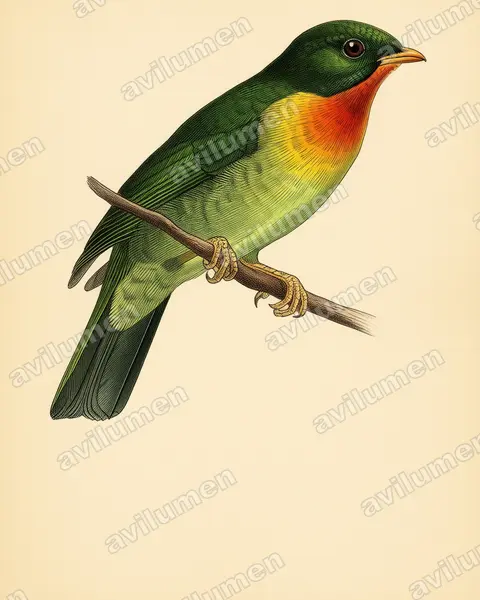
Vintage plate 
Ink 
Oil 
Realistic 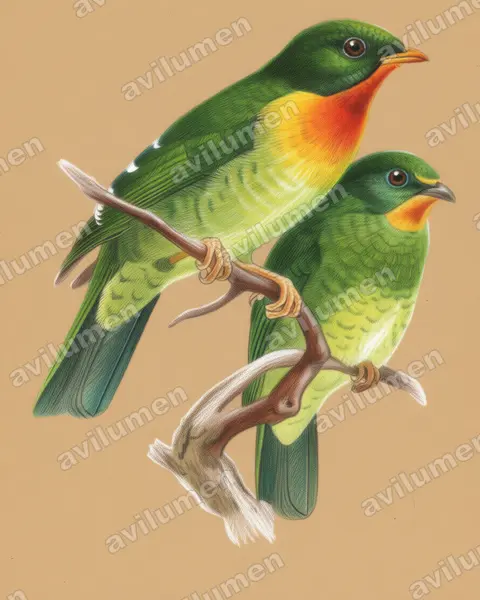
Colored pencil
Illustrations based on the photograph by John Gerrard Keulemans (Public domain), from Wikimedia Commons.
Digital editions
HD Digital Art Pack — Scarlet-breasted Fruiteater
Digital download: 6 high-resolution illustrations of the Scarlet-breasted Fruiteater (Pipreola frontalis), print-ready. This is a digital file; no animal or physical item is included.
AI Avatar — Scarlet-breasted Fruiteater
Generate an avatar fusing your face with the Scarlet-breasted Fruiteater (Pipreola frontalis). Delivered digitally in 8K, watermark-free. Digital product; no animals are sold or brokered.
Instant download. No live birds are sold.
Frequently asked questions
- Is Pipreola frontalis (Scarlet-breasted Fruiteater) endangered?
- The IUCN Red List places Pipreola frontalis, commonly known as the Scarlet-breasted Fruiteater, in the «Least concern» category. «Least concern» means it is not currently threatened.
- Where does Pipreola frontalis (Scarlet-breasted Fruiteater) live?
- Pipreola frontalis (Scarlet-breasted Fruiteater) is found in South America.
- What family does Pipreola frontalis (Scarlet-breasted Fruiteater) belong to?
- Pipreola frontalis (Scarlet-breasted Fruiteater) belongs to the family Cotingidae, in the order Passeriformes.
- What colour is Pipreola frontalis (Scarlet-breasted Fruiteater)?
- The plumage of Pipreola frontalis (Scarlet-breasted Fruiteater) combines these colours: Green, Black, and Red.
More from the same family
 Least concern
Scaled Fruiteater
Ampelioides tschudii
The scaled fruiteater is a species of bird in the family Cotingidae. It is the only member of the genus Ampelioides. This bird is found in Bolivia, Colombia, Ecuador, Peru, and Venezuela, where its natural habitat is the high elevation tropical forests of the Andes mountains. The scaled fruiteater is a chunky, short-tailed, flat-headed bird measuring 19–20 cm (7.5–7.9 in) in length.
from $1.99
 Least concern
Red-crested Cotinga
Ampelion rubrocristatus
The red-crested cotinga is a species of bird in the family Cotingidae. It is found in Bolivia, Colombia, Ecuador, Peru, and Venezuela.
from $1.99
 Least concern
Chestnut-crested Cotinga
Ampelion rufaxilla
The chestnut-crested cotinga is a species of bird in the family Cotingidae. It is found in Bolivia, Colombia, Ecuador, and Peru.
from $1.99
 Critically endangered
Kinglet Calyptura
Calyptura cristata
The kinglet calyptura is a small Critically Endangered passerine bird in the family Tyrannidae, the tyrant flycatchers. It is endemic to southeastern Brazil.
from $1.99