Green Racket-tail
Prioniturus luconensis
Avilumen editorial team ·

The green racket-tail is an endemic parrot of the Philippines where it is found on Luzon and Marinduque. This species was once common, but is rapidly declining and is currently classified as endangered due to lowland deforestation and capture for cage-bird trade. The population is now estimated to be just 300 - 800 mature individuals and is continuing to decline with many local extinctions in its former range.
The green racket-tail (Prioniturus luconensis) is an endemic parrot of the Philippines where it is found on Luzon and Marinduque. This species was once common, but is rapidly declining and is currently classified as endangered due to lowland deforestation and capture for cage-bird trade. The population is now estimated to be just 300 - 800 mature individuals and is continuing to decline with many local extinctions in its former range.
It is illegal to hunt, capture, or keep Green racket-tails and any other wild bird in the Philippines under Philippine Law RA 9147.
Description
They are sexually dimorphic. Males are entirely yellow-green, with paler underparts and head. The two central tail feathers are elongated with bare shafts and terminated with black rackets. Females are generally darker and less yellowish, while the bare tail shafts are shorter. Juveniles do not have rackets at the tail. It is the smallest of all the racquet-tails with a total length of about 29 centimetres (11 in).
This species is monotypic.
Behaviour and ecology
Feeds on fruit, particularly bananas, flowers and seeds of growing corn, and rice.
Like all other Racket-tails, they are cavity nesters. According to poachers, chicks are often poached in the month of May.
Habitat and conservation status
Green racket-tails can be found in the canopy of tropical lowland rainforests in elevations of up to 700 metres (2,300 ft) where it mainly prefers primary forest but is also seen in secondary forest and forest. They have also been recorded visiting cultivations to feed on crops.
It is listed as Endangered with the population estimated at 300 - 800 mature individuals remaining, as of 2024. It has gone locally extinct in many of its former sites and is feared extinct on Marinduque. Its main threat is trapping for the cage-bird trade. Local extinctions as a direct result of forest loss are very likely. In 1988, forest cover was just 3% on Marinduque and 24% on Luzon with the remaining forest continuing to be threatened by both legal and illegal logging. mining, road construction, slash-and-burn or kaingin.
In its stronghold in Subic has experienced increased illegal logging and deforestation continues in Maria Aurora Memorial Natural Park. Interspecific competition is also a threat as they have been replaced by the commoner Blue-crowned racket-tail in Quezon National Forest Park.
It is currently known from two protected areas Bataan National Park and the Northern Sierra Madre Natural Park. It receives nominal protection in the Maria Aurora Memorial Natural Park. However, like most areas in the Philippines protection and enforcement is lax and deforestation and the cage-bird trade continue.
Conservation actions proposed include surveys to identify further sites supporting key populations, with a view to formally establishing them as protected areas. Research its ecology and year-round requirements, to improve understanding of its management needs. Examine trends in Racket-tail species at all sites to monitor the spread of the apparently invasive Blue-crowned racket-tail. Improve protection measures against logging at Subic Bay Forest Reserve. Clamp down on illegal logging within the species's range, and ensure that environmental impact assessments are carried out before any new logging concessions are granted. Establish a captive breeding population to support future reintroduction and supplementation efforts. Lobby against proposed developments that threaten suitable habitat.
Text adapted from Wikipedia · CC BY-SA 4.0
Where it lives
Plumage colours
Taxonomy
- Order
- Psittaciformes
- Family
- Psittacidae
- Genus
- Prioniturus
- Conservation status
- Endangered
Listen to its call
No recording yet
Illustration gallery
6 illustrations of Prioniturus luconensis (Green Racket-tail) in different styles, true to its real plumage. Shown watermarked; the art pack includes the high-resolution originals, ready to print.
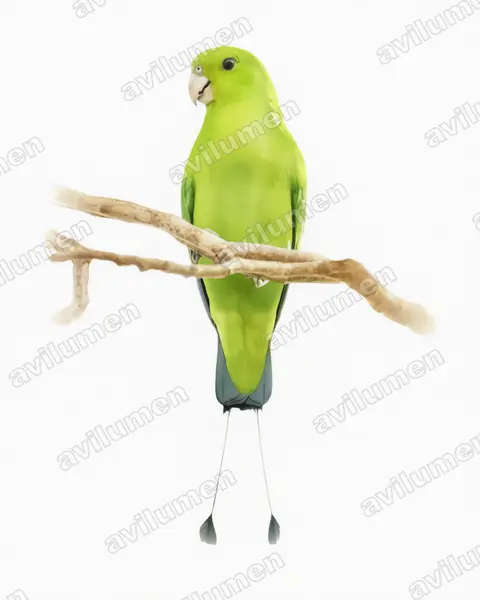
Watercolor 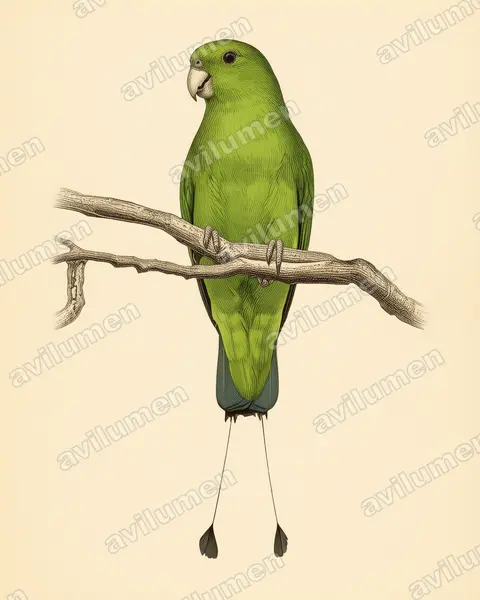
Vintage plate 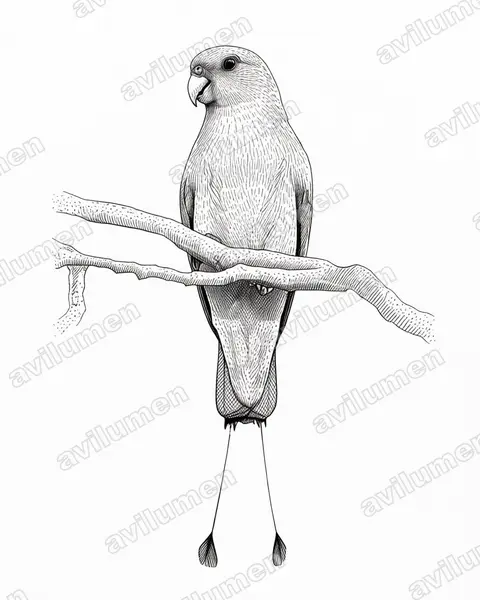
Ink 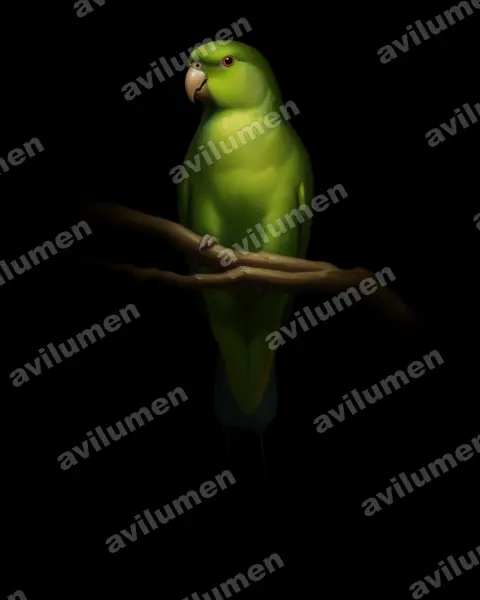
Oil 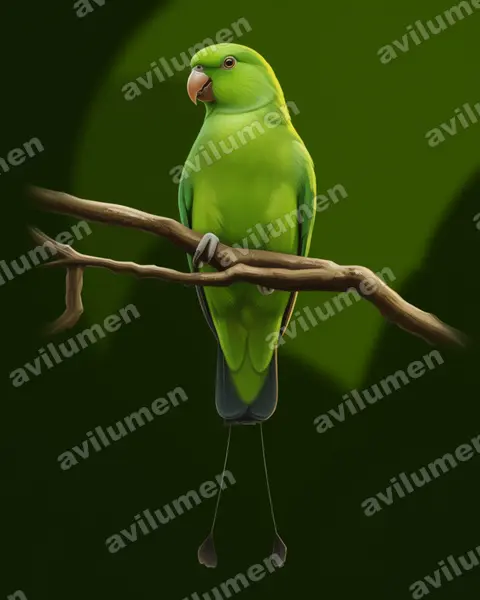
Realistic 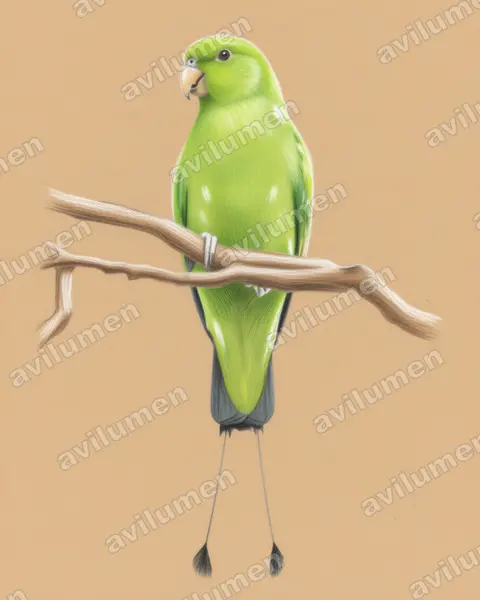
Colored pencil
Illustrations based on the photograph by Vinz Pascua (CC BY-SA 4.0), from Wikimedia Commons.
Digital editions
HD Digital Art Pack — Green Racket-tail
Digital download: 6 high-resolution illustrations of the Green Racket-tail (Prioniturus luconensis), print-ready. This is a digital file; no animal or physical item is included.
AI Avatar — Green Racket-tail
Generate an avatar fusing your face with the Green Racket-tail (Prioniturus luconensis). Delivered digitally in 8K, watermark-free. Digital product; no animals are sold or brokered.
Instant download. No live birds are sold.
Frequently asked questions
- Is Prioniturus luconensis (Green Racket-tail) endangered?
- The IUCN Red List places Prioniturus luconensis, commonly known as the Green Racket-tail, in the «Endangered» category. «Endangered» means it faces a very high risk of disappearing in the wild.
- Where does Prioniturus luconensis (Green Racket-tail) live?
- Prioniturus luconensis (Green Racket-tail) is found in Philippines.
- What family does Prioniturus luconensis (Green Racket-tail) belong to?
- Prioniturus luconensis (Green Racket-tail) belongs to the family Psittacidae, in the order Psittaciformes.
- What colour is Prioniturus luconensis (Green Racket-tail)?
- The plumage of Prioniturus luconensis (Green Racket-tail) combines these colours: Green.
More from the same family
 Near threatened
Yellow-faced Parrot
Alipiopsitta xanthops
The yellow-faced parrot, formerly also known as the yellow-faced amazon, is the only species of the genus Alipiopsitta. It is a Neotropical parrot, and was classified in the genus Amazona for many years. It is a predominantly green and yellow-plumaged bird with a yellow head. It is a semi-nomadic species found in the cerrado region of Brazil and adjacent Bolivia.
from $1.99
 Least concern
Moluccan King Parrot
Alisterus amboinensis
The Moluccan king parrot is a parrot endemic to Peleng Island, Maluku, and West Papua in Indonesia. It is sometimes referred to as the Ambon king parrot or Amboina king parrot, but this is potentially misleading, as it is found on numerous other islands than Ambon. The male and female are similar in appearance, with a predominantly red head and underparts, green wings, and blue back and tail.
from $1.99
 Least concern
Papuan King Parrot
Alisterus chloropterus
The Papuan king parrot, also known as the green-winged king parrot, is a species of parrot in the family Psittaculidae found in New Guinea. Its natural habitats are subtropical or tropical moist lowland forest and subtropical or tropical moist montane forest.
from $1.99
 Least concern
Australian King Parrot
Alisterus scapularis
The Australian king parrot is a species of parrot endemic to eastern Australia ranging from Cooktown in Queensland to Port Campbell in Victoria. Found in humid and heavily forested upland regions of the eastern portion of the continent, including eucalyptus wooded areas in and directly adjacent to subtropical and temperate rainforest. They feed on fruits and seeds gathered from trees or on the ground.
from $1.99