White Bellbird
Procnias albus
Avilumen editorial team ·

The white bellbird is a species of bird in the family Cotingidae, the cotingas. It is found in Brazil, French Guiana, Guyana, Suriname, Venezuela, and as a vagrant to Trinidad.
The white bellbird (Procnias albus) is a species of bird in the family Cotingidae, the cotingas. It is found in Brazil, French Guiana, Guyana, Suriname, Venezuela, and as a vagrant to Trinidad.
Taxonomy and systematics
The white bellbird has two subspecies, the nominate P. a. albus (Hermann, 1783) and P. a. wallacei (Oren & Novaes, 1985). It shares genus Procnias with three other species; it and the three-wattled bellbird (P. tricarunculatus) are sister species.
The species' specific epithet has often been spelled alba, but albus is correct due to the masculine gender of Procnias.
Description
The white bellbird is about 27 to 29 cm (11 to 11 in) long; males weigh 210 to 222 g (7.4 to 7.8 oz). The species is dramatically sexually dimorphic though both sexes have a short bill that opens very wide. Males are unique. Females resemble female bearded bellbirds (P. averano). Adult males of the nominate subspecies have entirely white plumage. They have a single black wattle with a few white feathers that drapes from the base of the maxilla. Females do not have a wattle. Adult females have an olive-green head and upperparts. Their wings and tail are also olive-green with somewhat duskier primaries and their coverts. Their underparts are yellow with olive streaks. Both sexes have a blackish iris, a black bill with pale cutting edges, and dark gray legs and feet. Immature birds resemble females, and males take a year or more to attain white plumage and the wattle. Subspecies P. a. wallacei has a longer and thinner bill than the nominate and its throat has a slight gray tinge.
Distribution and habitat
The white bellbird has a disjunct distribution. The nominate subspecies has by far the larger range of the two. It is found from eastern Bolívar state in eastern Venezuela east across the Guianas and at scattered locations across the northern parts of Brazil's Roraima and Pará states. A small population is also on Cerro de la Neblina in the far south of Venezuela's Amazonas state. Subspecies P. a. wallacei is found in the Serra dos Carajás in southeastern Pará. The nominate subspecies has also occurred as a vagrant on Trinidad.
The white bellbird inhabits humid forest, mostly in the lowlands but also on the slopes of tepuis in Venezuela. In elevation it ranges between 450 and 1,100 m (1,500 and 3,600 ft) in Venezuela and from near sea level to 1,250 m (4,100 ft) in Brazil.
Movement
The white bellbird appears to be partially migratory though details are poorly defined. The nominate subspecies makes some elevational movements between the breeding and non-breeding seasons. The species also wanders, with isolated records outside its core range.
Feeding
The white bellbird apparently feeds only on fruit. It sometimes plucks it while perched but more often during a sally from a perch. The fruit is swallowed whole and seeds are regurgitated.
Breeding
The nesting behavior of the white bellbird is not well defined. Its breeding season appears to span from February to June. A study published in 1973 posited that its behavior is very similar to that of the bearded bellbird. Males of that species are sedentary, marking their territory throughout the year except when molting by calling from exposed perches, often above the canopy. Females join males to mate and alone tend the nest. One source states that a sparse nest is built on open branches and that the clutch is one or two eggs. Male white bellbirds display from treetops. They call with a horizontal posture, with the wattle inflated, and either hold still or lean right and left as they call.
Vocalization
The white bellbird is believed to be the world's loudest bird, with calls of up to 125 dB(A) (at equivalent 1m distance). The record was previously held by the screaming piha, which was recorded at 116 dB.
The white bellbird has two main vocalizations. One is "a loud kong-kay like two sharp blows on a cracked bell, given with the head held immobile". It varies this call with a swing to right for the first note and to the left for the second. The species' second call is "a more musical, droning duaaaaaaaaa...deeeeeee, almost hypnotic".
Status
The IUCN has assessed the white bellbird as being of least concern. Its population size is not known and is believed to be decreasing. No immediate threats have been identified. It is considered "quite local" in Venezuela and rare in Brazil. It is overall "uncommon, thinly distributed and difficult to observe, although conspicuous and very locally common when singing. Populations in remote highlands of E & S Venezuela and the Guianas should remain little disturbed for foreseeable future."
Text adapted from Wikipedia · CC BY-SA 4.0
Where it lives
Plumage colours
Distribution

Taxonomy
- Order
- Passeriformes
- Family
- Cotingidae
- Genus
- Procnias
- Conservation status
- Least concern
Listen to its call
No recording yet
Illustration gallery
6 illustrations of Procnias albus (White Bellbird) in different styles, true to its real plumage. Shown watermarked; the art pack includes the high-resolution originals, ready to print.

Watercolor 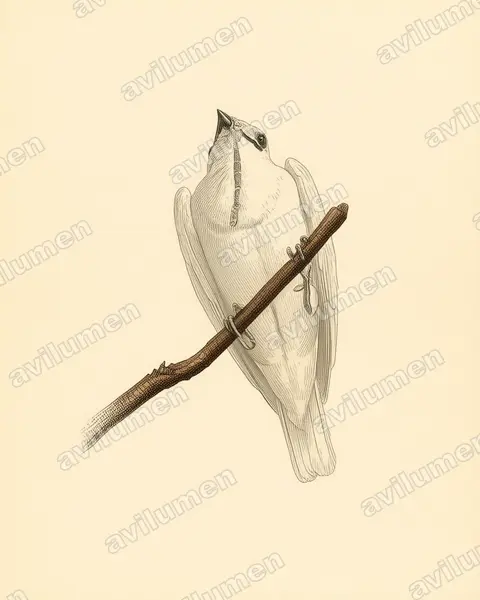
Vintage plate 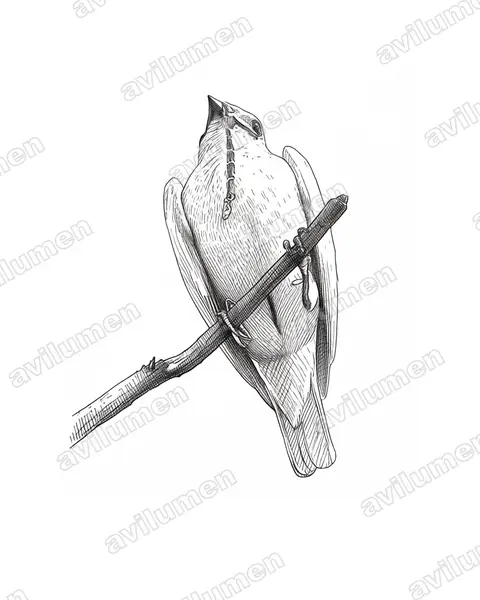
Ink 
Oil 
Realistic 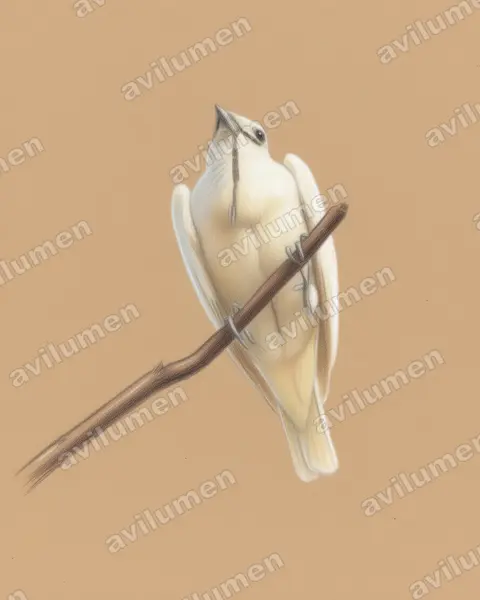
Colored pencil
Illustrations based on the photograph by Hector Bottai (CC BY-SA 4.0), from Wikimedia Commons.
Digital editions
HD Digital Art Pack — White Bellbird
Digital download: 6 high-resolution illustrations of the White Bellbird (Procnias albus), print-ready. This is a digital file; no animal or physical item is included.
AI Avatar — White Bellbird
Generate an avatar fusing your face with the White Bellbird (Procnias albus). Delivered digitally in 8K, watermark-free. Digital product; no animals are sold or brokered.
Instant download. No live birds are sold.
Frequently asked questions
- Is Procnias albus (White Bellbird) endangered?
- The IUCN Red List places Procnias albus, commonly known as the White Bellbird, in the «Least concern» category. «Least concern» means it is not currently threatened.
- Where does Procnias albus (White Bellbird) live?
- Procnias albus (White Bellbird) is found in Brazil and South America.
- What family does Procnias albus (White Bellbird) belong to?
- Procnias albus (White Bellbird) belongs to the family Cotingidae, in the order Passeriformes.
- What colour is Procnias albus (White Bellbird)?
- The plumage of Procnias albus (White Bellbird) combines these colours: White.
More from the same family
 Least concern
Scaled Fruiteater
Ampelioides tschudii
The scaled fruiteater is a species of bird in the family Cotingidae. It is the only member of the genus Ampelioides. This bird is found in Bolivia, Colombia, Ecuador, Peru, and Venezuela, where its natural habitat is the high elevation tropical forests of the Andes mountains. The scaled fruiteater is a chunky, short-tailed, flat-headed bird measuring 19–20 cm (7.5–7.9 in) in length.
from $1.99
 Least concern
Red-crested Cotinga
Ampelion rubrocristatus
The red-crested cotinga is a species of bird in the family Cotingidae. It is found in Bolivia, Colombia, Ecuador, Peru, and Venezuela.
from $1.99
 Least concern
Chestnut-crested Cotinga
Ampelion rufaxilla
The chestnut-crested cotinga is a species of bird in the family Cotingidae. It is found in Bolivia, Colombia, Ecuador, and Peru.
from $1.99
 Critically endangered
Kinglet Calyptura
Calyptura cristata
The kinglet calyptura is a small Critically Endangered passerine bird in the family Tyrannidae, the tyrant flycatchers. It is endemic to southeastern Brazil.
from $1.99