Pale-mandibled Aracari
Pteroglossus erythropygius
Avilumen editorial team ·

The pale-mandibled aracari or pale-billed araçari is a near-passerine bird in the toucan family Ramphastidae. It is found in southern Panama, western Colombia, Ecuador and northwestern Peru.
The pale-mandibled aracari or pale-billed araçari (Pteroglossus erythropygius) is a near-passerine bird in the toucan family Ramphastidae. It is found in southern Panama, western Colombia, Ecuador and northwestern Peru.
Taxonomy and systematics
The pale-mandibled aracari was formally described in 1843 as Pteroglossus erythropygius by the English ornithologist John Gould based on a specimen in the collection of the British naval officer Edward Belcher. The specific epithet combines the Ancient Greek ερυθρος/eruthros meaning "red" with -πυγιος/-pugios meaning "-rumped". Gould did not specify a type locality but this has been designated as Ecuador.
Two subspecies are recognised:
P. e. sanguineus Gould, J, 1854 – eastern Panama and northern Colombia southward to northwestern Ecuador (northern Esmeraldas and adjacent Imbabura)
P. e. erythropygius Gould, J, 1843 – western Ecuador (western Esmeraldas southward to El Oro) and northwestern Peru (eastern Tumbes)
The subspecies P. e. sanguineus has sometimes been treated as a separate species, the stripe-billed aracari.
Description
The pale-mandibled aracari is 40.5 to 43 cm (16 to 17 in) long including its 11.5 to 12.5 cm (4.5 to 4.9 in) bill. It weighs 175 to 250 g (6.2 to 8.8 oz). Males and females have the same coloration of the bill and plumage but the female's bill is shorter than the male's. The adult's bill has a narrow vertical white line at its base. Its maxilla is creamy yellow with a black stripe along its lower edge. The bill's mandible is creamy yellow with a black tip. Adults have mostly glossy black upperparts with bright red lower back, rump, and uppertail coverts. Their head, throat, and uppermost breast are greenish black. Their lower breast, belly, and undertail coverts are yellow. The breast has a variable red wash and a black spot in its center; the upper belly is crossed by a narrow red and black band. Their thighs are brown. Juveniles are much duller than adults, with a sooty-black head and chest and brownish olive upperparts. The red rump and yellow underparts are paler, and the breast spot, belly band, and bill pattern are indistinct.
Distribution and habitat
The pale-mandibled aracari is found from southern Panama south to Peru's Department of Tumbes.
It inhabits the interior and edges of evergreen primary forest and mature secondary forest and also coffee, cacao, and fruit plantations.
Social behavior
Pale-mandibled aracaris typically travel in groups of about six to eight or more individuals that sometimes include other toucan species. They also roost communally; up to seven may occupy a cavity overnight.
Feeding
The pale-mandibled aracari's diet is mostly fruit but it also feeds on large insects, the eggs and nestlings of other birds, and other small vertebrates. It mostly forages from the forest's mid level to the canopy but will feed on fruits in the understory. They glean fruit by stretching from a perch, bending, and even hanging upside down. They regurgitate large fruit seeds which often remain viable.
Breeding
The pale-mandibled aracari's breeding season is from December to May. It nests in tree cavities, usually those excavated by large woodpeckers but also natural ones. They may enlarge the cavity, which can be up to 30 m (98 ft) above the ground. The clutch size is usually three eggs but can be as large as five. The incubation period is 16 to 17 days and both parents incubate. Fledging occurs 26 to 30 days after hatch. The parents and often up to three other adults provision the nestlings. They are fed mostly with insects when young.
Vocalization
The pale-mandibled aracari's usual call is "a loud, arresting, high-pitched, and squeaky 'ksisik' or 'ksiyik!'."
Conservation status
The IUCN has assessed the pale-mandibled aracari as being of Least Concern, though its population size is not known and is believed to be decreasing. No immediate threats have been identified. "[A]lthough it tolerates secondary forest, it nonetheless is very susceptible to deforestation".
Text adapted from Wikipedia · CC BY-SA 4.0
Taxonomy
- Order
- Piciformes
- Family
- Ramphastidae
- Genus
- Pteroglossus
- Conservation status
- Least concern
Listen to its call
No recording yet
Care guide
Toucan and Aracari Care Guide: Diet and Housing
How to care for toucans and aracaris: low-iron diet, iron storage disease (hemochromatosis), aviary setup, health, behavior and CITES legal status.
Read the guide →Illustration gallery
6 illustrations of Pteroglossus erythropygius (Pale-mandibled Aracari) in different styles, true to its real plumage. Shown watermarked; the art pack includes the high-resolution originals, ready to print.
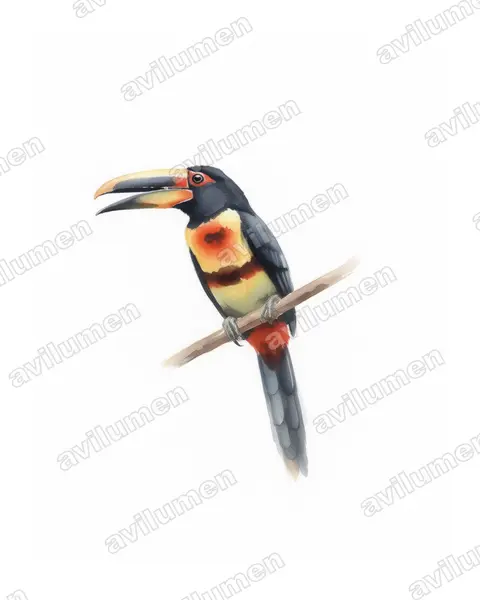
Watercolor 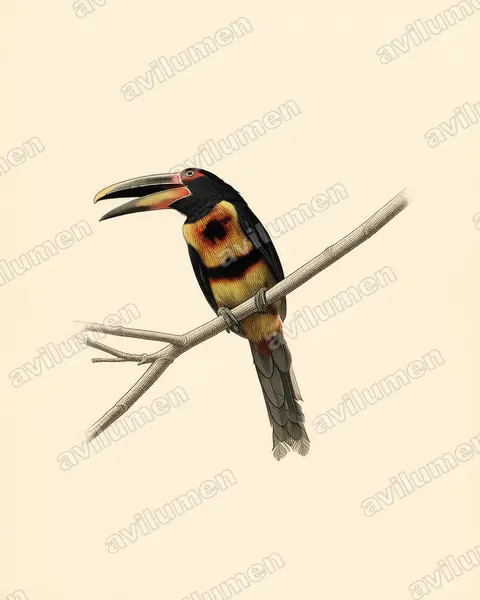
Vintage plate 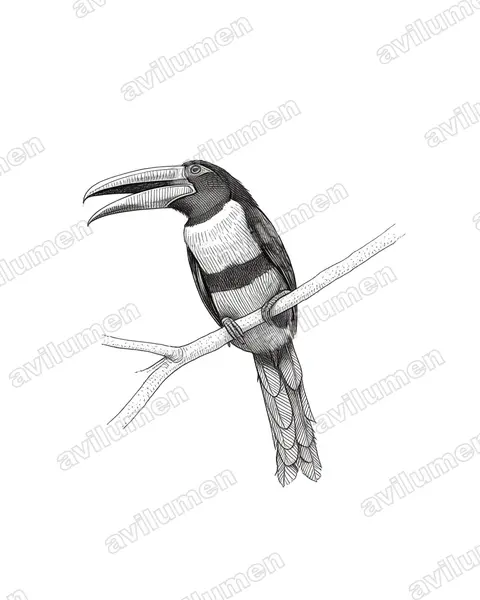
Ink 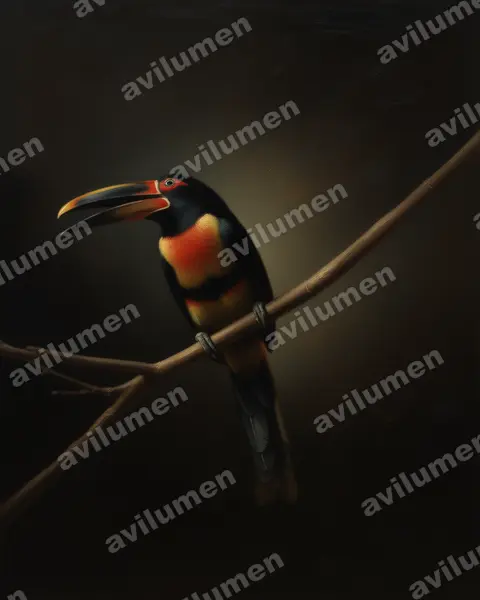
Oil 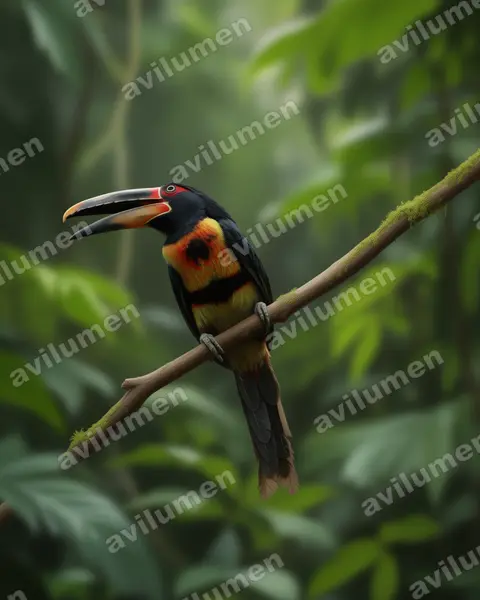
Realistic 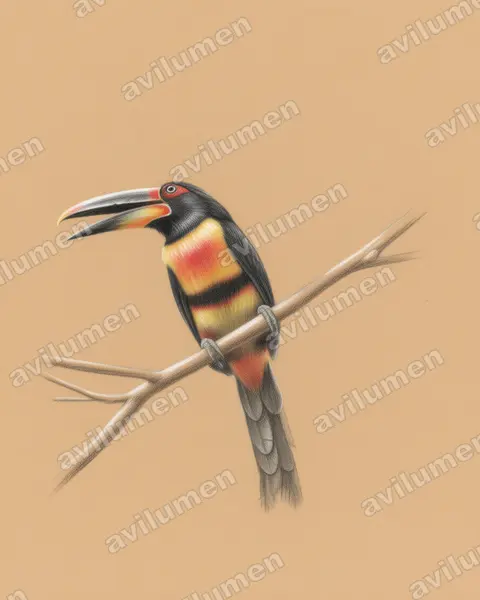
Colored pencil
Illustrations based on the photograph by Steven Carlton (CC BY 2.0), from Wikimedia Commons.
Digital editions
HD Digital Art Pack — Pale-mandibled Aracari
Digital download: 6 high-resolution illustrations of the Pale-mandibled Aracari (Pteroglossus erythropygius), print-ready. This is a digital file; no animal or physical item is included.
AI Avatar — Pale-mandibled Aracari
Generate an avatar fusing your face with the Pale-mandibled Aracari (Pteroglossus erythropygius). Delivered digitally in 8K, watermark-free. Digital product; no animals are sold or brokered.
Instant download. No live birds are sold.
Frequently asked questions
- Is Pteroglossus erythropygius (Pale-mandibled Aracari) endangered?
- The IUCN Red List places Pteroglossus erythropygius, commonly known as the Pale-mandibled Aracari, in the «Least concern» category. «Least concern» means it is not currently threatened.
- What family does Pteroglossus erythropygius (Pale-mandibled Aracari) belong to?
- Pteroglossus erythropygius (Pale-mandibled Aracari) belongs to the family Ramphastidae, in the order Piciformes.
- What colour is Pteroglossus erythropygius (Pale-mandibled Aracari)?
- The plumage of Pteroglossus erythropygius (Pale-mandibled Aracari) combines these colours: Black, Yellow, and Red.
More from the same family
 Least concern
Hooded Mountain Toucan
Andigena cucullata
The hooded mountain toucan is a species of bird in the toucan family Ramphastidae. It is found in Bolivia and Peru.
from $1.99
 Near threatened
Grey-breasted Mountain Toucan
Andigena hypoglauca
The grey-breasted mountain toucan is a least-concern species of bird in the toucan family, Ramphastidae. It is found in South American countries such as Colombia, Ecuador and Peru.
from $1.99
 Near threatened
Plate-billed Mountain Toucan
Andigena laminirostris
The plate-billed mountain toucan is a species of bird in the family Ramphastidae. It is native to the west slope of Ecuador and extreme southern Colombia, where it lives in the high-altitude humid mountain forests of the Andes.
from $1.99
 Least concern
Black-billed Mountain Toucan
Andigena nigrirostris
The black-billed mountain toucan is a species of bird in the toucan family Ramphastidae. It is found in Colombia, Ecuador, Peru, and Venezuela.
from $1.99