Lesser seedcracker
Pyrenestes minor
Avilumen editorial team ·

The lesser seedcracker or Nyasa seedcracker is a fairly common species of estrildid finch found in eastern Africa. It has an estimated global extent of occurrence of 925,000 km2 (357,000 mi2) and is found in Malawi, Mozambique, Tanzania and Zimbabwe. The International Union for Conservation of Nature has classified the species as being of least concern.
The lesser seedcracker or Nyasa seedcracker (Pyrenestes minor) is a fairly common species of estrildid finch found in eastern Africa. It has an estimated global extent of occurrence of 925,000 km2 (357,000 mi2) and is found in Malawi, Mozambique, Tanzania and Zimbabwe. The International Union for Conservation of Nature has classified the species as being of least concern.
Description
The lesser seedcracker grows to a length of about 14 cm (5.5 in). The male plumage is brown tinged with olive, apart from the forehead, crown, side of face, chin, throat and upper breast which are bright red, and the rump and central tail feathers which are deep blood red. The underparts are paler than the upper parts. The female is similar but has a smaller area of red on the face and crown. The short, broad beak is black, the brown eye is surrounded by a white eye ring, and the legs are greyish-brown or dark grey. The juvenile is similar to the adults but the colours are more muted. This species could be confused with the black-bellied seedcracker but the two species do not share a common range.
Distribution and habitat
This is a resident but somewhat uncommon species and occurs in southern Tanzania, eastern Zimbabwe, southern Malawi and northern Mozambique. It is found in upland forests, at altitudes of between 725 and 1,800 m (2,400 and 5,900 ft), both in high rainfall areas and in forest margins in drier areas, in Brachystegia woodland, clearings, scrubby areas and areas of rank vegetation, often near watercourses.
Behaviour
The lesser seedcracker is a mostly resident species, but is a partial migrant in eastern Zimbabwe. It usually forages in pairs low in the undergrowth, or sometimes on the ground, feeding on grass and other seeds, including rice and the large hard seeds of the bamboo Olyra latifolia. Breeding takes place between December and March in Malawi and Zimbabwe, and between March and May in Mozambique.
Status
The lesser seedcracker has a very wide range. It faces no particular threats and the population is stable, so the International Union for Conservation of Nature has assessed its conservation status as being of "least concern".
Text adapted from Wikipedia · CC BY-SA 4.0
Taxonomy
- Order
- Passeriformes
- Family
- Estrildidae
- Genus
- Pyrenestes
- Conservation status
- Least concern
Listen to its call
No recording yet
Care guide
Canary and Finch Care Guide: Diet, Housing and Breeding
How to care for canaries, zebra finches, Gouldian finches and other finches: diet, flight cage setup, health, song and breeding. A guide for bird keepers.
Read the guide →Illustration gallery
6 illustrations of Pyrenestes minor (Lesser seedcracker) in different styles, true to its real plumage. Shown watermarked; the art pack includes the high-resolution originals, ready to print.
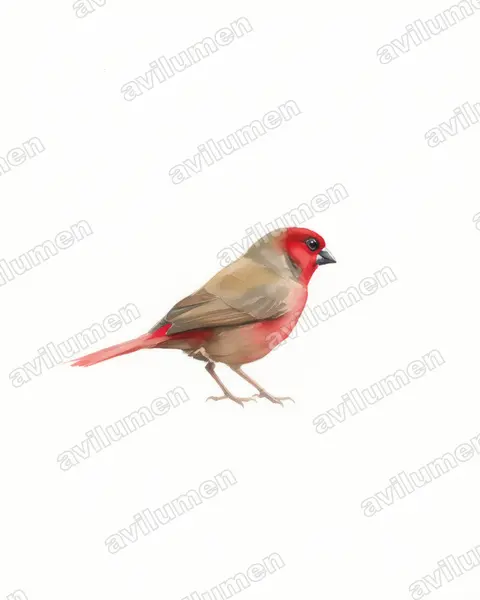
Watercolor 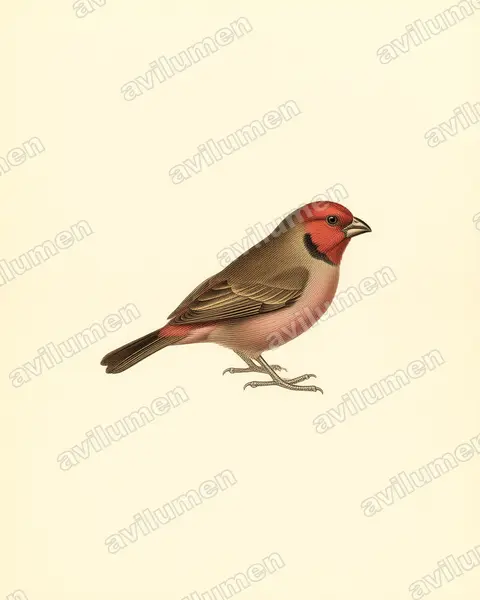
Vintage plate 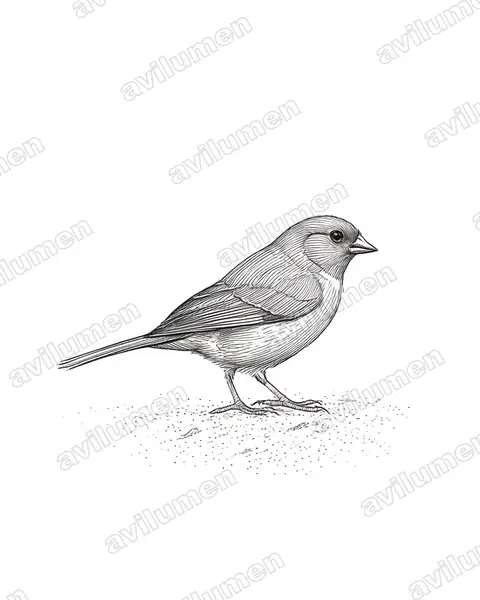
Ink 
Oil 
Realistic 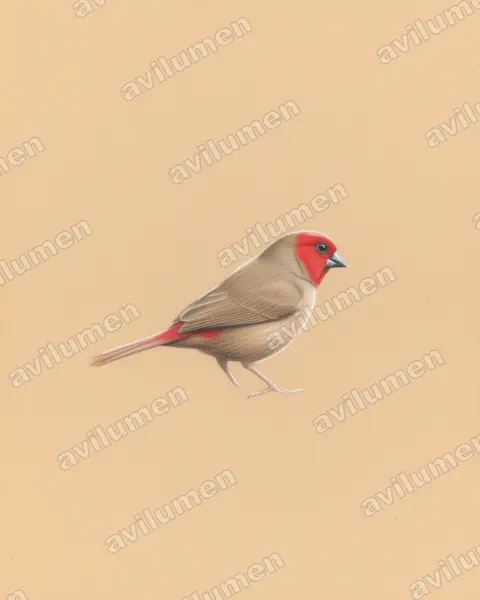
Colored pencil
Illustrations based on the photograph by (c) William Stephens, some rights reserved (CC BY) (CC BY 4.0), from Wikimedia Commons.
Digital editions
HD Digital Art Pack — Lesser seedcracker
Digital download: 6 high-resolution illustrations of the Lesser seedcracker (Pyrenestes minor), print-ready. This is a digital file; no animal or physical item is included.
AI Avatar — Lesser seedcracker
Generate an avatar fusing your face with the Lesser seedcracker (Pyrenestes minor). Delivered digitally in 8K, watermark-free. Digital product; no animals are sold or brokered.
Instant download. No live birds are sold.
Frequently asked questions
- Is Pyrenestes minor (Lesser seedcracker) endangered?
- The IUCN Red List places Pyrenestes minor, commonly known as the Lesser seedcracker, in the «Least concern» category. «Least concern» means it is not currently threatened.
- Where does Pyrenestes minor (Lesser seedcracker) live?
- Pyrenestes minor (Lesser seedcracker) is found in Africa.
- What family does Pyrenestes minor (Lesser seedcracker) belong to?
- Pyrenestes minor (Lesser seedcracker) belongs to the family Estrildidae, in the order Passeriformes.
- What colour is Pyrenestes minor (Lesser seedcracker)?
- The plumage of Pyrenestes minor (Lesser seedcracker) combines these colours: Brown.
More from the same family
 Least concern
Red-headed finch
Amadina erythrocephala
The red-headed finch is a common species of estrildid finch found in Africa. It has an estimated global extent of occurrence of 1,600,000 km2 (620,000 sq mi). It is found in Angola, Botswana, Lesotho, Namibia, South Africa and Zimbabwe.
from $1.99
 Least concern
Cut-throat finch
Amadina fasciata
The cut-throat finch is a common species of estrildid finch found throughout Africa; it is also known as the bearded finch, the ribbon finch, the cut throat, and the weaver finch.
from $1.99
 Least concern
Red avadavat
Amandava amandava
The red avadavat, red munia or strawberry finch, is a sparrow-sized bird of the family Estrildidae. It is found in the open fields and grasslands of tropical Asia and is popular as a cage bird due to the colourful plumage of the males in their breeding season. It breeds in the Indian subcontinent in the monsoon season.
from $1.99
 Vulnerable
Green avadavat
Amandava formosa
The green avadavat or green munia is a species of Estrildid finch with green and yellow on the body, a bright red bill and black "zebra stripes" on the flanks. They are endemic to the Indian subcontinent and were formerly popular as cagebirds. The name "avadavat" is a corruption of the name the city of Ahmedabad in Gujarat, India, which was a centre of bird trade.
from $1.99