Santa Marta Parakeet
Pyrrhura viridicata
Avilumen editorial team ·

The Santa Marta parakeet is an Endangered species of bird in subfamily Arinae of the family Psittacidae, the African and New World parrots. It is endemic to Colombia.
The Santa Marta parakeet (Pyrrhura viridicata) is an Endangered species of bird in subfamily Arinae of the family Psittacidae, the African and New World parrots. It is endemic to Colombia.
Taxonomy and systematics
The Santa Marta parakeet's exact placement within genus Pyrrhura is unsure. The species is monotypic.
Description
The Santa Marta parakeet is 23 to 25 cm (9.1 to 9.8 in) long. The sexes are the same. Adults have a mostly green head with a red forehead and brownish ear coverts. Their upperparts are green. Their breast and upper belly have a scarlet "belt" and the rest of their underparts are green. Their wing is mostly green with yellow to orange upperwing and underwing coverts; their primaries are blue. Their tail is dull reddish. Immature birds are similar to adults but without the red belt on their underside.
Distribution and habitat
The Santa Marta parakeet is found only in the Sierra Nevada de Santa Marta, an isolated mountain range in northern Colombia. Though it apparently was previously found on all sides of the range, it now appears to occur only along the north and northwestern slopes. It primarily inhabits humid pre-montane and montane forest, mostly in areas that receive at least 2,000 mm (79 in) of annual rainfall. It also less frequently occurs in secondary forest and cultivated areas. In elevation it ranges between 2,000 and 3,500 m (6,600 and 11,500 ft).
Movement
The Santa Marta parakeet does not migrate, but it is somewhat nomadic in response to the availability of its food sources.
Feeding
The Santa Marta parakeet feeds on a variety of fruits and seeds, with the fruit of Croton bogotanus providing a major part of its diet. It also feeds on flowers, leaves, and lichens. It forages in flocks of up to about 20 individuals. Its diet varies over time with the changing abundance of its food, and it appears to use a wider variety of resources when its preferred food is not available. This behavior is interpreted to indicate some ecological flexibility.
Breeding
In a completely natural setting, the Santa Marta parakeet nests only in dead wax palms (Ceroxylon ceriferum); it also uses nest boxes placed in or near the forest. Most of the data on its breeding biology comes from monitoring nest boxes. The species has two breeding season peaks, between December and May and between June and October. The second season is thought to be a response to competition for nest cavities from larger parrot species. The clutch ranges from three to seven eggs with a mean of 4.5. The incubation period is 22 to 28 days and fledging occurs up to 45 days after hatch. The Santa Marta parakeet exhibits cooperative breeding.
Vocalization
The Santa Marta parakeet "uses screeching calls during flight".
Status
The IUCN originally assessed the Santa Marta parakeet as Near Threatened, then in 1994 as Vulnerable, and since 2000 as Endangered. It has a limited range and its estimated population of between 1800 and 3200 mature individuals is believed to be decreasing. About half of its original habitat has been lost to plantations of non-native trees such as pine and Eucalyptus, and clearing for pasture continues. The species is hunted in some areas but that and the pet trade appear to be only minor influences on its decline. About 80% of the species' population appears to be in Sierra Nevada de Santa Marta National Natural Park though some occur in two private preserves. The protection of habitat in the national park is not fully effective.
Text adapted from Wikipedia · CC BY-SA 4.0
Where it lives
Plumage colours
Distribution

Taxonomy
- Order
- Psittaciformes
- Family
- Psittacidae
- Genus
- Pyrrhura
- Conservation status
- Endangered
Listen to its call
No recording yet
Care guide
Budgie, Conure and Parakeet Care Guide
How to care for budgies, conures, parrotlets, ringnecks and other parakeets: diet, cage setup, health, behavior, breeding and legal status for owners.
Read the guide →Illustration gallery
6 illustrations of Pyrrhura viridicata (Santa Marta Parakeet) in different styles, true to its real plumage. Shown watermarked; the art pack includes the high-resolution originals, ready to print.
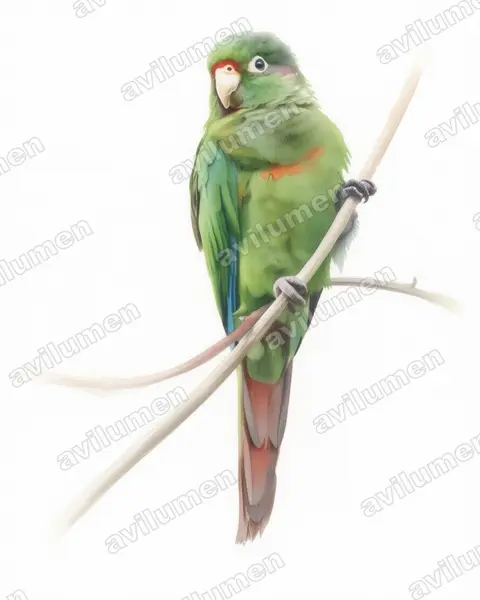
Watercolor 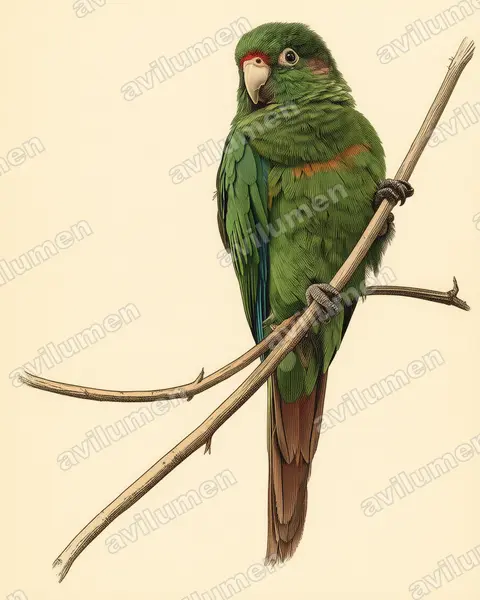
Vintage plate 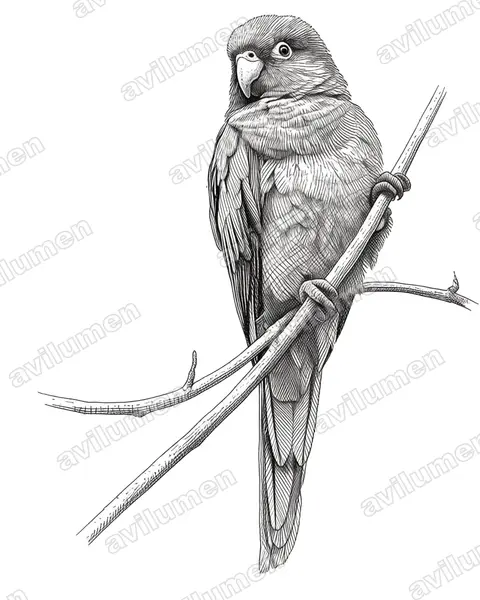
Ink 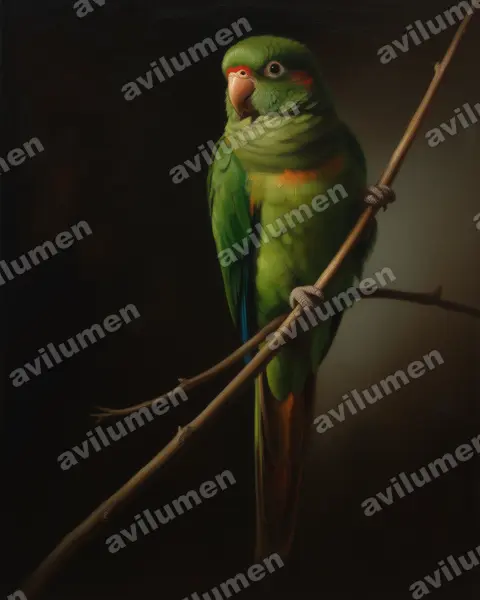
Oil 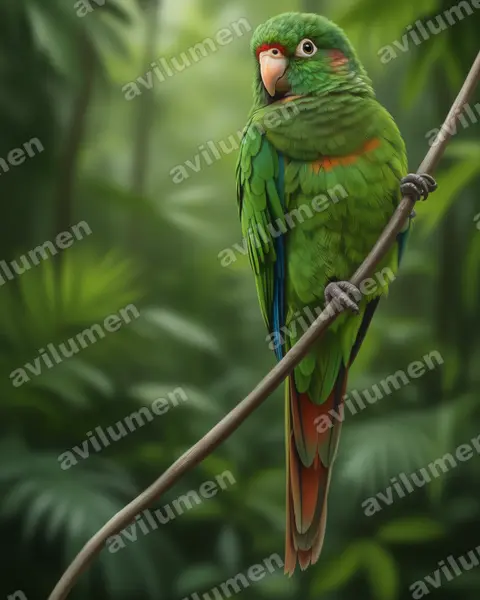
Realistic 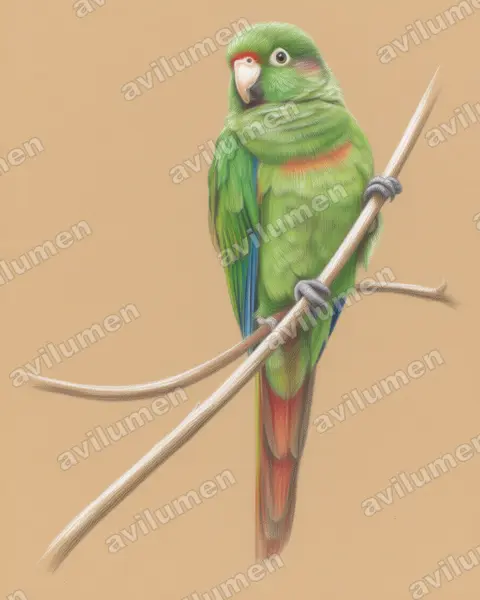
Colored pencil
Illustrations based on the photograph by William Stephens (CC BY 4.0), from Wikimedia Commons.
Digital editions
HD Digital Art Pack — Santa Marta Parakeet
Digital download: 6 high-resolution illustrations of the Santa Marta Parakeet (Pyrrhura viridicata), print-ready. This is a digital file; no animal or physical item is included.
AI Avatar — Santa Marta Parakeet
Generate an avatar fusing your face with the Santa Marta Parakeet (Pyrrhura viridicata). Delivered digitally in 8K, watermark-free. Digital product; no animals are sold or brokered.
Instant download. No live birds are sold.
Frequently asked questions
- Is Pyrrhura viridicata (Santa Marta Parakeet) endangered?
- The IUCN Red List places Pyrrhura viridicata, commonly known as the Santa Marta Parakeet, in the «Endangered» category. «Endangered» means it faces a very high risk of disappearing in the wild.
- Where does Pyrrhura viridicata (Santa Marta Parakeet) live?
- Pyrrhura viridicata (Santa Marta Parakeet) is found in South America.
- What family does Pyrrhura viridicata (Santa Marta Parakeet) belong to?
- Pyrrhura viridicata (Santa Marta Parakeet) belongs to the family Psittacidae, in the order Psittaciformes.
- What colour is Pyrrhura viridicata (Santa Marta Parakeet)?
- The plumage of Pyrrhura viridicata (Santa Marta Parakeet) combines these colours: Green.
More from the same family
 Near threatened
Yellow-faced Parrot
Alipiopsitta xanthops
The yellow-faced parrot, formerly also known as the yellow-faced amazon, is the only species of the genus Alipiopsitta. It is a Neotropical parrot, and was classified in the genus Amazona for many years. It is a predominantly green and yellow-plumaged bird with a yellow head. It is a semi-nomadic species found in the cerrado region of Brazil and adjacent Bolivia.
from $1.99
 Least concern
Moluccan King Parrot
Alisterus amboinensis
The Moluccan king parrot is a parrot endemic to Peleng Island, Maluku, and West Papua in Indonesia. It is sometimes referred to as the Ambon king parrot or Amboina king parrot, but this is potentially misleading, as it is found on numerous other islands than Ambon. The male and female are similar in appearance, with a predominantly red head and underparts, green wings, and blue back and tail.
from $1.99
 Least concern
Papuan King Parrot
Alisterus chloropterus
The Papuan king parrot, also known as the green-winged king parrot, is a species of parrot in the family Psittaculidae found in New Guinea. Its natural habitats are subtropical or tropical moist lowland forest and subtropical or tropical moist montane forest.
from $1.99
 Least concern
Australian King Parrot
Alisterus scapularis
The Australian king parrot is a species of parrot endemic to eastern Australia ranging from Cooktown in Queensland to Port Campbell in Victoria. Found in humid and heavily forested upland regions of the eastern portion of the continent, including eucalyptus wooded areas in and directly adjacent to subtropical and temperate rainforest. They feed on fruits and seeds gathered from trees or on the ground.
from $1.99