Bronze mannikin
Spermestes cucullata
Avilumen editorial team ·

The bronze mannikin or bronze munia is a small passerine bird of the Afrotropics. This very social estrildid finch is an uncommon to locally abundant bird in much of Africa south of the Sahara Desert, where it is resident, nomadic or irruptive in mesic savanna or forest margin habitats. It has an estimated global extent of occurrence of 23,600,000 km2 (9,100,000 sq mi).
The bronze mannikin or bronze munia (Spermestes cucullata) is a small passerine (i.e. perching) bird of the Afrotropics. This very social estrildid finch is an uncommon to locally abundant bird in much of Africa south of the Sahara Desert, where it is resident, nomadic or irruptive in mesic savanna or forest margin habitats. It has an estimated global extent of occurrence of 23,600,000 km2 (9,100,000 sq mi). It is the smallest and most widespread of four munia species on the African mainland, the other being black-and-white, red-backed and magpie mannikin. It co-occurs with the Madagascar mannikin on the Comoro Islands, and was introduced to Puerto Rico. Especially in the West Africa, it is considered a pest in grain and rice fields. It is locally trapped for the pet bird trade.
Taxonomy
The bronze mannikin was formally described in 1837 by the English naturalist William Swainson and given the binomial name Spermestes cucullata. The specific epithet is from Late Latin cucullatus meaning "hooded". The type locality is Senegal.
Two subspecies are recognised:
S. c. cucullata Swainson, 1837 – Senegal and Gambia to south Sudan, Uganda, west Kenya and the island of Bioko
S. c. scutata Heuglin, 1863 – Ethiopia and east Kenya to southeast South Africa, east Angola and Comoro Islands
Description
The bronze mannikin is one of the smallest munia species, measuring 9–10 cm in length and weighing 7–12 grams. The adult is a compact bird with a short black tail, and stubby black and pale grey (not distinctly bluish) mandibles. It is black to brownish black on the head, chin, throat and center of the chest, with some purple-green iridescence on the face and sides of the breast. It has greyish brown upper parts and white underparts with irregular barring on the flanks and rump. A small green iridescent patch is present on the outer scapular feathers, besides, especially in the western race, the sides of the lower breast. Wing coverts and remiges are bordered in a paler or warmer tone. The sexes are similar. Immature birds are dun brown above with buff head and underpart plumage. They moult into full adult plumage by age six months, when the males also begin to sing and exhibit breeding behaviour. The race S. c. scutata has barred rather than bronzy green plumage at the junction of the lower breast and flanks. Rump and upper tail feathers only finely barred and almost uniformly dark. These characters are however somewhat variable and unpredictable.
This species has a number of calls including a rreep-rreeep in flight, a twittering when perched, consisting of various wheezy or buzzing notes. The song is a concatenated and somewhat repetitive series of notes.
Distribution and habitat
The bronze mannikin is native to mainland Africa and the Bioko, Pemba, Zanzibar, Mafia and Comoro islands, and has been introduced to Puerto Rico, where it is established. The two accepted races have an extensive region around the upper Nile River which is inhabited by birds with intermediate features. A proposed third race, S. c. subsp. tressellata Clancey, 1964 is not generally recognized.
Behaviour and ecology
The bronze mannikin is a tiny gregarious bird which feeds mainly on seeds, including wild grass seeds, millet, rice and grain. Alternatively termites, nectar or strands of algae may also be eaten. Before going to roost at nightfall, they usually visit a watering hole where vegetation is hanging into the water. They roost at night in ball-shaped nests, which in the non-breeding season are built solely for this purpose. These slovenly communal roosting nests are dismantled (for reuse of material) and rebuilt almost daily at the same or a new location, in a communal effort. Each party, numbering 8 to 20 birds, seems to be dominated by a single adult male. The flock defends the immediate vicinity of a nest against intruders, but newcomers to a flock are easily accepted. They may associate with waxbill or other mannikin species, and may also use their vacated nests. Pairs often allopreen.
Breeding
They are incessant nest builders that may raise up to four broods a year, given favourable circumstances. The nest is a large domed grass structure in a tree, into which 4 to 8 small, white eggs are laid. Incubation takes 12 days, and chicks fledge after three weeks, and are independent in another three weeks. The chicks are reared on soft green seeds and insects.
Text adapted from Wikipedia · CC BY-SA 4.0
Distribution

Taxonomy
- Order
- Passeriformes
- Family
- Estrildidae
- Genus
- Spermestes
- Conservation status
- Least concern
Listen to its call
No recording yet
Care guide
Canary and Finch Care Guide: Diet, Housing and Breeding
How to care for canaries, zebra finches, Gouldian finches and other finches: diet, flight cage setup, health, song and breeding. A guide for bird keepers.
Read the guide →Illustration gallery
6 illustrations of Spermestes cucullata (Bronze mannikin) in different styles, true to its real plumage. Shown watermarked; the art pack includes the high-resolution originals, ready to print.
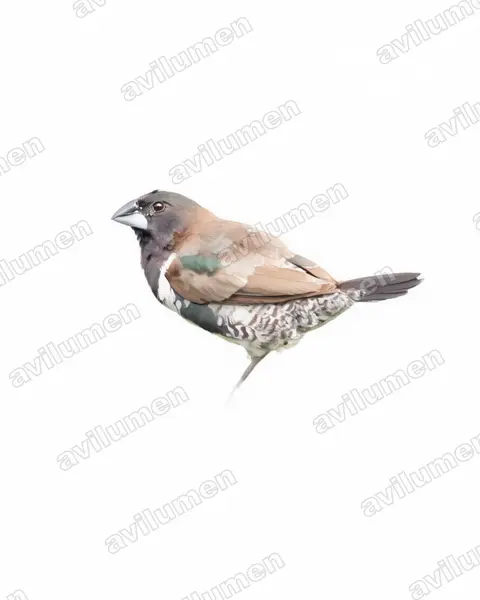
Watercolor 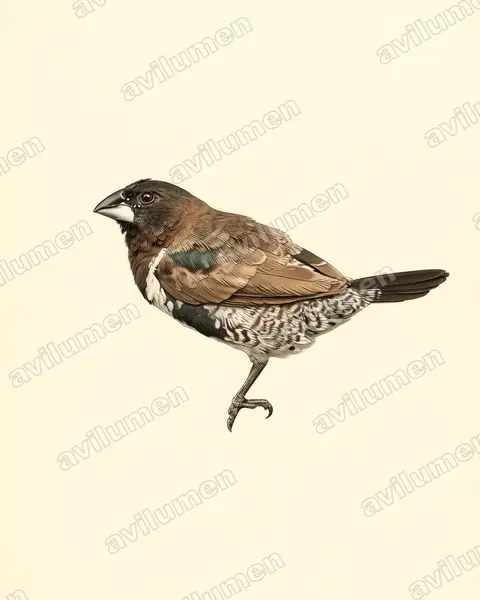
Vintage plate 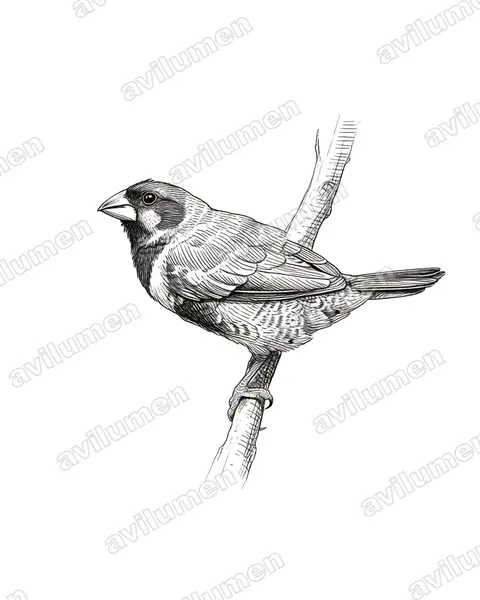
Ink 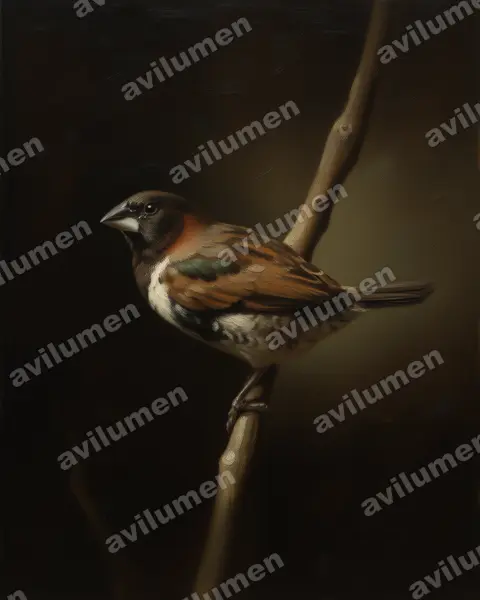
Oil 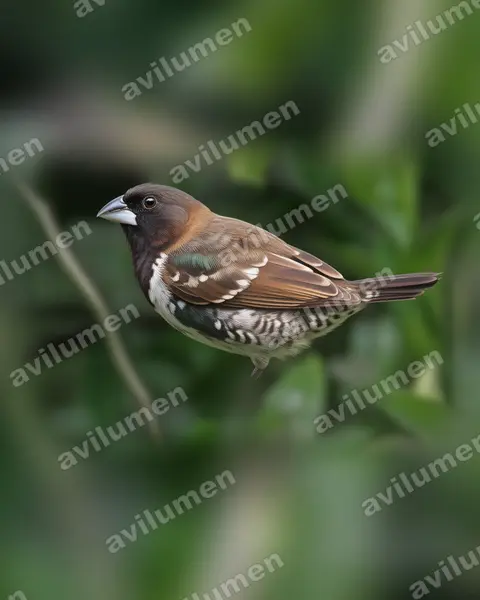
Realistic 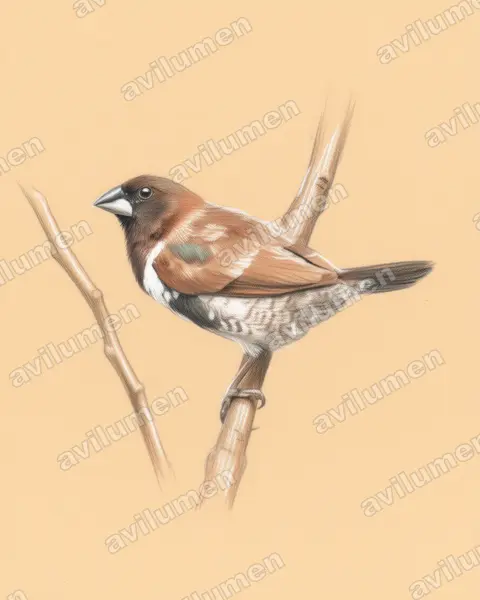
Colored pencil
Illustrations based on the photograph by gisela gerson lohman-braun (CC BY-SA 2.0), from Wikimedia Commons.
Digital editions
HD Digital Art Pack — Bronze mannikin
Digital download: 6 high-resolution illustrations of the Bronze mannikin (Spermestes cucullata), print-ready. This is a digital file; no animal or physical item is included.
AI Avatar — Bronze mannikin
Generate an avatar fusing your face with the Bronze mannikin (Spermestes cucullata). Delivered digitally in 8K, watermark-free. Digital product; no animals are sold or brokered.
Instant download. No live birds are sold.
Frequently asked questions
- Is Spermestes cucullata (Bronze mannikin) endangered?
- The IUCN Red List places Spermestes cucullata, commonly known as the Bronze mannikin, in the «Least concern» category. «Least concern» means it is not currently threatened.
- What family does Spermestes cucullata (Bronze mannikin) belong to?
- Spermestes cucullata (Bronze mannikin) belongs to the family Estrildidae, in the order Passeriformes.
- What colour is Spermestes cucullata (Bronze mannikin)?
- The plumage of Spermestes cucullata (Bronze mannikin) combines these colours: Brown and Black.
More from the same family
 Least concern
Red-headed finch
Amadina erythrocephala
The red-headed finch is a common species of estrildid finch found in Africa. It has an estimated global extent of occurrence of 1,600,000 km2 (620,000 sq mi). It is found in Angola, Botswana, Lesotho, Namibia, South Africa and Zimbabwe.
from $1.99
 Least concern
Cut-throat finch
Amadina fasciata
The cut-throat finch is a common species of estrildid finch found throughout Africa; it is also known as the bearded finch, the ribbon finch, the cut throat, and the weaver finch.
from $1.99
 Least concern
Red avadavat
Amandava amandava
The red avadavat, red munia or strawberry finch, is a sparrow-sized bird of the family Estrildidae. It is found in the open fields and grasslands of tropical Asia and is popular as a cage bird due to the colourful plumage of the males in their breeding season. It breeds in the Indian subcontinent in the monsoon season.
from $1.99
 Vulnerable
Green avadavat
Amandava formosa
The green avadavat or green munia is a species of Estrildid finch with green and yellow on the body, a bright red bill and black "zebra stripes" on the flanks. They are endemic to the Indian subcontinent and were formerly popular as cagebirds. The name "avadavat" is a corruption of the name the city of Ahmedabad in Gujarat, India, which was a centre of bird trade.
from $1.99