Beautiful firetail
Stagonopleura bella
Avilumen editorial team ·

The beautiful firetail is a common species of estrildid finch found in Australia. It has an estimated global extent of occurrence of 1,000,000 km2 (390,000 sq mi). The species inhabits temperate shrubland habitats in Australia. The IUCN has classified the species as being of least concern.
The beautiful firetail (Stagonopleura bella) is a common species of estrildid finch found in Australia. It has an estimated global extent of occurrence of 1,000,000 km2 (390,000 sq mi). The species inhabits temperate shrubland habitats in Australia. The IUCN has classified the species as being of least concern.
Description
At 10 to 13 cm (3.9 to 5.1 in) long and weighing 14 g (1⁄2 oz) the beautiful firetail is a small plump bird, slightly smaller than the diamond firetail. Its plumage is mostly olive-brown. The white chest has a fine pattern of dark lines. The head has a black mask with pale blue rings around the eyes and a thick red beak. Its rump is a deep red, its legs and feet are creamy pink. The wings and tail are short and rounded. Juvenile birds are less colourful with a smaller face mask and a blackish beak. The male has a black abdomen.
Distribution and habitat
The beautiful firetail is endemic to Southeastern Australia. Its distribution range extends from Newcastle to Kangaroo Island, however, the bird is most prolific in Tasmania and off-shore islands. It lives in coastal heathland, forests and shrubbery, never far from water. Its preference for near water habitats was shown in a study of its occurrence in intact forest areas of the Victorian Central Highlands, where it was almost exclusively found in riparian habitat.
The beautiful firetail is considered a resident bird, keeping close to home.
Behaviour
The beautiful firetail mainly feeds on grass seed and Casuarina and Melaleuca seeds. It can also be found in association with Banksia ericifolia heathland in coastal New South Wales. Small insects and snails occasionally complement this herbivore diet. The birds are usually found in pairs or forming small groups of up to 20 individuals.
Reproduction
In the breeding season lasting from October to January, the beautiful firetail nests in dense foliage near the ground. The nest is made of grass and thin twigs, its insides are covered in feathers. It is bottle-shaped with a long tunnel-like entrance on one side leading to a spherical nesting chamber.
Both parents build the nest together, brood the five to eight egg clutch for about 20 days, and feed the hatched chicks, which leave the nest after about another 20 days. After another four weeks the chicks are left to their own devices and reach sexual maturity at about nine to twelve months of age.
Text adapted from Wikipedia · CC BY-SA 4.0
Distribution

Taxonomy
- Order
- Passeriformes
- Family
- Estrildidae
- Genus
- Stagonopleura
- Conservation status
- Least concern
Listen to its call
No recording yet
Care guide
Canary and Finch Care Guide: Diet, Housing and Breeding
How to care for canaries, zebra finches, Gouldian finches and other finches: diet, flight cage setup, health, song and breeding. A guide for bird keepers.
Read the guide →Illustration gallery
6 illustrations of Stagonopleura bella (Beautiful firetail) in different styles, true to its real plumage. Shown watermarked; the art pack includes the high-resolution originals, ready to print.
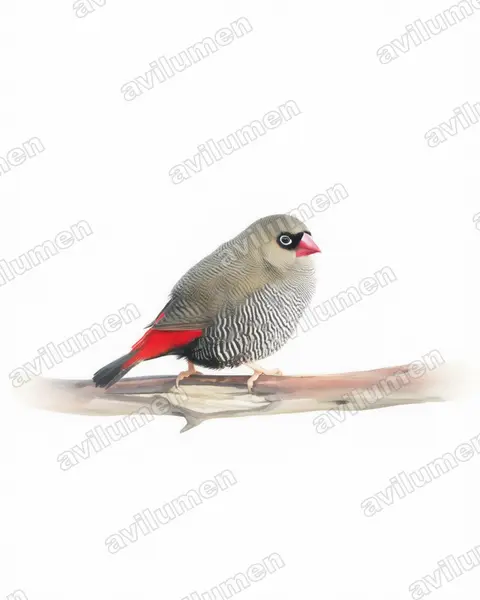
Watercolor 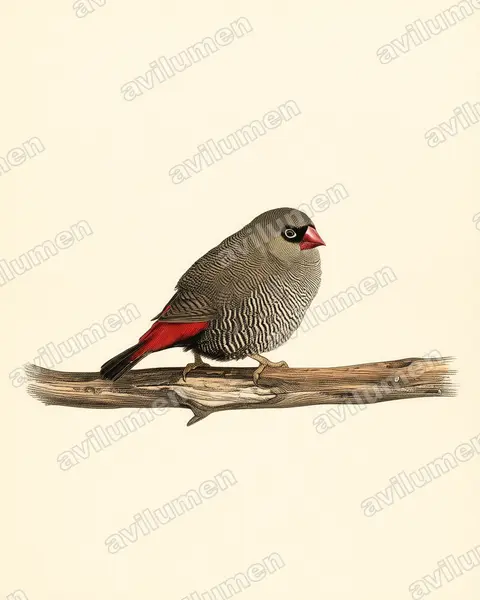
Vintage plate 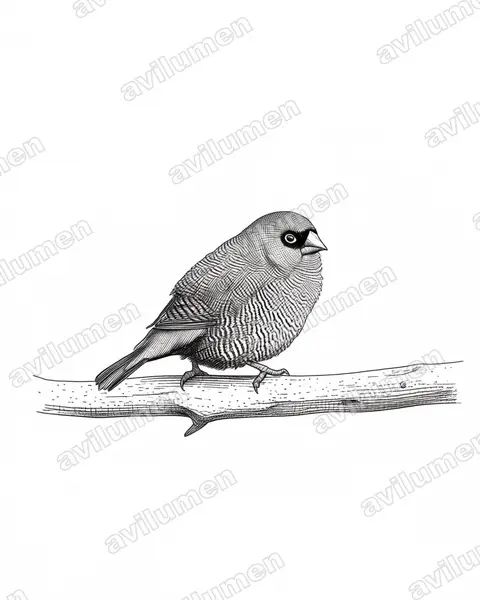
Ink 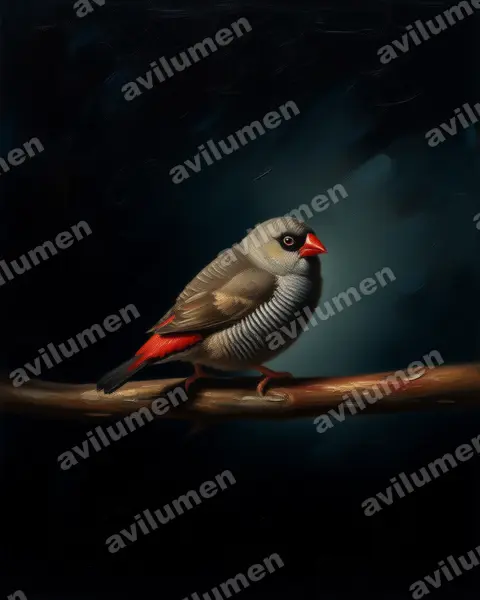
Oil 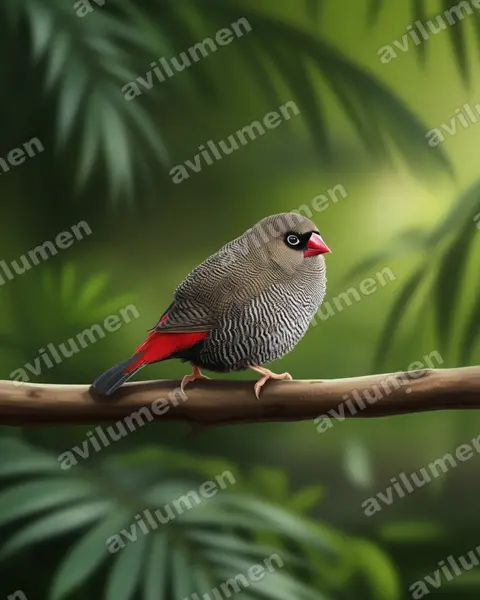
Realistic 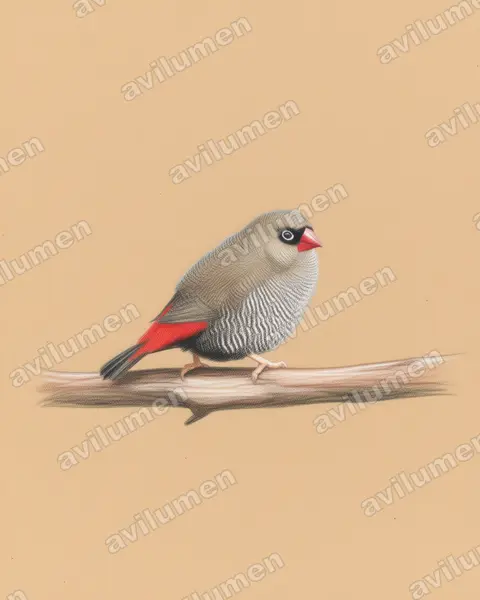
Colored pencil
Illustrations based on the photograph by JJ Harrison (https://www.jjharrison.com.au/) (CC BY-SA 3.0), from Wikimedia Commons.
Digital editions
HD Digital Art Pack — Beautiful firetail
Digital download: 6 high-resolution illustrations of the Beautiful firetail (Stagonopleura bella), print-ready. This is a digital file; no animal or physical item is included.
AI Avatar — Beautiful firetail
Generate an avatar fusing your face with the Beautiful firetail (Stagonopleura bella). Delivered digitally in 8K, watermark-free. Digital product; no animals are sold or brokered.
Instant download. No live birds are sold.
Frequently asked questions
- Is Stagonopleura bella (Beautiful firetail) endangered?
- The IUCN Red List places Stagonopleura bella, commonly known as the Beautiful firetail, in the «Least concern» category. «Least concern» means it is not currently threatened.
- Where does Stagonopleura bella (Beautiful firetail) live?
- Stagonopleura bella (Beautiful firetail) is found in Australia.
- What family does Stagonopleura bella (Beautiful firetail) belong to?
- Stagonopleura bella (Beautiful firetail) belongs to the family Estrildidae, in the order Passeriformes.
- What colour is Stagonopleura bella (Beautiful firetail)?
- The plumage of Stagonopleura bella (Beautiful firetail) combines these colours: Red and Brown.
More from the same family
 Least concern
Red-headed finch
Amadina erythrocephala
The red-headed finch is a common species of estrildid finch found in Africa. It has an estimated global extent of occurrence of 1,600,000 km2 (620,000 sq mi). It is found in Angola, Botswana, Lesotho, Namibia, South Africa and Zimbabwe.
from $1.99
 Least concern
Cut-throat finch
Amadina fasciata
The cut-throat finch is a common species of estrildid finch found throughout Africa; it is also known as the bearded finch, the ribbon finch, the cut throat, and the weaver finch.
from $1.99
 Least concern
Red avadavat
Amandava amandava
The red avadavat, red munia or strawberry finch, is a sparrow-sized bird of the family Estrildidae. It is found in the open fields and grasslands of tropical Asia and is popular as a cage bird due to the colourful plumage of the males in their breeding season. It breeds in the Indian subcontinent in the monsoon season.
from $1.99
 Vulnerable
Green avadavat
Amandava formosa
The green avadavat or green munia is a species of Estrildid finch with green and yellow on the body, a bright red bill and black "zebra stripes" on the flanks. They are endemic to the Indian subcontinent and were formerly popular as cagebirds. The name "avadavat" is a corruption of the name the city of Ahmedabad in Gujarat, India, which was a centre of bird trade.
from $1.99