Ruspoli's Turaco
Tauraco ruspolii
Avilumen editorial team ·

Ruspoli's turaco, also known as Prince Ruspoli's turaco, is a species of bird in the family Musophagidae. It is endemic to southern Ethiopia where its natural habitat is subtropical or tropical dry forests. It is threatened by habitat loss.
Ruspoli's turaco (Menelikornis ruspolii), also known as Prince Ruspoli's turaco, is a species of bird in the family Musophagidae. It is endemic to southern Ethiopia where its natural habitat is subtropical or tropical dry forests. It is threatened by habitat loss.
Taxonomy
The species was first collected by Eugenio Ruspoli in either 1892 or 1893, but due to his subsequent death, the location and date of this find remain unknown. However, his collection was examined by T. Salvadori, who named the bird in his honor.
Habitat
Prince Ruspoli's Turaco, also known as Tauraco ruspolii, is primarily found in juniper (Juniperus) woodland accompanied by dense evergreen undergrowth near Arero and Wadera. However, it is believed that this elusive bird species has a preference for drier forest edges, acacia-conifer woodland, and mixed broadleaf scrub. It typically inhabits elevations ranging from 1250 to 1860 meters above sea level.
Text adapted from Wikipedia · CC BY-SA 4.0
Taxonomy
- Order
- Musophagiformes
- Family
- Musophagidae
- Genus
- Tauraco
- Conservation status
- Near threatened
Listen to its call
No recording yet
Illustration gallery
6 illustrations of Tauraco ruspolii (Ruspoli's Turaco) in different styles, true to its real plumage. Shown watermarked; the art pack includes the high-resolution originals, ready to print.
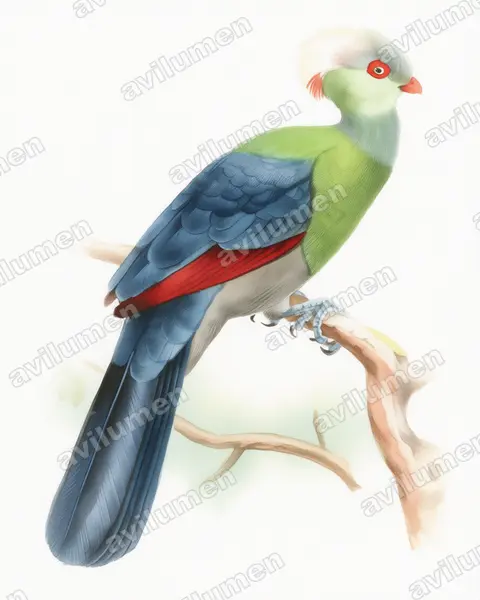
Watercolor 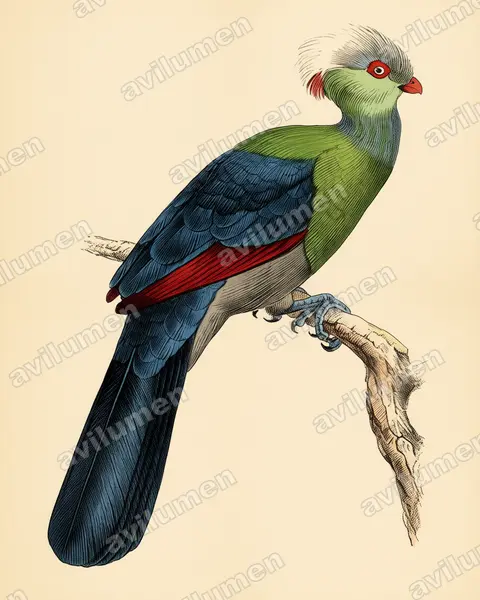
Vintage plate 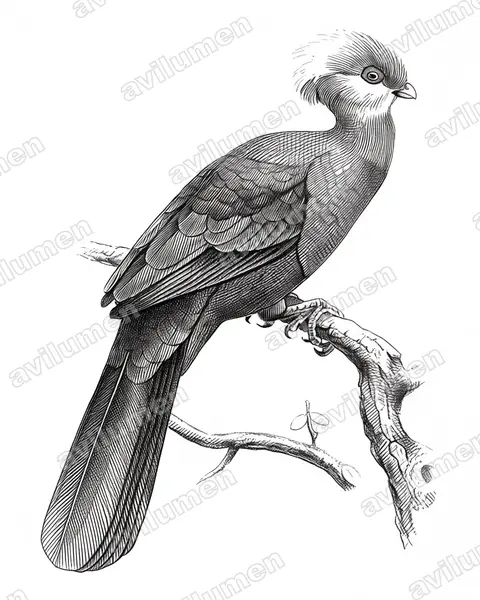
Ink 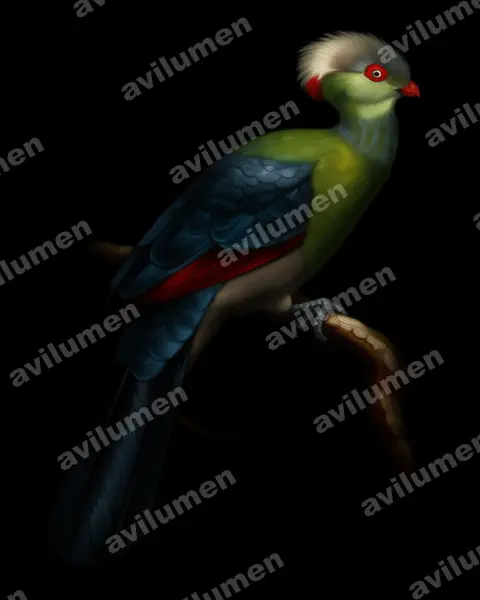
Oil 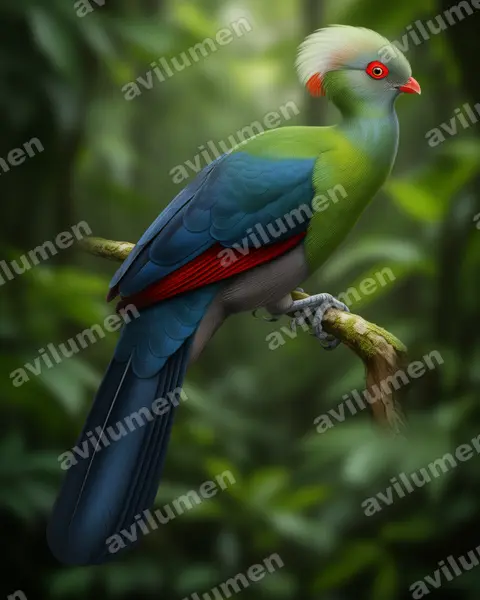
Realistic 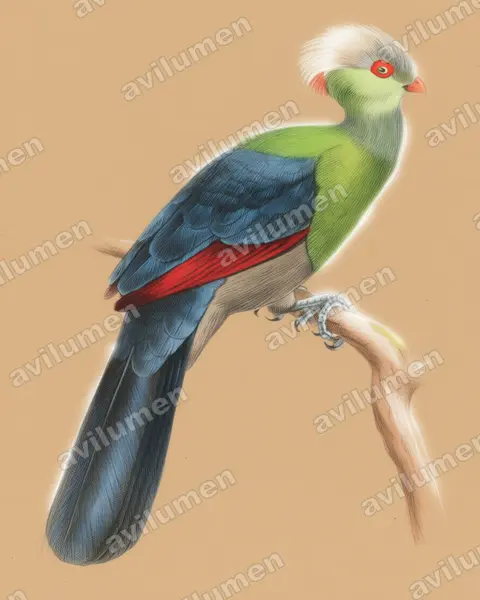
Colored pencil
Illustrations based on the photograph by Henrik Grønvold (Public domain), from Wikimedia Commons.
Digital editions
HD Digital Art Pack — Ruspoli's Turaco
Digital download: 6 high-resolution illustrations of the Ruspoli's Turaco (Tauraco ruspolii), print-ready. This is a digital file; no animal or physical item is included.
AI Avatar — Ruspoli's Turaco
Generate an avatar fusing your face with the Ruspoli's Turaco (Tauraco ruspolii). Delivered digitally in 8K, watermark-free. Digital product; no animals are sold or brokered.
Instant download. No live birds are sold.
Frequently asked questions
- Is Tauraco ruspolii (Ruspoli's Turaco) endangered?
- The IUCN Red List places Tauraco ruspolii, commonly known as the Ruspoli's Turaco, in the «Near threatened» category. «Near threatened» means it is not threatened yet, but is close to becoming so.
- Where does Tauraco ruspolii (Ruspoli's Turaco) live?
- Tauraco ruspolii (Ruspoli's Turaco) is found in Africa.
- What family does Tauraco ruspolii (Ruspoli's Turaco) belong to?
- Tauraco ruspolii (Ruspoli's Turaco) belongs to the family Musophagidae, in the order Musophagiformes.
- What colour is Tauraco ruspolii (Ruspoli's Turaco)?
- The plumage of Tauraco ruspolii (Ruspoli's Turaco) combines these colours: Green.
More from the same family
 Least concern
Great Blue Turaco
Corythaeola cristata
The great blue turaco is a bird species of the family Musophagidae. At 70–76 cm (28–30 in) in length, it is the largest species of turaco. It has predominantly grey-blue plumage with an upright blue-black crest around 10 cm (3.9 in) high. The male and female have similar plumage. It is widespread throughout the African tropical rainforest.
from $1.99
 Least concern
Grey Go-away-bird
Corythaixoides concolor
The grey go-away-bird, also known as grey lourie, grey loerie, or kwêvoël, is a bold and common turaco of the southern Afrotropics. They are present in arid to moist, open woodlands and thorn savanna, especially near surface water. They regularly form groups and parties that forage in tree tops, or dust bathe on the ground.
from $1.99
 Not evaluated
White-bellied go-away-bird
Corythaixoides leucogaster
The white-bellied go-away-bird is a bird of eastern Africa in the family Musophagidae, commonly known as turacos.
from $1.99
 Least concern
Bare-faced Go-away-bird
Corythaixoides personatus
The bare-faced go-away-bird is a species of bird in the family Musophagidae which is native to the eastern Afrotropics. It is named for its distinctive and uniquely bare, black face.
from $1.99