Pin-tailed Whydah
Vidua macroura
Avilumen editorial team ·

The pin-tailed whydah is a small songbird with a conspicuous pennant-like tail in breeding males. It is a resident breeding bird in most of Africa south of the Sahara Desert.
The pin-tailed whydah (Vidua macroura) is a small songbird with a conspicuous pennant-like tail in breeding males. It is a resident breeding bird in most of Africa south of the Sahara Desert.
Taxonomy
The pin-tailed whydah was first described by the German naturalist Peter Simon Pallas in 1764 and given the binomial name Fringilla macroura.
Description
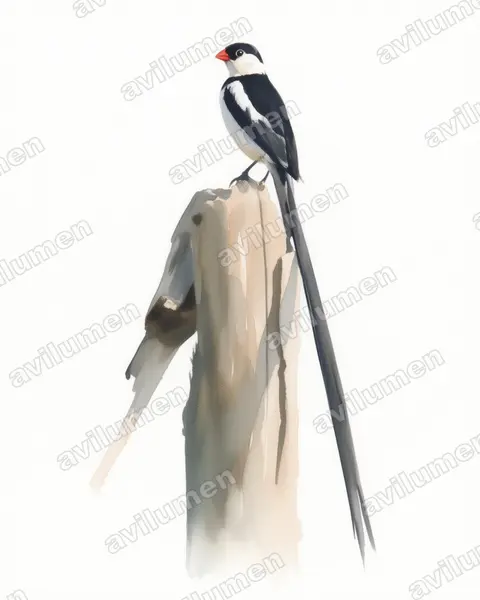
The pin-tailed whydah is 12–13 cm in length, although the breeding male's tail adds another 20 cm to this. The adult male has a black back and crown, and a very long black tail. The wings are dark brown with white patches, and the underparts and the head, apart from the crown, are white. The bill is bright red. The female and non-breeding male have streaked brown upperparts, whitish underparts with buff flanks, and a buff and black face pattern. They lack the long tail extension, but retain the red bill. Immature birds are like the female but plainer and with a greyish bill.
Distribution and habitat
The pin-tailed whydah occurs in much of sub-Saharan Africa, favouring grassland, scrubs and savannah, also coming into parks and gardens. In Portugal it is established in the region around Aveiro, with observations occurring north and south of it. It has been introduced to southern California, with a sizable population existing there, as well as Puerto Rico and Singapore. It can be kept as a domesticated pet in the United States. It is also widely kept as a cage bird elsewhere, with occasional escapes and releases.
Ecology
The species is a brood parasite which lays its eggs in the nests of estrildid finches, especially waxbills. Unlike the common cuckoo, it does not destroy the host's eggs. Typically, 2–4 eggs are added to those already present. The eggs of both the host and the whydah are white, although the whydah's are slightly larger. The nestling whydahs mimic the gape pattern of the fledglings of the host species.
The male pin-tailed whydah is territorial, and one male often has several females in his small group. He has an elaborate courtship flight display, which includes hovering over the female to display his tail. The song is given from a high perch, and consists of rapid squeaking and churring. The diet of this species consists of seeds and grain.
Text adapted from Wikipedia · CC BY-SA 4.0
Where it lives
Taxonomy
- Order
- Passeriformes
- Family
- Viduidae
- Genus
- Vidua
- Conservation status
- Least concern
Listen to its call
No recording yet
Illustration gallery
6 illustrations of Vidua macroura (Pin-tailed Whydah) in different styles, true to its real plumage. Shown watermarked; the art pack includes the high-resolution originals, ready to print.
Watercolor 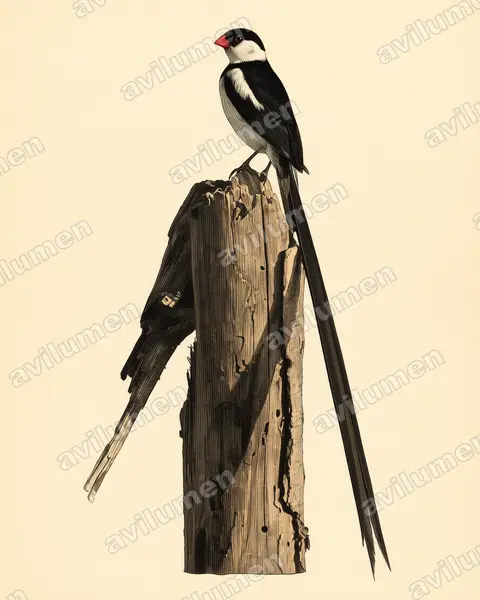
Vintage plate 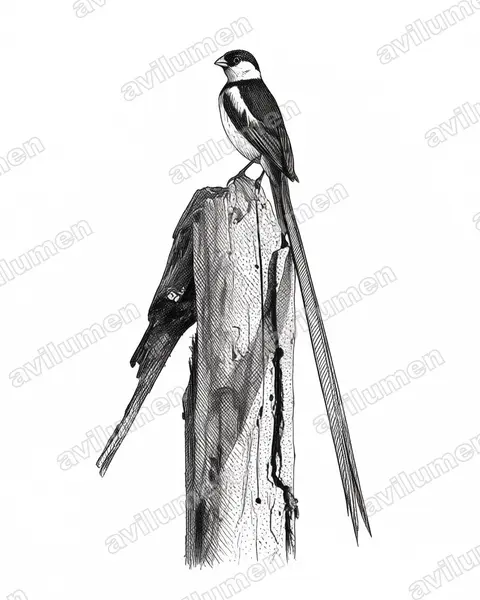
Ink 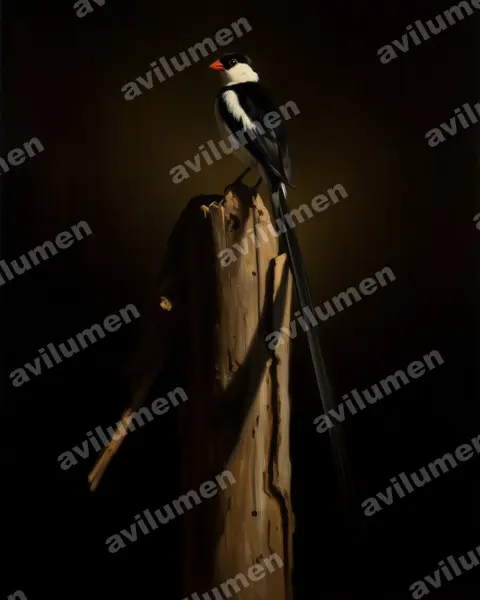
Oil 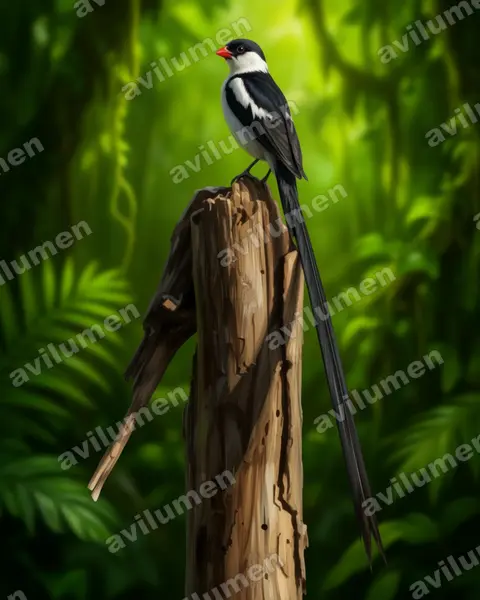
Realistic 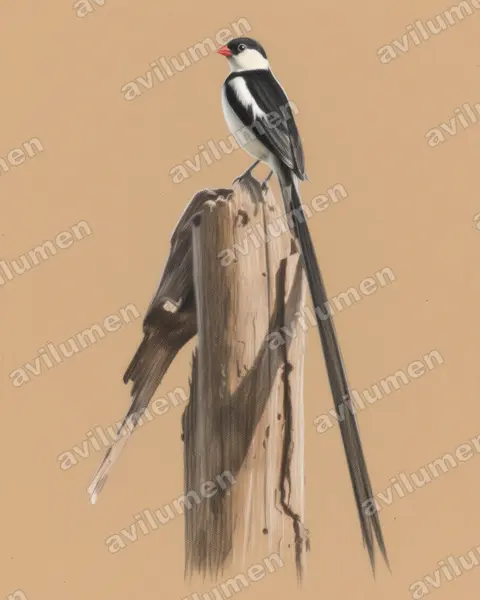
Colored pencil
Illustrations based on the photograph by Charles J. Sharp (CC BY-SA 4.0), from Wikimedia Commons.
Digital editions
HD Digital Art Pack — Pin-tailed Whydah
Digital download: 6 high-resolution illustrations of the Pin-tailed Whydah (Vidua macroura), print-ready. This is a digital file; no animal or physical item is included.
AI Avatar — Pin-tailed Whydah
Generate an avatar fusing your face with the Pin-tailed Whydah (Vidua macroura). Delivered digitally in 8K, watermark-free. Digital product; no animals are sold or brokered.
Instant download. No live birds are sold.
Frequently asked questions
- Is Vidua macroura (Pin-tailed Whydah) endangered?
- The IUCN Red List places Vidua macroura, commonly known as the Pin-tailed Whydah, in the «Least concern» category. «Least concern» means it is not currently threatened.
- Where does Vidua macroura (Pin-tailed Whydah) live?
- Vidua macroura (Pin-tailed Whydah) is found in Africa and Burkina Faso.
- What family does Vidua macroura (Pin-tailed Whydah) belong to?
- Vidua macroura (Pin-tailed Whydah) belongs to the family Viduidae, in the order Passeriformes.
- What colour is Vidua macroura (Pin-tailed Whydah)?
- The plumage of Vidua macroura (Pin-tailed Whydah) combines these colours: Black and White.