Blue-fronted Parrot
Amazona aestiva
Avilumen editorial team ·

The blue-fronted amazon, also called the blue-fronted parrot, the turquoise-fronted amazon and the turquoise-fronted parrot, is a South American species of amazon parrot and one of the most common amazon parrots kept in captivity as a pet or companion parrot. Its common name is derived from the distinctive blue/turquoise marking on its head just above its beak.
The blue-fronted amazon (Amazona aestiva), also called the blue-fronted parrot, the turquoise-fronted amazon and the turquoise-fronted parrot, is a South American species of amazon parrot and one of the most common amazon parrots kept in captivity as a pet or companion parrot. Its common name is derived from the distinctive blue/turquoise marking on its head just above its beak.
Taxonomy
The blue-fronted amazon was one of the many species originally described by Carl Linnaeus in his landmark 1758 10th edition of Systema Naturae. Its specific epithet is the feminine form of the Latin adjective aestivus, "of the summer". Two subspecies are recognized:
A. a. aestiva (nominate) is found in eastern Brazil. The leading edge of the wing ("shoulder") is red.
A. a. xanthopteryx occurs from northern and eastern Bolivia through adjacent parts of Brazil, to Paraguay and northern Argentina. The "shoulder" is partly or wholly yellow. Generally with more yellow to the head than nominate.
The taxon xanthopteryx has been treated as a separate species, but the two subspecies interbreed freely where they come into contact.
Additionally, there are significant individual variations in both facial pattern and amount of yellow/red to the "shoulder". In one extreme, individuals with essentially no yellow on the head and entirely green "shoulders" are known from north-western Argentina.
Description
The blue-fronted amazon is a mainly green parrot about 38 cm (15 in) long. They have blue feathers on the forehead above the beak and yellow on the face and crown. Distribution of blue and yellow varies greatly among individuals. Unlike most other Amazona parrots, its beak is mostly black. There is no overt sexual dimorphism to the human eye, but analysis of the feathers using spectrometry, a method which allows the plumage to be seen as it would be by a parrot's tetrachromatic vision, shows clear differences between the plumage of the sexes. Juveniles of parrots are duller and have dark irises.
Distribution and habitat
The range of the blue-fronted amazon extends over eastern and northern Bolivia, eastern Brazil, Paraguay and northern Argentina. It is found in forests (though generally avoids extensive humid forests such as the Amazon), woodland, savanna and palm groves.
A small feral breeding population is also present in the greener regions of Stuttgart in Germany and Genoa in Italy. Although they have been observed in the wild in Puerto Rico, they are probably the result of escaped pets, and no reproduction has been recorded.
Breeding
The blue-fronted amazon nests in tree cavities. The oval eggs are white and measure around 38 × 30 mm. There are usually three to five in a clutch. The female incubates the eggs for about 27 days and the chicks leave the nest about 60 days after hatching.
Status
The status of this species is evaluated as being of least concern by BirdLife International. However, while it remains common throughout a significant part of its range, there is evidence of a population decline, and this species has been heavily traded: Since 1981 when it was listed on CITES Appendix II, 413,505 wild-caught individuals have been recorded in international trade (UNEP-WCMC CITES Trade Database, January 2005). It is regarded as a crop pest in parts of its native range.
Paradoxically, illegal trade may have contributed to expansions of the range of this parrot: It is becoming common in Rio de Janeiro, which is not a part of its historical range, something attributed to escaped caged birds.
Aviculture
The blue-fronted amazon is commonly seen as a pet, both in South America and other parts of the world. Their talking ability varies greatly from individual to individual, but some speak nearly as well as the yellow-headed amazon group (yellow-naped, Panama, yellow-crowned, double yellow-headed). They seem to have a proclivity for singing. They require interaction but also can play with toys contently for several hours at a time. Pets require plenty of toys, perches, and climbing room. As with some other birds, under no circumstances are blue-fronted amazons to eat avocado. Some individuals, particularly males, can be aggressive in spring, the mating season.
An extremely rare red (or chocolate raspberry) mutation of the species appeared in captivity in 2004, bred by the psittaculturist Howard Voren. The mutation results in yellow plumage being replaced by that of a red/pink hue and greens with a chocolate-brown, with the depth and intensity of color varying by location upon the body.
Cited text
Forshaw, Joseph M.; Cooper, William T. (1978). Parrots of the World (2nd ed.). Melbourne: Landsdowne Editions. ISBN 0-7018-0690-7.
Text adapted from Wikipedia · CC BY-SA 4.0
Where it lives
Distribution

Taxonomy
- Order
- Psittaciformes
- Family
- Psittacidae
- Genus
- Amazona
- Conservation status
- Near threatened
Listen to its call
No recording yet
Care guide
Amazon, African Grey and Eclectus Parrot Care Guide
How to care for Amazon parrots, African greys, eclectus and pionus: diet, cage setup, health, behavior and CITES requirements for medium and large parrots.
Read the guide →Illustration gallery
6 illustrations of Amazona aestiva (Blue-fronted Parrot) in different styles, true to its real plumage. Shown watermarked; the art pack includes the high-resolution originals, ready to print.
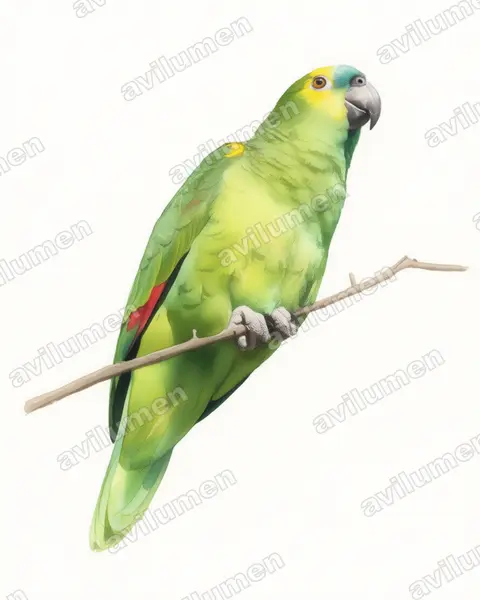
Watercolor 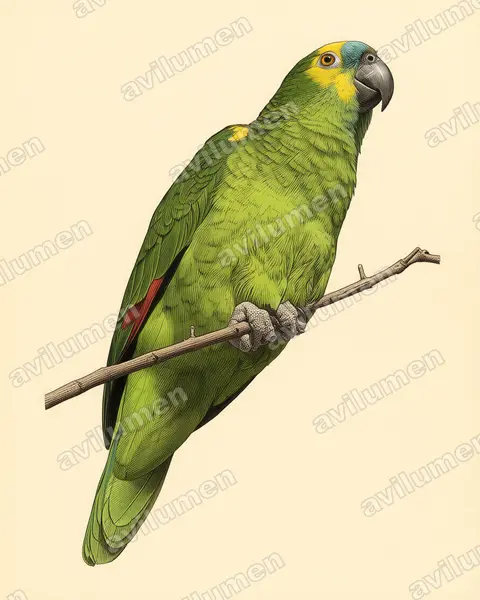
Vintage plate 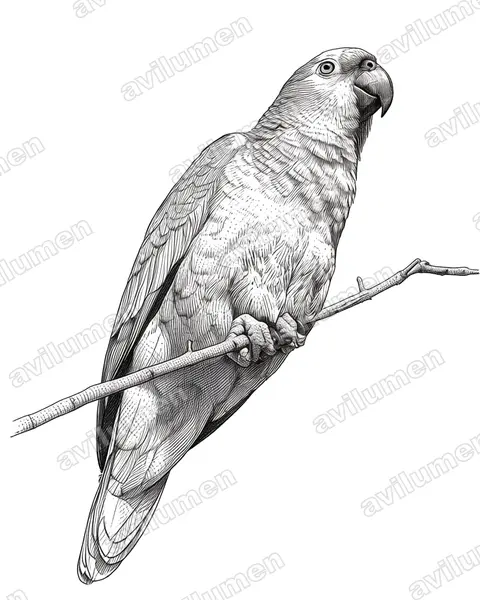
Ink 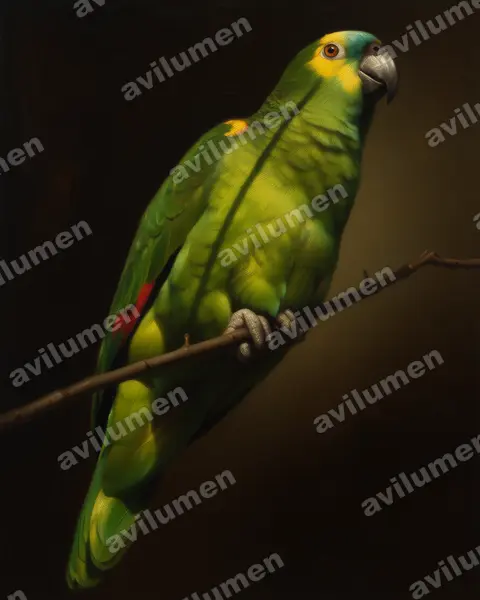
Oil 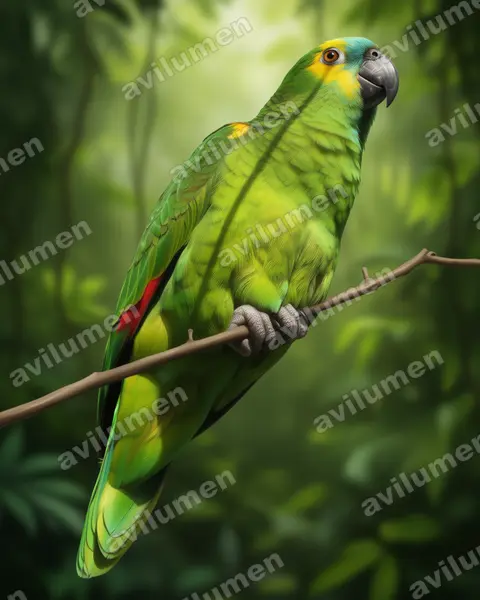
Realistic 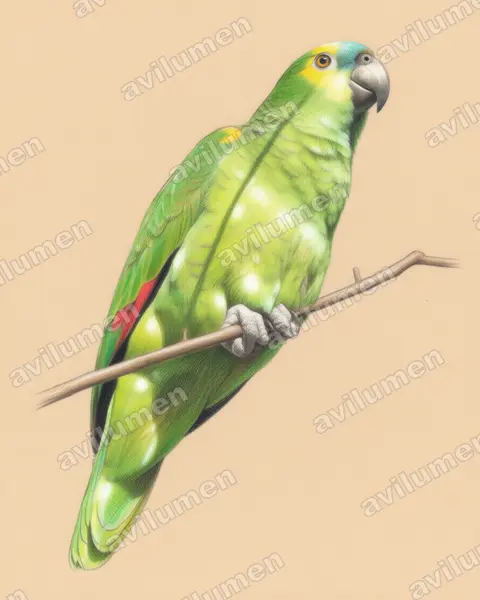
Colored pencil
Illustrations based on the photograph by derivative work: Snowmanradio (talk) Blue-fronted_Amazon_(Amazona_aestiva)_-8.jpg: mauroguanandi (CC BY 2.0), from Wikimedia Commons.
Digital editions
HD Digital Art Pack — Blue-fronted Parrot
Digital download: 6 high-resolution illustrations of the Blue-fronted Parrot (Amazona aestiva), print-ready. This is a digital file; no animal or physical item is included.
AI Avatar — Blue-fronted Parrot
Generate an avatar fusing your face with the Blue-fronted Parrot (Amazona aestiva). Delivered digitally in 8K, watermark-free. Digital product; no animals are sold or brokered.
Instant download. No live birds are sold.
Frequently asked questions
- Is Amazona aestiva (Blue-fronted Parrot) endangered?
- The IUCN Red List places Amazona aestiva, commonly known as the Blue-fronted Parrot, in the «Near threatened» category. «Near threatened» means it is not threatened yet, but is close to becoming so.
- Where does Amazona aestiva (Blue-fronted Parrot) live?
- Amazona aestiva (Blue-fronted Parrot) is found in Brazil and South America.
- What family does Amazona aestiva (Blue-fronted Parrot) belong to?
- Amazona aestiva (Blue-fronted Parrot) belongs to the family Psittacidae, in the order Psittaciformes.
- What colour is Amazona aestiva (Blue-fronted Parrot)?
- The plumage of Amazona aestiva (Blue-fronted Parrot) combines these colours: Green, Blue, and Yellow.
More from the same family
 Near threatened
Yellow-faced Parrot
Alipiopsitta xanthops
The yellow-faced parrot, formerly also known as the yellow-faced amazon, is the only species of the genus Alipiopsitta. It is a Neotropical parrot, and was classified in the genus Amazona for many years. It is a predominantly green and yellow-plumaged bird with a yellow head. It is a semi-nomadic species found in the cerrado region of Brazil and adjacent Bolivia.
from $1.99
 Least concern
Moluccan King Parrot
Alisterus amboinensis
The Moluccan king parrot is a parrot endemic to Peleng Island, Maluku, and West Papua in Indonesia. It is sometimes referred to as the Ambon king parrot or Amboina king parrot, but this is potentially misleading, as it is found on numerous other islands than Ambon. The male and female are similar in appearance, with a predominantly red head and underparts, green wings, and blue back and tail.
from $1.99
 Least concern
Papuan King Parrot
Alisterus chloropterus
The Papuan king parrot, also known as the green-winged king parrot, is a species of parrot in the family Psittaculidae found in New Guinea. Its natural habitats are subtropical or tropical moist lowland forest and subtropical or tropical moist montane forest.
from $1.99
 Least concern
Australian King Parrot
Alisterus scapularis
The Australian king parrot is a species of parrot endemic to eastern Australia ranging from Cooktown in Queensland to Port Campbell in Victoria. Found in humid and heavily forested upland regions of the eastern portion of the continent, including eucalyptus wooded areas in and directly adjacent to subtropical and temperate rainforest. They feed on fruits and seeds gathered from trees or on the ground.
from $1.99