Southern Mealy Amazon
Amazona farinosa
Avilumen editorial team ·

The mealy amazon or mealy parrot is among the largest parrots in the genus Amazona, the amazon parrots. It is a mainly green parrot with a total length of 38–41 cm (15–16 in). It is native to tropical Central and South America. This species, the southern mealy amazon, the northern mealy amazon are considered conspecific.
The mealy amazon or mealy parrot (Amazona farinosa) is among the largest parrots in the genus Amazona, the amazon parrots. It is a mainly green parrot with a total length of 38–41 cm (15–16 in). It is native to tropical Central and South America. This species, the southern mealy amazon (Amazona farinosa farinosa), the northern mealy amazon (Amazona farinosa guatemalae) are considered conspecific.
Taxonomy
A. f. guatemalae: Found from southeastern Mexico to Honduras. Also known as the northern mealy amazon, blue-crowned mealy amazon or the Guatemalan amazon.
A. f. virenticeps: Found in Nicaragua to western Panama. Also known as the Costa Rican mealy amazon or the green-headed amazon.
A. f. farinosa : Found in tropical Central and South America. Also known as the southern mealy amazon.
The mealy amazon was described by the French polymath Georges-Louis Leclerc, Comte de Buffon in 1780 in his Histoire Naturelle des Oiseaux from a specimen collected in Cayenne, French Guiana. The bird was also illustrated in a hand-coloured plate engraved by François-Nicolas Martinet in the Planches Enluminées D'Histoire Naturelle which was produced under the supervision of Edme-Louis Daubenton to accompany Buffon's text. Neither the plate caption nor Buffon's description included a scientific name but in 1783 the Dutch naturalist Pieter Boddaert coined the binomial name Psittacus farinosus in his catalogue of the Planches Enluminées. The mealy amazon is now placed in the large Neotropical genus Amazona that was introduced by the French naturalist René Lesson in 1830. The species is monotypic. The specific epithet farinosa is from the Latin farinosus meaning "sprinkled with flour", referring to down feather § powder down.
Description
The mealy amazon has a total length of about 38–41 cm (15–16 in) and weighs 540–700 g (19–25 oz). Captives commonly are heavier. It is among the largest parrots in the Americas, mainly being surpassed by the large macaws. It has a relatively short and square shaped tail, as do the other members of the Amazona genus.
The mealy amazon is mainly green. The back and nape often have a whitish tinge; almost as if it had been covered in a thin layer of flour ("meal"; hence its name). The distal half of the tail is paler and more yellow than the basal half, thus resulting in a distinctly bi-colored look. In flight it shows a bluish-black trailing edge to the wing and a conspicuous red speculum. Occasionally a few yellow feathers are apparent on the top of the head.
In South America, it is commonly confused with the yellow-crowned amazon, but can be recognized by its larger size, less yellow to the crown (not entirely reliable, as some yellow-crowned may show almost none), the whitish tinge to its plumage, broader white eye-ring, and red of the leading edge of the wing placed near the phalanx (not near the radiale), but this is often difficult to see (especially on perched birds). Their voices are also strikingly different.
Distribution and habitat
The mealy amazon occurs in tropical Central America and South America. It frequents humid to semi-humid forest (only rarely in deciduous forest) and plantations. In regions dominated by open/dry habitats it is restricted to gallery forest or completely absent.
Behaviour
The mealy amazon is social and can be found in pairs or in large flocks. They are even known to interact with other parrots, such as macaws. They are usually quiet but can be loud at dusk and dawn. In captivity, they are known as one of the gentlest and calmest of all amazons.
Breeding
After mealy amazons reach sexual maturity they usually form monogamous relationships with a single partner. Each year courtship usually begins in early spring, and the female will usually lay three or four white eggs in a tree-cavity nest. The female incubates the eggs for about 26 days. The male regurgitates food for the female during the incubation period, and later for the chicks in the nest as well. The chicks leave the nest about 60 days after hatching.
Food and feeding
The diet of the mealy amazon consists mostly of fruits, seeds, berries, nuts, blossoms, and leaf buds.
Status and conservation
It is fairly common in most of its range, but has declined locally due to habitat loss and trapping for the wild parrot trade. Trafficking of the birds (as for exotic pets) is illegal in many nations, but the species are still smuggled into the United States from Mexico. In some areas mealy amazons are hunted as food. The mealy amazon sometimes feeds on human crops (especially corn) and may be considered a crop pest.
The mealy amazon is bred in captivity with some regularity. It is sometimes kept as a companion parrot and is reported by owners to have a calm, gentle, docile and affectionate temperament towards humans.
Text adapted from Wikipedia · CC BY-SA 4.0
Where it lives
Plumage colours
Distribution

Taxonomy
- Order
- Psittaciformes
- Family
- Psittacidae
- Genus
- Amazona
- Conservation status
- Least concern
Listen to its call
No recording yet
Care guide
Amazon, African Grey and Eclectus Parrot Care Guide
How to care for Amazon parrots, African greys, eclectus and pionus: diet, cage setup, health, behavior and CITES requirements for medium and large parrots.
Read the guide →Illustration gallery
6 illustrations of Amazona farinosa (Southern Mealy Amazon) in different styles, true to its real plumage. Shown watermarked; the art pack includes the high-resolution originals, ready to print.
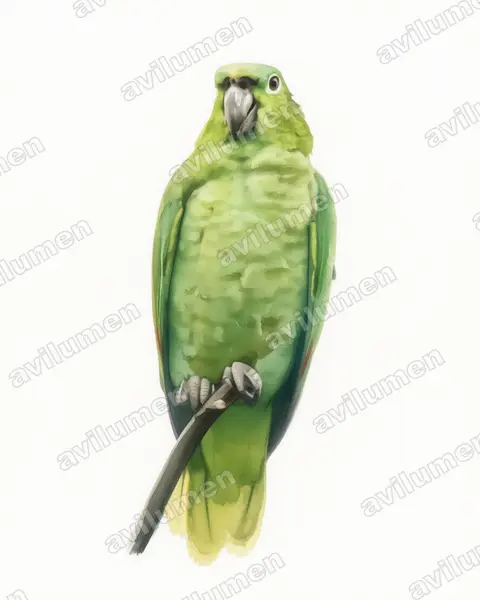
Watercolor 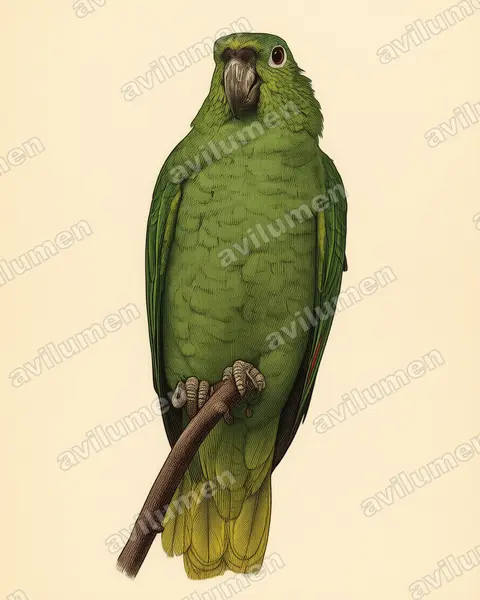
Vintage plate 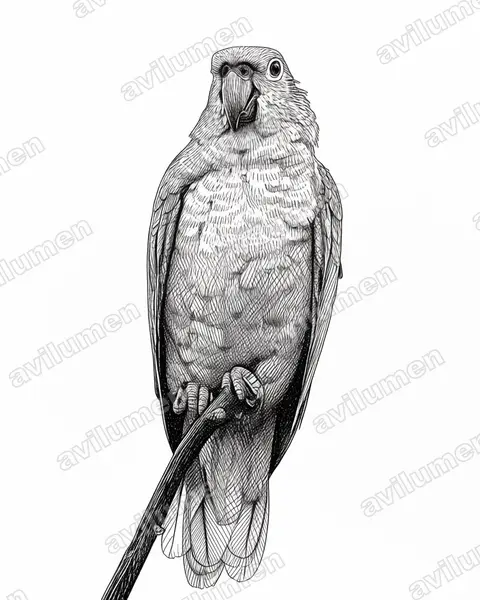
Ink 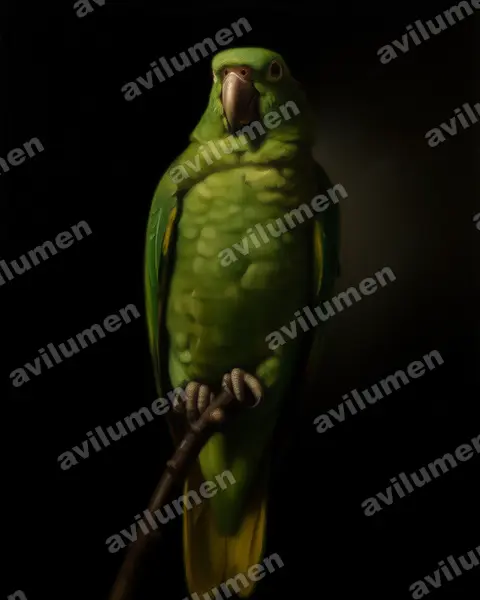
Oil 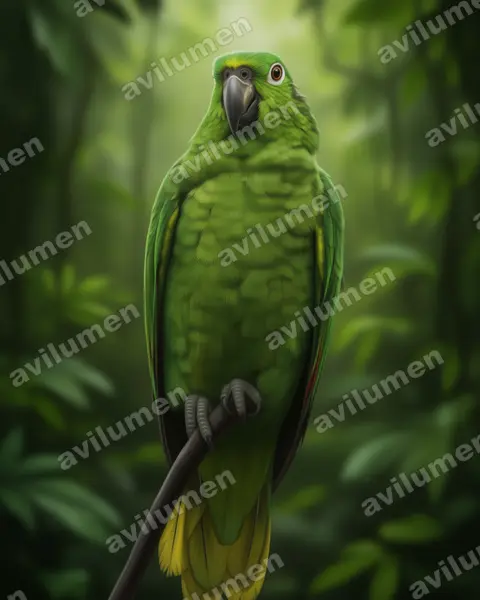
Realistic 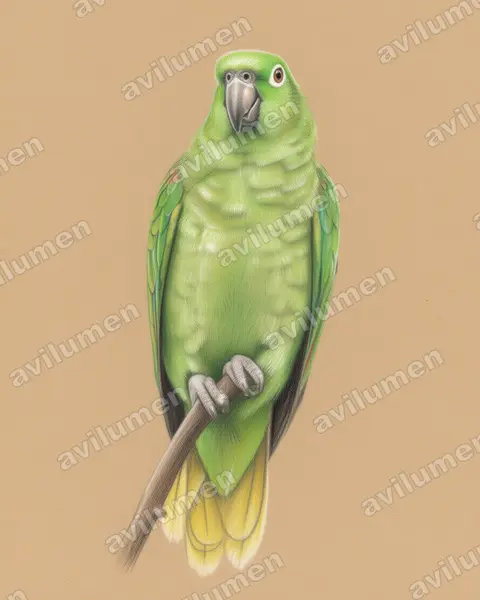
Colored pencil
Illustrations based on the photograph by Attila Oláh (CC BY 4.0), from Wikimedia Commons.
Digital editions
HD Digital Art Pack — Southern Mealy Amazon
Digital download: 6 high-resolution illustrations of the Southern Mealy Amazon (Amazona farinosa), print-ready. This is a digital file; no animal or physical item is included.
AI Avatar — Southern Mealy Amazon
Generate an avatar fusing your face with the Southern Mealy Amazon (Amazona farinosa). Delivered digitally in 8K, watermark-free. Digital product; no animals are sold or brokered.
Instant download. No live birds are sold.
Frequently asked questions
- Is Amazona farinosa (Southern Mealy Amazon) endangered?
- The IUCN Red List places Amazona farinosa, commonly known as the Southern Mealy Amazon, in the «Least concern» category. «Least concern» means it is not currently threatened.
- Where does Amazona farinosa (Southern Mealy Amazon) live?
- Amazona farinosa (Southern Mealy Amazon) is found in Brazil and South America.
- What family does Amazona farinosa (Southern Mealy Amazon) belong to?
- Amazona farinosa (Southern Mealy Amazon) belongs to the family Psittacidae, in the order Psittaciformes.
- What colour is Amazona farinosa (Southern Mealy Amazon)?
- The plumage of Amazona farinosa (Southern Mealy Amazon) combines these colours: Green.
More from the same family
 Near threatened
Yellow-faced Parrot
Alipiopsitta xanthops
The yellow-faced parrot, formerly also known as the yellow-faced amazon, is the only species of the genus Alipiopsitta. It is a Neotropical parrot, and was classified in the genus Amazona for many years. It is a predominantly green and yellow-plumaged bird with a yellow head. It is a semi-nomadic species found in the cerrado region of Brazil and adjacent Bolivia.
from $1.99
 Least concern
Moluccan King Parrot
Alisterus amboinensis
The Moluccan king parrot is a parrot endemic to Peleng Island, Maluku, and West Papua in Indonesia. It is sometimes referred to as the Ambon king parrot or Amboina king parrot, but this is potentially misleading, as it is found on numerous other islands than Ambon. The male and female are similar in appearance, with a predominantly red head and underparts, green wings, and blue back and tail.
from $1.99
 Least concern
Papuan King Parrot
Alisterus chloropterus
The Papuan king parrot, also known as the green-winged king parrot, is a species of parrot in the family Psittaculidae found in New Guinea. Its natural habitats are subtropical or tropical moist lowland forest and subtropical or tropical moist montane forest.
from $1.99
 Least concern
Australian King Parrot
Alisterus scapularis
The Australian king parrot is a species of parrot endemic to eastern Australia ranging from Cooktown in Queensland to Port Campbell in Victoria. Found in humid and heavily forested upland regions of the eastern portion of the continent, including eucalyptus wooded areas in and directly adjacent to subtropical and temperate rainforest. They feed on fruits and seeds gathered from trees or on the ground.
from $1.99