Vinaceous-breasted amazon
Amazona vinacea
Avilumen editorial team ·

The vinaceous-breasted amazon, also called the vinaceous-breasted parrot and occasionally simply vinaceous amazon/parrot is an endangered species of bird in subfamily Arinae of the family Psittacidae, the African and New World parrots. It is found in Argentina, Brazil, and Paraguay.
The vinaceous-breasted amazon (Amazona vinacea), also called the vinaceous-breasted parrot and occasionally simply vinaceous amazon/parrot is an endangered species of bird in subfamily Arinae of the family Psittacidae, the African and New World parrots. It is found in Argentina, Brazil, and Paraguay.
Taxonomy and systematics
The vinaceous-breasted amazon is monotypic.
Description
The vinaceous-breasted amazon is 30 to 36 cm (12 to 14 in) long. It is mostly green, with red lores and forehead, a turquoise nape, and a lilac breast. Its carpal edge, speculum, and base of the outer tail feathers are red. Its primaries have blue to black ends. Its bill has a rosy pink to red base and a horn-colored tip. Its iris is red-orange to chestnut surrounded by pale gray skin and its legs and feet are gray.
Distribution and habitat
The vinaceous-breasted amazon has a disjunct distribution. It is found in scattered locations generally from Brazil's São Paulo state south into Rio Grande do Sul, eastern Paraguay, and far northeastern Argentina's Misiones Province. It formerly occurred as far north as Bahia and south to Argentina's Corrientes Province. It inhabits a wide variety of landscapes within the Atlantic Forest biome but seems to concentrate in mixed forest with large amounts of paraná pine (Araucaria angustifolia). It also occurs in small forest patches, young secondary forest, pastures and grasslands with scattered trees, plantations of introduced pine and Eucalyptus, and around towns.
Movement
The vinaceous-breasted amazon does not seem to have a uniform pattern of migration. It is present in some areas only during the breeding season but is a year-round resident in others.
Feeding
The vinaceous-breasted amazon forages mostly in tree-tops and often in flocks. Seeds of paraná pine are a primary food source during winter but the species has been observed feeding on seeds, fruits, buds, and flowers of more than 30 plant species both native and introduced.
Breeding
The vinaceous-breasted amazon breeds mainly between August and December but the season may sometimes extend into March. It nests in tree cavities, some of them created by rot and others previously excavated by woodpeckers. The clutch size is two to four eggs. The female appears to do almost all of the incubation, which lasts about a month. Both parents provision nestlings; in captivity the time to fledging is about seven to 10 weeks after hatch.
Vocalization
The vinaceous-breasted amazon is usually silent at the nest and when foraging but highly vocal in flight and when perched away from the nest. Its typical call is described by one author as "'creo creo" or "crau crau", and by another as "wout-wout-" or "wi-rout wi-rout".
Status
The IUCN originally assessed the vinaceous-breasted amazon in 1988 as Threatened, then in 1994 as Endangered, in 2004 as Vulnerable, and since 2009 again as Endangered. It has a very fragmented range and its estimated population of fewer than 2500 mature individuals is believed to be decreasing. Much of its habitat in the Atlantic Forest region has been cleared for timber, agriculture, and human settlement. It is a popular cage bird, and despite prohibitions, capture for the pet trade remains a threat. Large trees for nesting are scarce in some areas. Destruction of paraná pine seedlings by farmers and illegal harvest of their seeds threatens the parrot's primary winter food.
The vinaceous-breasted amazon's nesting is affected by competition from Africanized bees (Apis mellifera scutellata), an invasive species that has spread throughout South and Central America. It occupies potential nest cavities before the parrots can and sometimes takes over active nest cavities.
Text adapted from Wikipedia · CC BY-SA 4.0
Where it lives
Plumage colours
Distribution

Taxonomy
- Order
- Psittaciformes
- Family
- Psittacidae
- Genus
- Amazona
- Conservation status
- Endangered
Listen to its call
No recording yet
Care guide
Amazon, African Grey and Eclectus Parrot Care Guide
How to care for Amazon parrots, African greys, eclectus and pionus: diet, cage setup, health, behavior and CITES requirements for medium and large parrots.
Read the guide →Illustration gallery
6 illustrations of Amazona vinacea (Vinaceous-breasted amazon) in different styles, true to its real plumage. Shown watermarked; the art pack includes the high-resolution originals, ready to print.
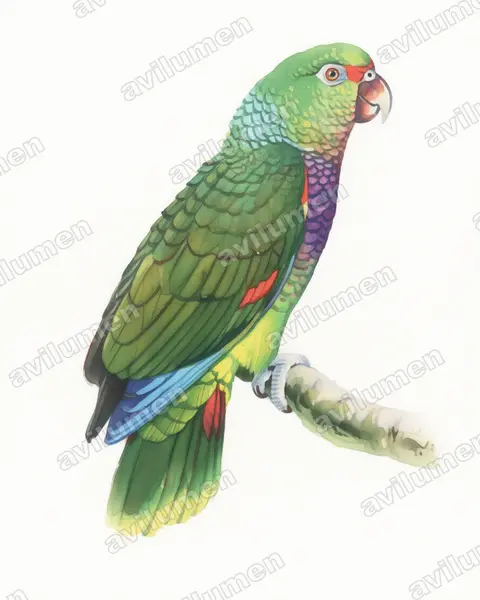
Watercolor 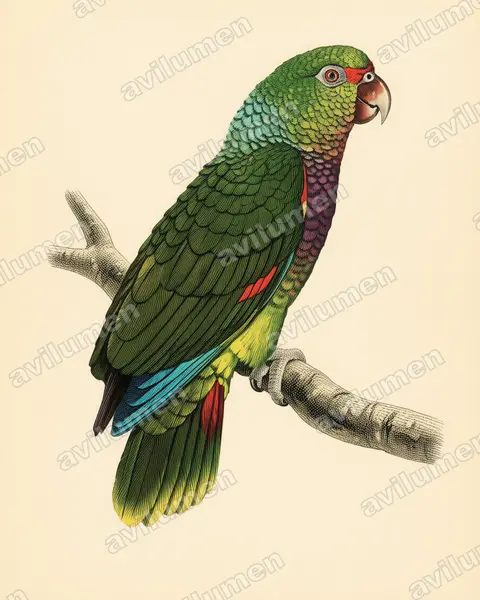
Vintage plate 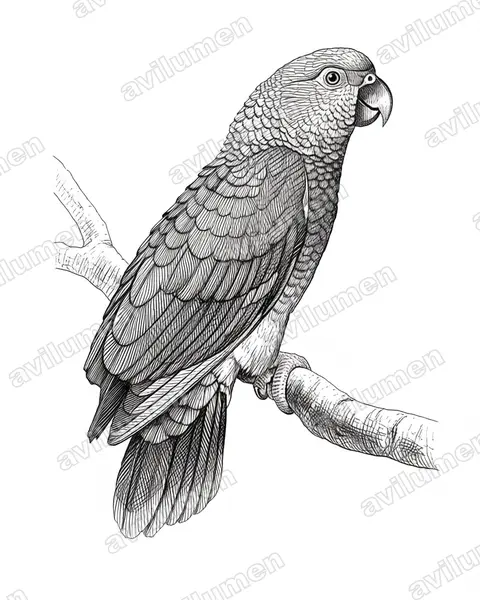
Ink 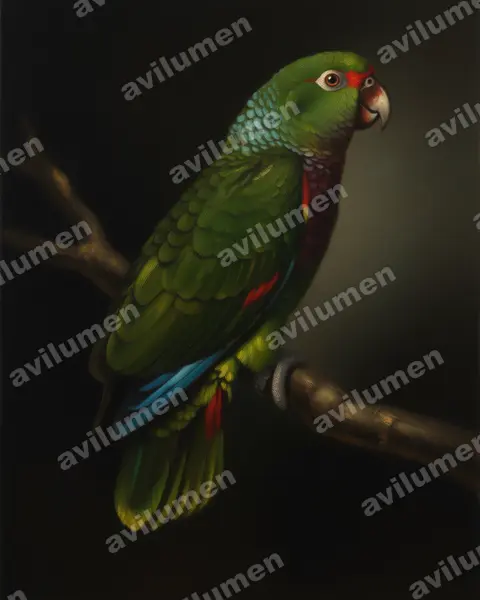
Oil 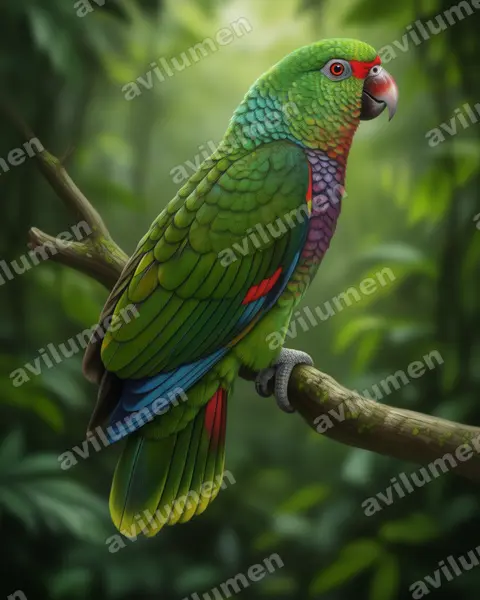
Realistic 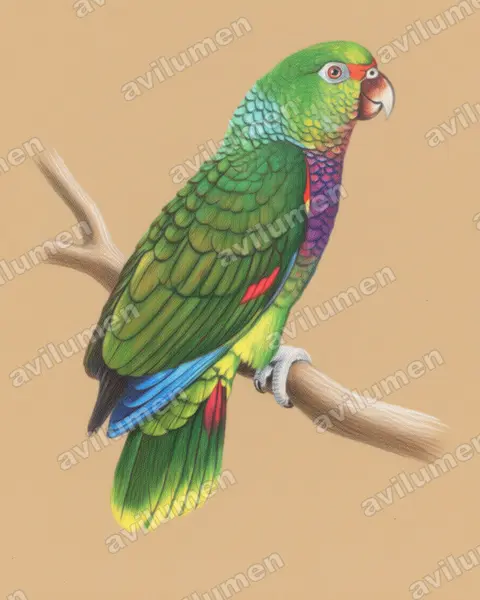
Colored pencil
Illustrations based on the photograph by Post of Brazil (Public domain), from Wikimedia Commons.
Digital editions
HD Digital Art Pack — Vinaceous-breasted amazon
Digital download: 6 high-resolution illustrations of the Vinaceous-breasted amazon (Amazona vinacea), print-ready. This is a digital file; no animal or physical item is included.
AI Avatar — Vinaceous-breasted amazon
Generate an avatar fusing your face with the Vinaceous-breasted amazon (Amazona vinacea). Delivered digitally in 8K, watermark-free. Digital product; no animals are sold or brokered.
Instant download. No live birds are sold.
Frequently asked questions
- Is Amazona vinacea (Vinaceous-breasted amazon) endangered?
- The IUCN Red List places Amazona vinacea, commonly known as the Vinaceous-breasted amazon, in the «Endangered» category. «Endangered» means it faces a very high risk of disappearing in the wild.
- Where does Amazona vinacea (Vinaceous-breasted amazon) live?
- Amazona vinacea (Vinaceous-breasted amazon) is found in Brazil and South America.
- What family does Amazona vinacea (Vinaceous-breasted amazon) belong to?
- Amazona vinacea (Vinaceous-breasted amazon) belongs to the family Psittacidae, in the order Psittaciformes.
- What colour is Amazona vinacea (Vinaceous-breasted amazon)?
- The plumage of Amazona vinacea (Vinaceous-breasted amazon) combines these colours: Green.
More from the same family
 Near threatened
Yellow-faced Parrot
Alipiopsitta xanthops
The yellow-faced parrot, formerly also known as the yellow-faced amazon, is the only species of the genus Alipiopsitta. It is a Neotropical parrot, and was classified in the genus Amazona for many years. It is a predominantly green and yellow-plumaged bird with a yellow head. It is a semi-nomadic species found in the cerrado region of Brazil and adjacent Bolivia.
from $1.99
 Least concern
Moluccan King Parrot
Alisterus amboinensis
The Moluccan king parrot is a parrot endemic to Peleng Island, Maluku, and West Papua in Indonesia. It is sometimes referred to as the Ambon king parrot or Amboina king parrot, but this is potentially misleading, as it is found on numerous other islands than Ambon. The male and female are similar in appearance, with a predominantly red head and underparts, green wings, and blue back and tail.
from $1.99
 Least concern
Papuan King Parrot
Alisterus chloropterus
The Papuan king parrot, also known as the green-winged king parrot, is a species of parrot in the family Psittaculidae found in New Guinea. Its natural habitats are subtropical or tropical moist lowland forest and subtropical or tropical moist montane forest.
from $1.99
 Least concern
Australian King Parrot
Alisterus scapularis
The Australian king parrot is a species of parrot endemic to eastern Australia ranging from Cooktown in Queensland to Port Campbell in Victoria. Found in humid and heavily forested upland regions of the eastern portion of the continent, including eucalyptus wooded areas in and directly adjacent to subtropical and temperate rainforest. They feed on fruits and seeds gathered from trees or on the ground.
from $1.99