Olive-throated Parakeet
Aratinga nana
Avilumen editorial team ·

The olive-throated parakeet, also known as the olive-throated conure in aviculture, is a species of bird in subfamily Arinae of the family Psittacidae, the African and New World parrots. It is found from Mexico to Costa Rica and in Jamaica; it has been introduced to the Dominican Republic on Hispaniola.
The olive-throated parakeet (Eupsittula nana), also known as the olive-throated conure in aviculture, is a species of bird in subfamily Arinae of the family Psittacidae, the African and New World parrots. It is found from Mexico to Costa Rica and in Jamaica; it has been introduced to the Dominican Republic on Hispaniola.
Taxonomy and systematics
The olive-throated parakeet was long included in genus Aratinga but since about 2014 has been in Eupsittula. The American Ornithological Society, the International Ornithological Committee, and the Clements taxonomy assign these three subspecies to the olive-throated parakeet:
E. n. vicinalis Bangs & Penard, T.E., 1919
E. n. astec (Souancé, 1857)
E. n. nana (Vigors, 1830)
BirdLife International's Handbook of the Birds of the World (HBW) treats E. n. astec as the species "Aztec parakeet" with E. n. vicinalis as a subspecies of it. It treats E. n. nana by itself as the "Jamaican parakeet".
This article follows the single species, three-subspecies, model.
Description
The "Jamaican" olive-throated parakeet E. n. nana is the nominate subspecies; it is 22 to 26 cm (8.7 to 10 in) long and weighs about 72 to 85 g (2.5 to 3.0 oz). The "Aztec" olive-throated parakeet is 21.5 to 25 cm (8.5 to 9.8 in) long and weighs about 85 g (3.0 oz). The sexes are alike. Adults of the nominate subspecies have a mainly dark green head and upperparts with yellowish ear coverts and rump. Bare white skin surrounds their eye. Their throat and breast are olive-brown that becomes olive on the belly and vent. Their wings are mostly green with dull blue on the upper side of the flight feathers and gray on their underside. Their tail's upper surface is green and its underside is yellowish. Their bill is browish horn color with a paler tip, their iris yellow to orange, and their legs blackish gray. Immature birds are similar to adults.
Subspecies E. n. astec ("Aztec" in part) has paler olive-brown underparts, especially on the belly and vent. Subspecies E. n. vicinalis is slightly larger than astec and is brighter green above and greener below.
Distribution and habitat
The olive-throated parakeet has two widely disjunct populations. The nominate subspecies E. n. nana is found naturally in Jamaica and has been introduced to the Dominican Republic. Subspecies E. n. vicinalis is found in northeastern Mexico from Tamaulipas to northern Veracruz. E. n. astec is found on the Caribbean side from Veracruz through Guatemala, Belize, Honduras, Nicaragua, and Costa Rica into western Panama's Bocas del Toro Province.
The olive-throated parakeet's principal habitat is deciduous woodlands. It also inhabits the interior and edges of humid forest, riparian areas, scrublands, and more open landscapes such as plantations, clearings with trees, and gardens. It occurs in pine stands throughout, a habitat which is heavily used in the Dominican Republic. In elevation it reaches 1,000 m (3,300 ft) in Mexico, 1,100 m (3,600 ft) in Honduras, 700 m (2,300 ft) in Costa Rica, and 1,500 m (4,900 ft) in Jamaica.
Movement
The nominate subspecies of the olive-throated parakeet makes some movements between moist and dryer habitats in response to the availability of food. The other two subspecies are generally considered to be year-round residents, but E. n. astec visits Caye Caulker off Belize in winter.
Feeding
A major part of the olive-throated parakeet's diet is fig fruits (Ficus); other fruits, leaves, and flowers are also eaten. On Jamaica the species is typically seen in flocks of up to about 20 individuals. On that island it is a crop pest, feeding especially on maize but also on corn and cultivated fruits. On the mainland, flocks can have 50 or more members and sometimes include Finsch's parakeet (Psittacara finschi).
Breeding
The nominate subspecies of the olive-throated parakeet nests between March and June in Jamaica and somewhat earlier in the Dominican Republic. It nests between January and April in Costa Rica and April and May in Belize and Guatemala. In all areas it nests in cavities in termitaria, which it usually excavates itself. It has nested in tree holes in Jamaica. The clutch size is three to five eggs. The incubation period, time to fledging, and details of parental care are not known.
Vocalization
The olive-throated parakeet's vocalizations differ little among the subspecies. Their calls are "a sharp, grating "krik-krik-krik-krik" or raucous "krrieh krrie krreah"."
Status
The IUCN follows HBW taxonomy and therefore has separately assessed the "Jamaican" and "Aztec" olive-throated parakeets. The Jamaican population is considered Near Threatened. It has a confined range, and its estimated population of 10,000 to 20,000 mature individuals is believed to be decreasing. "Habitat loss and fragmentation are perhaps the greatest on-going threats". Deforestation is not high but coastal development for residences, tourism, and industry is significant. Some small-scale poaching for food and the pet trade contribute to the decline. It is considered common and widespread in Jamaica but is persecuted as a crop pest. The population in the Dominican Republic is apparently increasing. The "Aztec" olive-throated parakeet is assessed as being of Least Concern. It has a large range but its population size is not known and is believed to be decreasing. No immediate threats have been identified. It is locally common to abundant and occurs in several protected areas, though some sub-populations have declined due to habitat loss. The species as a whole is listed in CITES Appendix II.
Text adapted from Wikipedia · CC BY-SA 4.0
Plumage colours
Distribution

Taxonomy
- Order
- Psittaciformes
- Family
- Psittacidae
- Genus
- Aratinga
- Conservation status
- Not evaluated
Listen to its call
No recording yet
Care guide
Budgie, Conure and Parakeet Care Guide
How to care for budgies, conures, parrotlets, ringnecks and other parakeets: diet, cage setup, health, behavior, breeding and legal status for owners.
Read the guide →Illustration gallery
6 illustrations of Aratinga nana (Olive-throated Parakeet) in different styles, true to its real plumage. Shown watermarked; the art pack includes the high-resolution originals, ready to print.
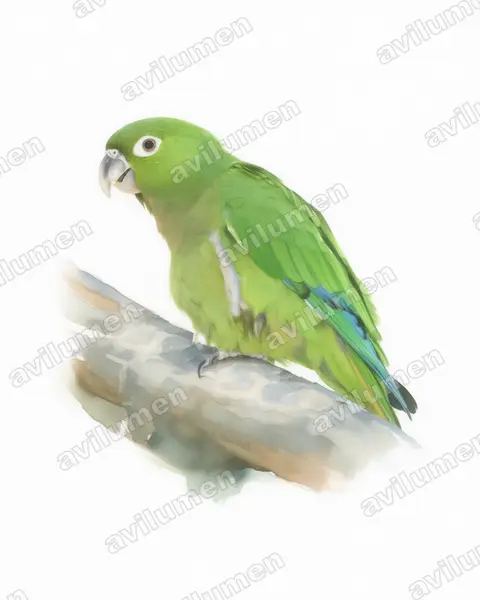
Watercolor 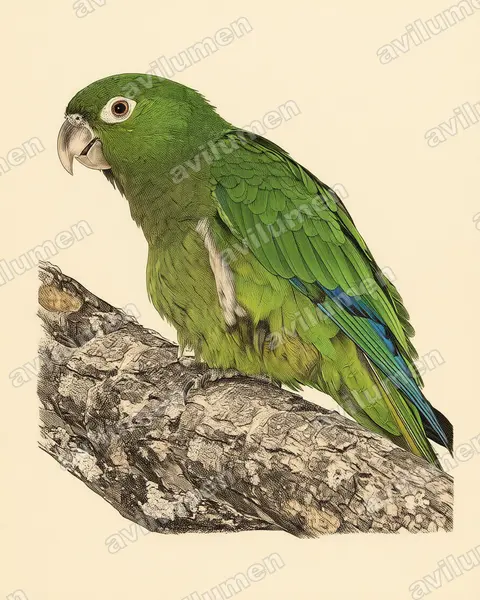
Vintage plate 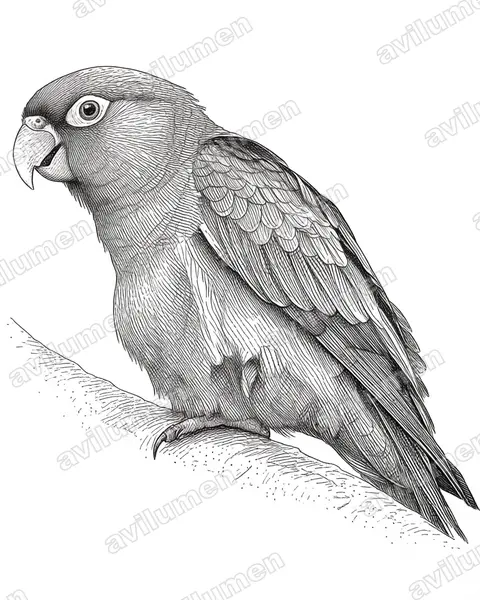
Ink 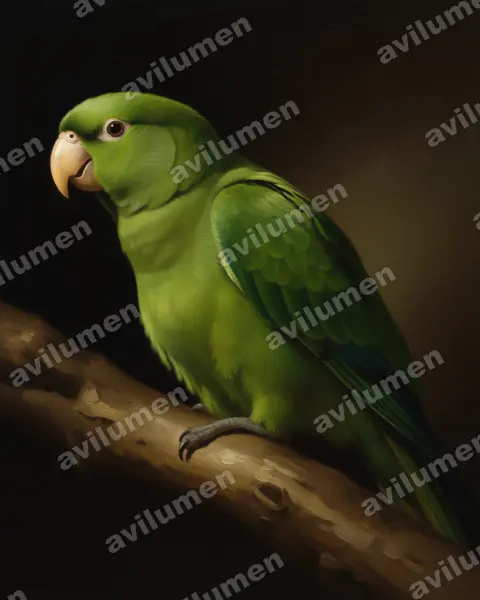
Oil 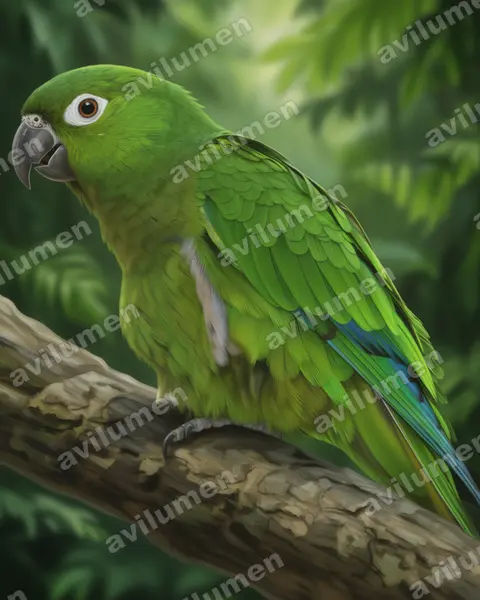
Realistic 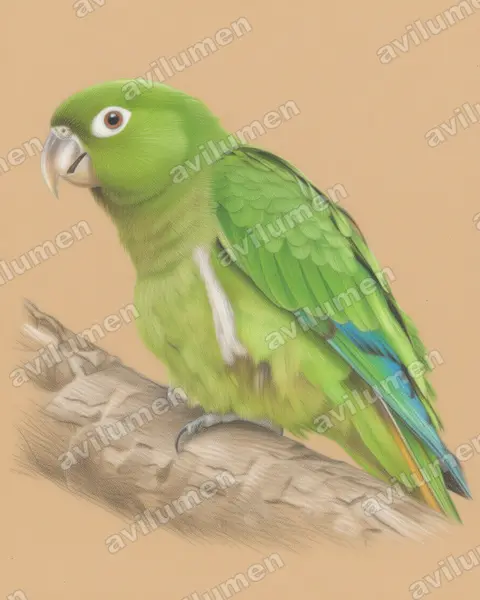
Colored pencil
Illustrations based on the photograph by http://www.birdphotos.com (CC BY 3.0), from Wikimedia Commons.
Digital editions
HD Digital Art Pack — Olive-throated Parakeet
Digital download: 6 high-resolution illustrations of the Olive-throated Parakeet (Aratinga nana), print-ready. This is a digital file; no animal or physical item is included.
AI Avatar — Olive-throated Parakeet
Generate an avatar fusing your face with the Olive-throated Parakeet (Aratinga nana). Delivered digitally in 8K, watermark-free. Digital product; no animals are sold or brokered.
Instant download. No live birds are sold.
Frequently asked questions
- Is Aratinga nana (Olive-throated Parakeet) endangered?
- The IUCN Red List places Aratinga nana, commonly known as the Olive-throated Parakeet, in the «Not evaluated» category. «Not evaluated» means the IUCN has not yet assessed this species.
- What family does Aratinga nana (Olive-throated Parakeet) belong to?
- Aratinga nana (Olive-throated Parakeet) belongs to the family Psittacidae, in the order Psittaciformes.
- What colour is Aratinga nana (Olive-throated Parakeet)?
- The plumage of Aratinga nana (Olive-throated Parakeet) combines these colours: Green.
More from the same family
 Near threatened
Yellow-faced Parrot
Alipiopsitta xanthops
The yellow-faced parrot, formerly also known as the yellow-faced amazon, is the only species of the genus Alipiopsitta. It is a Neotropical parrot, and was classified in the genus Amazona for many years. It is a predominantly green and yellow-plumaged bird with a yellow head. It is a semi-nomadic species found in the cerrado region of Brazil and adjacent Bolivia.
from $1.99
 Least concern
Moluccan King Parrot
Alisterus amboinensis
The Moluccan king parrot is a parrot endemic to Peleng Island, Maluku, and West Papua in Indonesia. It is sometimes referred to as the Ambon king parrot or Amboina king parrot, but this is potentially misleading, as it is found on numerous other islands than Ambon. The male and female are similar in appearance, with a predominantly red head and underparts, green wings, and blue back and tail.
from $1.99
 Least concern
Papuan King Parrot
Alisterus chloropterus
The Papuan king parrot, also known as the green-winged king parrot, is a species of parrot in the family Psittaculidae found in New Guinea. Its natural habitats are subtropical or tropical moist lowland forest and subtropical or tropical moist montane forest.
from $1.99
 Least concern
Australian King Parrot
Alisterus scapularis
The Australian king parrot is a species of parrot endemic to eastern Australia ranging from Cooktown in Queensland to Port Campbell in Victoria. Found in humid and heavily forested upland regions of the eastern portion of the continent, including eucalyptus wooded areas in and directly adjacent to subtropical and temperate rainforest. They feed on fruits and seeds gathered from trees or on the ground.
from $1.99