Australian Ringneck
Barnardius zonarius
Avilumen editorial team ·

The Australian ringneck is a parrot native to Australia. Except for extreme tropical and highland areas, the species has adapted to all conditions. Treatments of genus Barnardius have previously recognised two species, the Port Lincoln parrot and the mallee ringneck, but due to these readily interbreeding at the contact zone they are usually regarded as a single species B. zonarius with subspecific descriptions.
The Australian ringneck (Barnardius zonarius) is a parrot native to Australia. Except for extreme tropical and highland areas, the species has adapted to all conditions. Treatments of genus Barnardius have previously recognised two species, the Port Lincoln parrot (Barnardius zonarius) and the mallee ringneck (Barnardius barnardi), but due to these readily interbreeding at the contact zone they are usually regarded as a single species B. zonarius with subspecific descriptions. Currently, four subspecies are recognised, each with a distinct range.
In Western Australia, the ringneck competes for nesting space with the rainbow lorikeet, an introduced species. To protect the ringneck, culls of the lorikeet are sanctioned by authorities in this region. Overall, though, the ringneck is not a threatened species.
Description
The subspecies of the Australian ringneck differ considerably in colouration. It is a medium size species around 33 cm (13 in) long. The basic colour is green, and all four subspecies have the characteristic yellow ring around the hindneck; wings and tail are a mixture of green and blue.
The B. z. zonarius and B. z. semitorquatus subspecies have a dull black head; back, rump and wings are brilliant green; throat and breast bluish-green. The difference between these two subspecies is that B. z. zonarius has a yellow abdomen while B. z. semitorquatus has a green abdomen; the latter has also a prominent crimson frontal band that the former lacks (the intermediate shown in the box has characteristics of both subspecies). The two other subspecies differ from these subspecies by the bright green crown and nape and blush cheek-patches. The underparts of B. z. barnardi are turquoise-green with an irregular orange-yellow band across the abdomen; the back and mantle are deep blackish-blue and this subspecies has a prominent red frontal band. The B. z. macgillivrayi is generally pale green, with no red frontal band, and a wide uniform pale yellow band across the abdomen.
The calls of the Mallee ringneck and Cloncurry parrot have been described as "ringing", and the calls of the Port Lincoln ringneck and Twenty-eight parrot have been described as "strident". The name of the Twenty-eight is an onomatopoeic derived from its distinctive call, which sounds like "twenty-eight" (or the French equivalent, vingt-huit, according to one early description).
Taxonomy and naming
The Australian ringneck was first described by English naturalist George Shaw and drawn by Frederick Polydore Nodder in 1805 in their work The Naturalist's Miscellany: Or, Coloured Figures of Natural Objects; Drawn and Described Immediately From Nature. He called it Psittacus zonarius "zoned parrot". A broad-tailed parrot, it is most closely related to the rosellas of the genus Platycercus, and has been placed in that genus by some authorities, including Ferdinand Bauer.
Pre-existing names for the species, derived from the Nyungar language of Southwest Australia, are dowarn [pronounced dow'awn] and doomolok [dorm'awe'lawk]; these were identified from over one hundred records of regional and orthographic variants to supplement the names already suggested by John Gilbert, Dominic Serventy and others.
Currently, four subspecies of ringneck are recognised, all of which have been described as distinct species in the past: (As of 1993, the Twenty-eight and Cloncurry parrot were treated as subspecies of the Port Lincoln parrot and the mallee ringneck, respectively.)
Several other subspecies have been described, but are considered synonyms with one of the above subspecies. B. z. occidentalis has been synonymised with B. z. zonarius. Intermediates exist between all subspecies except for between B. z. zonarius and B. z. macgillivrayi. Intermediates have been associated with land clearing for agriculture in southern Western Australia.
The classification of this species is still debated, and molecular research by Joseph and Wilke in 2006 found that the complex split genetically into two clades—one roughly correlating with B. z. barnardi and the other with the other three forms; B. z. macgillivrayi was more closely related to B. z. zonarius than to the neighbouring B. z. barnardi. The researchers felt it was premature to reorganise the classification of the complex until more study was undertaken.
Behaviour
The Australian ringneck is active during the day and can be found in eucalypt woodlands and eucalypt-lined watercourses. The species is gregarious and depending on the conditions can be resident or nomadic. In trials of growing hybrid eucalypt trees in dry environments parrots, especially the Port Lincoln parrot, caused severe damage to the crowns of the younger trees during the research period between 2000–2003.
Feeding
This species eats a wide range of foods that include nectar, insects, seeds, fruit, and native and introduced bulbs. It will eat orchard-grown fruit and is sometimes seen as a pest by farmers.
Breeding
Breeding season for the northern populations starts in June or July, while the central and southern populations breed from August to December, but this can be delayed when climatic conditions are unfavourable. The nesting site is a hollow in a tree trunk. Generally four or five white oval eggs are laid measuring 29 mm x 23 mm, although a clutch may be as few as three and as many as six. Fledgling survival rates have been measured at 75%.
Conservation
Although the species is endemic, the species is considered not threatened, but in Western Australia, the Twenty-eight subspecies (B. z. semitorquatus) gets locally displaced by the introduced rainbow lorikeets that aggressively compete for nesting places. The rainbow lorikeet is considered a pest species in Western Australia and is subject to eradication in the wild.
In Western Australia, a licence is required to keep or dispose of more than four Port Lincoln ringnecks. All four subspecies are sold in the Canary Islands and in Australia, and they are traded via the CITES convention. The sale of the Cloncurry parrot is restricted in Queensland. The Australian ringneck can suffer from psittacine beak and feather disease, which causes a high nestling mortality rate in captivity.
Cited text
Lendon, Alan H. (1973). Australian Parrots in Field and Aviary (2nd ed.). Sydney: Angus and Robertson. ISBN 0-207-12424-8.
Text adapted from Wikipedia · CC BY-SA 4.0
Taxonomy
- Order
- Psittaciformes
- Family
- Psittacidae
- Genus
- Barnardius
- Conservation status
- Least concern
Listen to its call
No recording yet
Care guide
Budgie, Conure and Parakeet Care Guide
How to care for budgies, conures, parrotlets, ringnecks and other parakeets: diet, cage setup, health, behavior, breeding and legal status for owners.
Read the guide →Illustration gallery
6 illustrations of Barnardius zonarius (Australian Ringneck) in different styles, true to its real plumage. Shown watermarked; the art pack includes the high-resolution originals, ready to print.
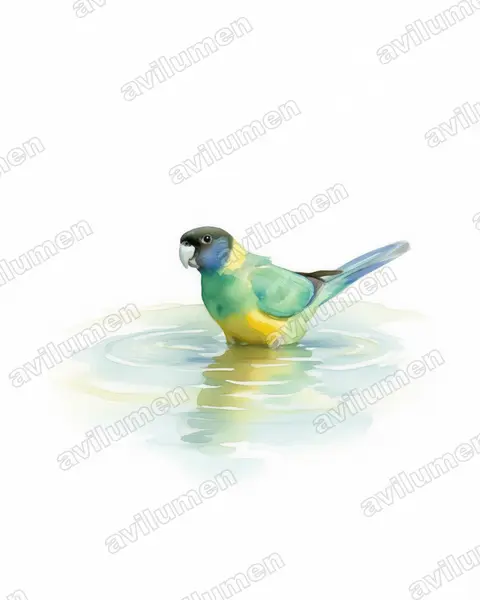
Watercolor 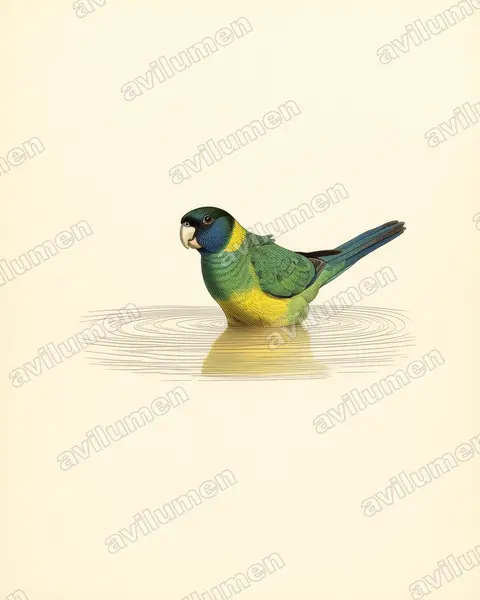
Vintage plate 
Ink 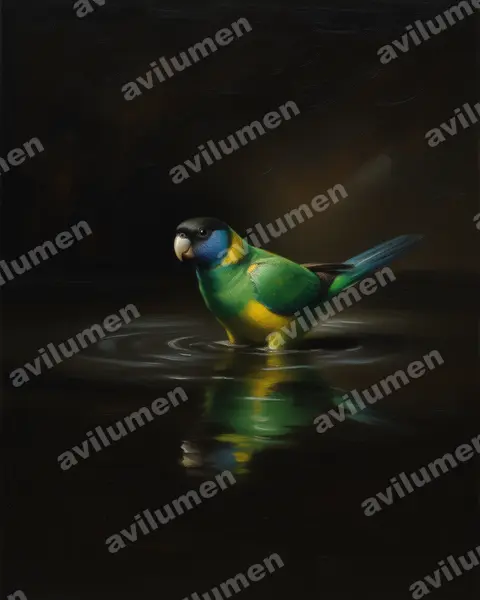
Oil 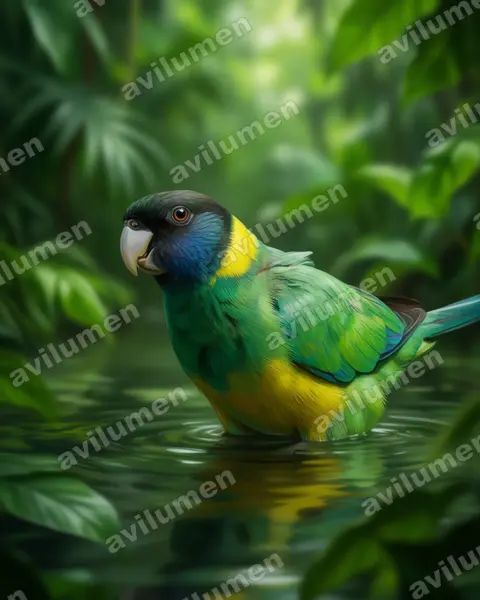
Realistic 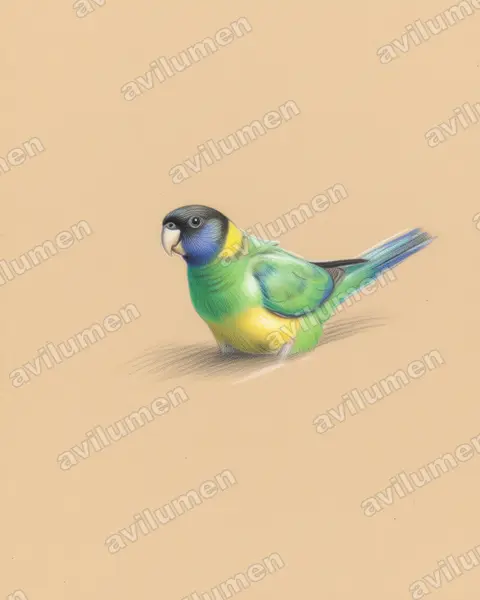
Colored pencil
Illustrations based on the photograph by Jim Bendon from Karratha, Australia (CC BY-SA 2.0), from Wikimedia Commons.
Digital editions
HD Digital Art Pack — Australian Ringneck
Digital download: 6 high-resolution illustrations of the Australian Ringneck (Barnardius zonarius), print-ready. This is a digital file; no animal or physical item is included.
AI Avatar — Australian Ringneck
Generate an avatar fusing your face with the Australian Ringneck (Barnardius zonarius). Delivered digitally in 8K, watermark-free. Digital product; no animals are sold or brokered.
Instant download. No live birds are sold.
Frequently asked questions
- Is Barnardius zonarius (Australian Ringneck) endangered?
- The IUCN Red List places Barnardius zonarius, commonly known as the Australian Ringneck, in the «Least concern» category. «Least concern» means it is not currently threatened.
- Where does Barnardius zonarius (Australian Ringneck) live?
- Barnardius zonarius (Australian Ringneck) is found in Australia.
- What family does Barnardius zonarius (Australian Ringneck) belong to?
- Barnardius zonarius (Australian Ringneck) belongs to the family Psittacidae, in the order Psittaciformes.
- What colour is Barnardius zonarius (Australian Ringneck)?
- The plumage of Barnardius zonarius (Australian Ringneck) combines these colours: Green and Yellow.
More from the same family
 Near threatened
Yellow-faced Parrot
Alipiopsitta xanthops
The yellow-faced parrot, formerly also known as the yellow-faced amazon, is the only species of the genus Alipiopsitta. It is a Neotropical parrot, and was classified in the genus Amazona for many years. It is a predominantly green and yellow-plumaged bird with a yellow head. It is a semi-nomadic species found in the cerrado region of Brazil and adjacent Bolivia.
from $1.99
 Least concern
Moluccan King Parrot
Alisterus amboinensis
The Moluccan king parrot is a parrot endemic to Peleng Island, Maluku, and West Papua in Indonesia. It is sometimes referred to as the Ambon king parrot or Amboina king parrot, but this is potentially misleading, as it is found on numerous other islands than Ambon. The male and female are similar in appearance, with a predominantly red head and underparts, green wings, and blue back and tail.
from $1.99
 Least concern
Papuan King Parrot
Alisterus chloropterus
The Papuan king parrot, also known as the green-winged king parrot, is a species of parrot in the family Psittaculidae found in New Guinea. Its natural habitats are subtropical or tropical moist lowland forest and subtropical or tropical moist montane forest.
from $1.99
 Least concern
Australian King Parrot
Alisterus scapularis
The Australian king parrot is a species of parrot endemic to eastern Australia ranging from Cooktown in Queensland to Port Campbell in Victoria. Found in humid and heavily forested upland regions of the eastern portion of the continent, including eucalyptus wooded areas in and directly adjacent to subtropical and temperate rainforest. They feed on fruits and seeds gathered from trees or on the ground.
from $1.99