Black-headed Berryeater
Carpornis melanocephala
Avilumen editorial team ·

The black-headed berryeater is a Near Threatened species of bird in the family Cotingidae, the cotingas. It is endemic to Brazil.
The black-headed berryeater (Carpornis melanocephala) is a Near Threatened species of bird in the family Cotingidae, the cotingas. It is endemic to Brazil.
Taxonomy and systematics
The hooded berryeater was originally described as Procnias melanocephalus. Early in the twentieth century some authors placed it in genus Ampelion but by 1970 it was moved to its present genus Carpornis that had been erected in 1846.
The black-headed berryeater shares its genus with the hooded berryeater (C. cuculata). It is monotypic.
Description
The black-headed berryeater is 20 to 21 cm (7.9 to 8.3 in) long; three individuals weighed between 63 to 67 g (2.2 to 2.4 oz). The sexes have almost identical plumage. Adult males have an entirely black head including the neck and throat with a very thin yellow "collar" around the sides and back of the neck. Their upperparts, wings, and tail are dull olive-green. Their underparts are mostly olive-yellow with fine dark olive bars and a plainer yellow lower belly. Adult females' heads have an olive wash. Both sexes have a fiery red to dark red iris, a blackish bill with a plumbeous base to the mandible, and gray legs and feet. Immatures are similar to adult females but have a dark gray head and a duller and more heavily barred throat and breast.
Distribution and habitat
The black-headed berryeater is found intermittently in southeastern Brazil in Alagoas and from Bahia south to northeastern Paraná. It primarily inhabits humid forest and at one location is found in restinga. In elevation it mostly ranges from sea level to 500 m (1,600 ft) and locally occurs up to about 700 m (2,300 ft).
Movement
The black-headed berryeater is a year-round resident.
Feeding
The black-headed berryeater feeds primarily on fruit; there is one record of its eating a stick insect. It usually forages from the forest's mid-story to the subcanopy.
Breeding
The black-headed berryeater's breeding season includes September but is otherwise unknown. The one known nest was a shallow cup made from dry leaves and stems in a tree fork; it resembled a pile of leaf litter. It held one egg that was pale horn-colored with brown spots and stripes. The female alone incubated. The male remained nearby during incubation. The incubation period, time to fledging, and other details of parental care are not known.
Vocalization
The black-headed berryeater's song is a "high, gliding-down, indignant-sounding njauow".
Status
The IUCN originally in 1988 assessed the black-headed berryeater as Threatened, then in 1994 as Vulnerable, and since August 2022 as Near Threatened. It has a fragmented range and its estimated population of between 2500 and 10,000 mature individuals is believed to be decreasing. "Given the species' low tolerance of converted habitats, it is severely threatened by forest loss. Extensive deforestation is continuing in this region and this species is now largely dependent on a few key protected areas." It is considered rare to uncommon. As of 2016 it occurred in 16 protected areas and was essentially absent outside them.
Text adapted from Wikipedia · CC BY-SA 4.0
Where it lives
Plumage colours
Distribution

Taxonomy
- Order
- Passeriformes
- Family
- Cotingidae
- Genus
- Carpornis
- Conservation status
- Near threatened
Listen to its call
No recording yet
Illustration gallery
6 illustrations of Carpornis melanocephala (Black-headed Berryeater) in different styles, true to its real plumage. Shown watermarked; the art pack includes the high-resolution originals, ready to print.
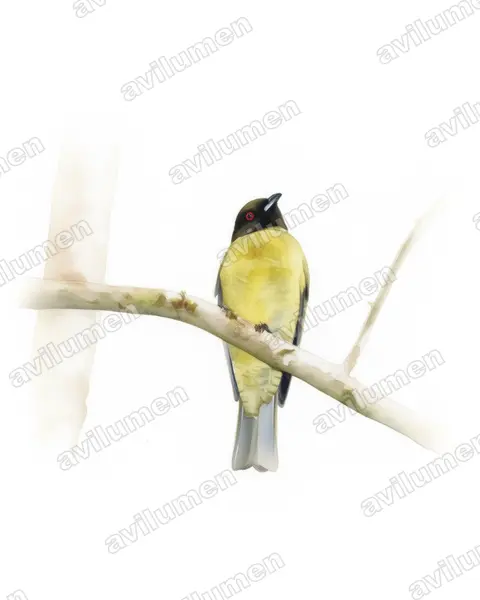
Watercolor 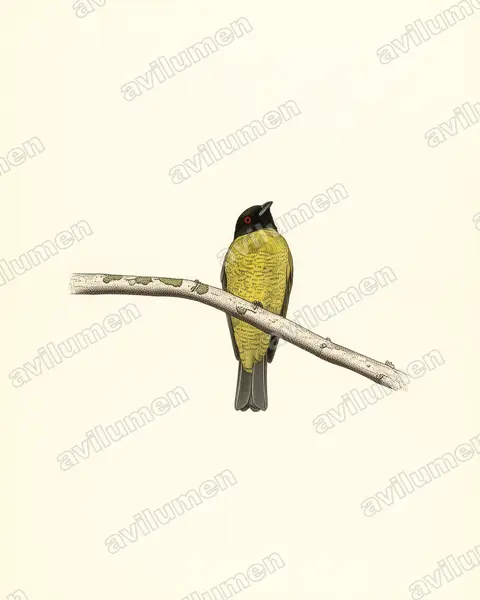
Vintage plate 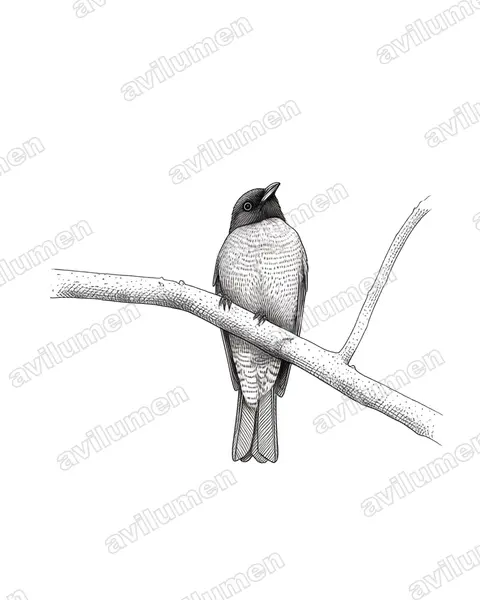
Ink 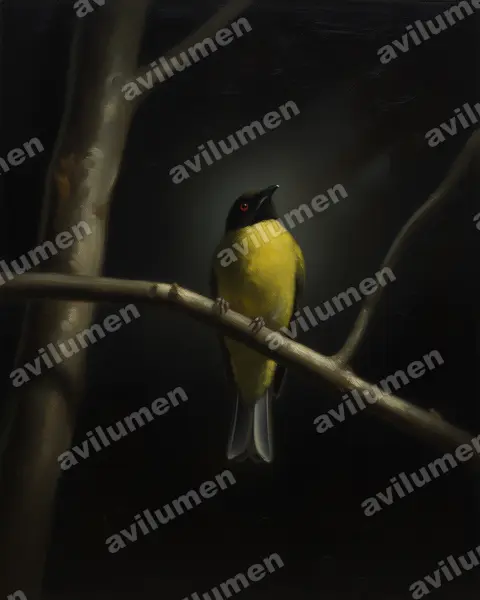
Oil 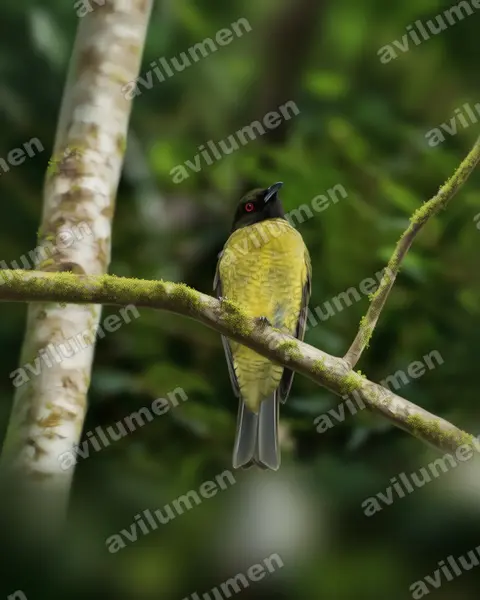
Realistic 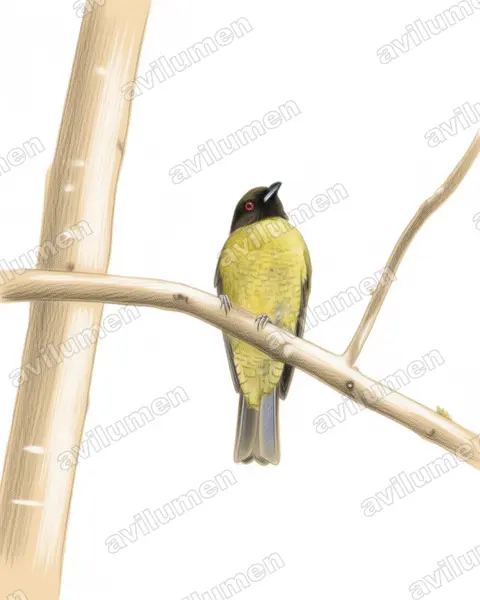
Colored pencil
Illustrations based on the photograph by Dario Sanches (CC BY-SA 2.0), from Wikimedia Commons.
Digital editions
HD Digital Art Pack — Black-headed Berryeater
Digital download: 6 high-resolution illustrations of the Black-headed Berryeater (Carpornis melanocephala), print-ready. This is a digital file; no animal or physical item is included.
AI Avatar — Black-headed Berryeater
Generate an avatar fusing your face with the Black-headed Berryeater (Carpornis melanocephala). Delivered digitally in 8K, watermark-free. Digital product; no animals are sold or brokered.
Instant download. No live birds are sold.
Frequently asked questions
- Is Carpornis melanocephala (Black-headed Berryeater) endangered?
- The IUCN Red List places Carpornis melanocephala, commonly known as the Black-headed Berryeater, in the «Near threatened» category. «Near threatened» means it is not threatened yet, but is close to becoming so.
- Where does Carpornis melanocephala (Black-headed Berryeater) live?
- Carpornis melanocephala (Black-headed Berryeater) is found in Brazil and South America.
- What family does Carpornis melanocephala (Black-headed Berryeater) belong to?
- Carpornis melanocephala (Black-headed Berryeater) belongs to the family Cotingidae, in the order Passeriformes.
- What colour is Carpornis melanocephala (Black-headed Berryeater)?
- The plumage of Carpornis melanocephala (Black-headed Berryeater) combines these colours: Black.
More from the same family
 Least concern
Scaled Fruiteater
Ampelioides tschudii
The scaled fruiteater is a species of bird in the family Cotingidae. It is the only member of the genus Ampelioides. This bird is found in Bolivia, Colombia, Ecuador, Peru, and Venezuela, where its natural habitat is the high elevation tropical forests of the Andes mountains. The scaled fruiteater is a chunky, short-tailed, flat-headed bird measuring 19–20 cm (7.5–7.9 in) in length.
from $1.99
 Least concern
Red-crested Cotinga
Ampelion rubrocristatus
The red-crested cotinga is a species of bird in the family Cotingidae. It is found in Bolivia, Colombia, Ecuador, Peru, and Venezuela.
from $1.99
 Least concern
Chestnut-crested Cotinga
Ampelion rufaxilla
The chestnut-crested cotinga is a species of bird in the family Cotingidae. It is found in Bolivia, Colombia, Ecuador, and Peru.
from $1.99
 Critically endangered
Kinglet Calyptura
Calyptura cristata
The kinglet calyptura is a small Critically Endangered passerine bird in the family Tyrannidae, the tyrant flycatchers. It is endemic to southeastern Brazil.
from $1.99