Abyssinian crimsonwing
Cryptospiza salvadorii
Avilumen editorial team ·

The Abyssinian crimsonwing, also known as the Ethiopian crimsonwing, Salvadori's crimsonwing or crimson-backed forest finch, is a common species of estrildid finch found in eastern Africa. It has an estimated global extent of occurrence of 190,000 km2 (73,000 mi2).
The Abyssinian crimsonwing (Cryptospiza salvadorii), also known as the Ethiopian crimsonwing, Salvadori's crimsonwing or crimson-backed forest finch, is a common species of estrildid finch found in eastern Africa. It has an estimated global extent of occurrence of 190,000 km2 (73,000 mi2).
Description
The Abyssinian crimsonwing is a small, shy greyish olive finch with bright crimson wings, mantle, back and rump. It is sexually dimorphic. In the males the head and upper mantle are greyish olive apart from the blackish lores, while the rest of the upper parts, except for the short, rounded, black tail, are deep crimson. The chin is dull yellow and the rest of the underparts are greyish-olive, with some flank feathers having red tips. The bill is black, and the eyes and legs are dark brown. The females is similar to the male, but duller red above and pale olive below. The juveniles are browner above with only patches of red colour. It measures 10–11 cm (3.9–4.3 in) in length and weighs 10.9–14 g (0.38–0.49 oz).
Voice
The call of the Abyssinian crimsonwing is a soft "tsip-tsip" which is given when the bird is flushed. The song is the call repeated but with a soft melodic sub-song which is rarely heard.
Distribution and subspecies
There are currently three recognised subspecies; a fourth C.s. crystallochresta which was described from Challa, in south western Ethiopia has been lumped in to the nominate subspecies. The three subspecies and their distributions are:
Cryptospiza salvadorii salvadorii Reichenow, 1892: Ethiopia and northern Kenya
Cryptospiza salvadorii kilimensis Moreau & W. L. Sclater, 1934: southern South Sudan, eastern Uganda, western, central and southern Kenya and northern Tanzania
Cryptospiza salvadorii ruwenzori W. L. Sclater, 1925: mountains of Albertine Rift in eastern Democratic Republic of Congo, south western Uganda, western Rwanda and western Burundi
Habitat and habits
The Abyssinian crimsonwing occurs in forest, particularly montane forest, from 1,500 to 300 m (4,920 to 980 ft) above sea level in Kenya, at the forest edge or in clearings where it normally remains among the undergrowth but sometimes seen higher in creepers. It also occurs in bamboo, thickets and dense brush, especially along watercourses.
It is a shy and rather elusive species which is easily alarmed, retreating into cover rapidly at the first indication of a threat. This means that it may be less uncommon than it appears. It is usually observed singly or in pairs, but small family parties have been reported. It feeds low down, often within cover, mainly on grass seeds, but other small seeds, such as Setaria spp, balsam Impatiens spp and stinging nettles Laportea spp, are also consumed. It may possibly also catch a few insects.
There are records of Abyssinian crimsonwing showing breeding behaviour from April and August in Ethiopia, while in Uganda it breeds in March at Bwindi and on Mount Elgon it breeds in June and November. All records of breeding behaviour are in dry months following rains.
Name
The binomial name and the alternative common name, Salvadori's crimsonwing, honour the Italian ornithologist Count Adelardo Tommaso Salvadori Paleotti, known as Tommaso Salvadori.
Text adapted from Wikipedia · CC BY-SA 4.0
Taxonomy
- Order
- Passeriformes
- Family
- Estrildidae
- Genus
- Cryptospiza
- Conservation status
- Least concern
Listen to its call
No recording yet
Care guide
Canary and Finch Care Guide: Diet, Housing and Breeding
How to care for canaries, zebra finches, Gouldian finches and other finches: diet, flight cage setup, health, song and breeding. A guide for bird keepers.
Read the guide →Illustration gallery
6 illustrations of Cryptospiza salvadorii (Abyssinian crimsonwing) in different styles, true to its real plumage. Shown watermarked; the art pack includes the high-resolution originals, ready to print.
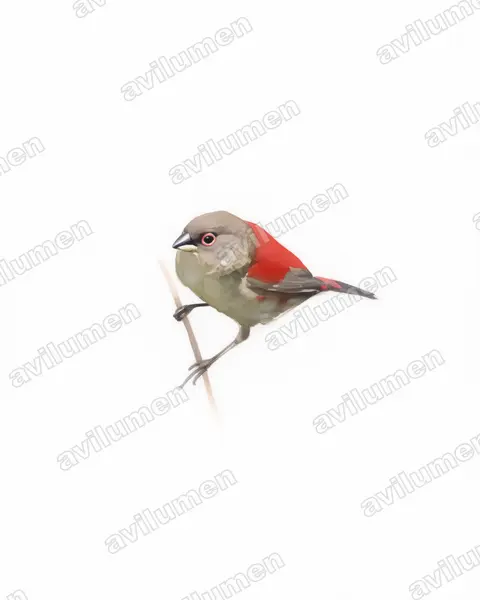
Watercolor 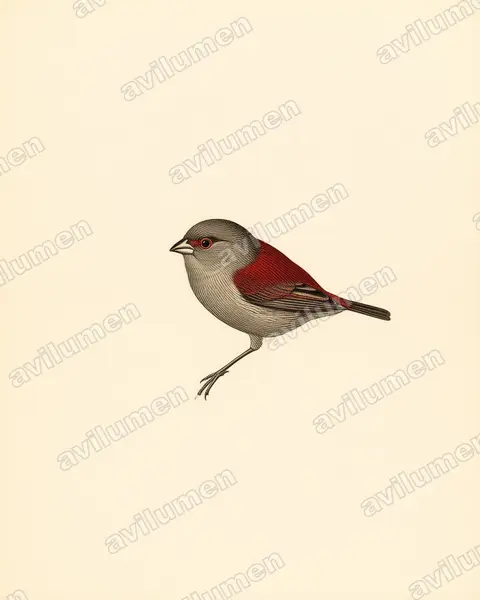
Vintage plate 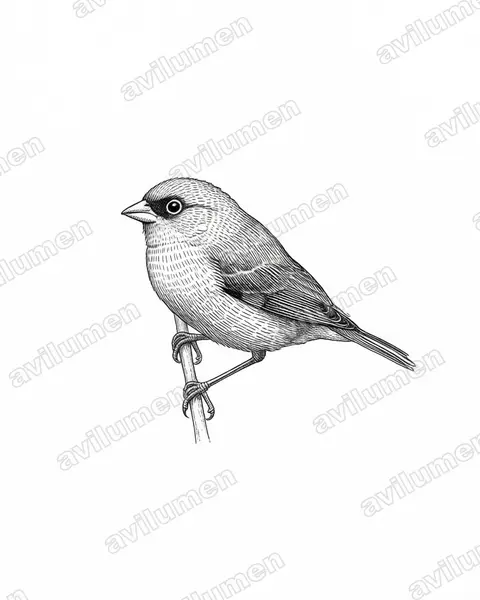
Ink 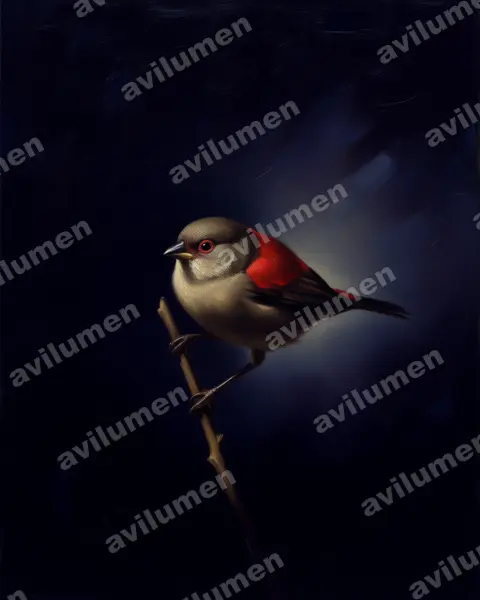
Oil 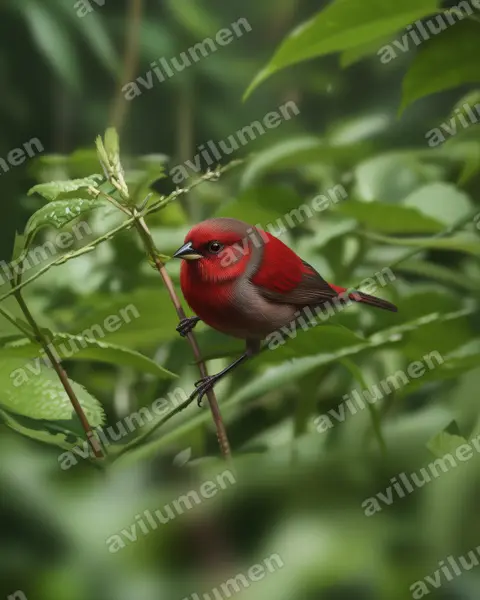
Realistic 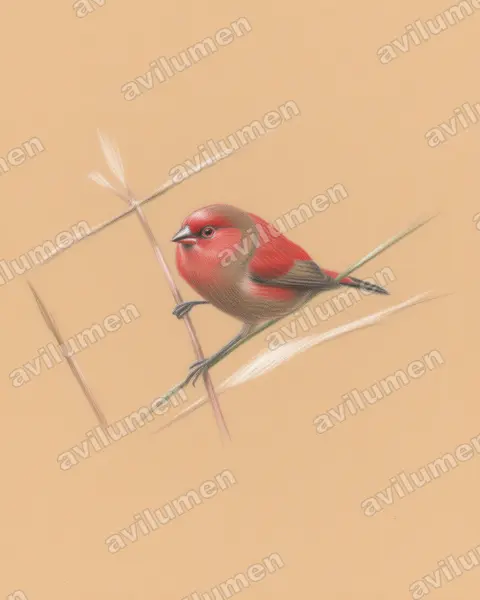
Colored pencil
Illustrations based on the photograph by mpgoodey (CC BY-SA 2.0), from Wikimedia Commons.
Digital editions
HD Digital Art Pack — Abyssinian crimsonwing
Digital download: 6 high-resolution illustrations of the Abyssinian crimsonwing (Cryptospiza salvadorii), print-ready. This is a digital file; no animal or physical item is included.
AI Avatar — Abyssinian crimsonwing
Generate an avatar fusing your face with the Abyssinian crimsonwing (Cryptospiza salvadorii). Delivered digitally in 8K, watermark-free. Digital product; no animals are sold or brokered.
Instant download. No live birds are sold.
Frequently asked questions
- Is Cryptospiza salvadorii (Abyssinian crimsonwing) endangered?
- The IUCN Red List places Cryptospiza salvadorii, commonly known as the Abyssinian crimsonwing, in the «Least concern» category. «Least concern» means it is not currently threatened.
- Where does Cryptospiza salvadorii (Abyssinian crimsonwing) live?
- Cryptospiza salvadorii (Abyssinian crimsonwing) is found in Africa.
- What family does Cryptospiza salvadorii (Abyssinian crimsonwing) belong to?
- Cryptospiza salvadorii (Abyssinian crimsonwing) belongs to the family Estrildidae, in the order Passeriformes.
- What colour is Cryptospiza salvadorii (Abyssinian crimsonwing)?
- The plumage of Cryptospiza salvadorii (Abyssinian crimsonwing) combines these colours: Grey and Red.
More from the same family
 Least concern
Red-headed finch
Amadina erythrocephala
The red-headed finch is a common species of estrildid finch found in Africa. It has an estimated global extent of occurrence of 1,600,000 km2 (620,000 sq mi). It is found in Angola, Botswana, Lesotho, Namibia, South Africa and Zimbabwe.
from $1.99
 Least concern
Cut-throat finch
Amadina fasciata
The cut-throat finch is a common species of estrildid finch found throughout Africa; it is also known as the bearded finch, the ribbon finch, the cut throat, and the weaver finch.
from $1.99
 Least concern
Red avadavat
Amandava amandava
The red avadavat, red munia or strawberry finch, is a sparrow-sized bird of the family Estrildidae. It is found in the open fields and grasslands of tropical Asia and is popular as a cage bird due to the colourful plumage of the males in their breeding season. It breeds in the Indian subcontinent in the monsoon season.
from $1.99
 Vulnerable
Green avadavat
Amandava formosa
The green avadavat or green munia is a species of Estrildid finch with green and yellow on the body, a bright red bill and black "zebra stripes" on the flanks. They are endemic to the Indian subcontinent and were formerly popular as cagebirds. The name "avadavat" is a corruption of the name the city of Ahmedabad in Gujarat, India, which was a centre of bird trade.
from $1.99