Spix's Macaw
Cyanopsitta spixii
Avilumen editorial team ·

Spix's macaw, also known as the little blue macaw, or simply blue macaw, is a macaw species that was endemic to Brazil. It is a member of tribe Arini in the subfamily Arinae, part of the family Psittacidae. It was first described in 1638 by German naturalist Georg Marcgrave when he was working in Pernambuco in Dutch Brazil.
Spix's macaw (Cyanopsitta spixii), also known as the little blue macaw, or simply blue macaw, is a macaw species that was endemic to Brazil. It is a member of tribe Arini in the subfamily Arinae (Neotropical parrots), part of the family Psittacidae (the true parrots). It was first described in 1638 by German naturalist Georg Marcgrave when he was working in Pernambuco in Dutch Brazil. It is named for German biologist Johann Baptist von Spix, who collected a specimen in 1819 on the bank of the São Francisco River near Juazeiro. This bird has been completely extirpated from its natural range, and following a several-year-long survey, the IUCN officially declared it extinct in the wild in 2019. However, after over 20 years of conservation efforts, 200 macaws have been bred from captive birds, and 52 individual birds have since been reintroduced into their natural environment in June 2022.
The bird is a medium-size parrot weighing about 300 grams (11 oz), smaller than most of the large macaws. Its appearance is various shades of blue, with a grey-blue head, light blue underparts, and vivid blue upperparts. Males and females are almost identical in appearance; however, the females are slightly smaller.
The species inhabited riparian Caraibeira (Tabebuia aurea) woodland galleries in the drainage basin of the Rio São Francisco within the Caatinga dry forest climate of interior northeastern Brazil. It had a very restricted natural habitat due to its dependence on the tree for nesting, feeding and roosting. It feeds primarily on seeds and nuts of Caraiba and various Euphorbiaceae (spurge) shrubs, the dominant vegetation of the Caatinga. Due to deforestation in its limited range and specialized habitat, the bird was rare in the wild throughout the twentieth century. It has always been very rare in captivity, partly due to the remoteness of its natural range.
It is listed on CITES Appendix I, which makes international trade prohibited except for legitimate conservation, scientific or educational purposes. The IUCN regard the Spix's macaw as extinct in the wild. Its last known stronghold in the wild was in northeastern Bahia, Brazil, and sightings were very rare. After a 2000 sighting of a male bird, the next and last sighting was in 2016.
The species is now maintained through a captive breeding program at several conservation organizations under the aegis of the Brazilian government. One of these organizations, the Association for the Conservation of Threatened Parrots (ACTP), moved birds back from Germany to Brazil in 2020 as part of their plan to release Spix's macaws back into the wild. The Brazilian Chico Mendes Institute for Biodiversity Conservation (ICMBio) is conducting a project Ararinha-Azul with an associated plan to restore the species to the wild as soon as sufficient breeding birds and restored habitat are available.
Taxonomy
Spix's macaw is the only known species of the genus Cyanopsitta. The genus name is derived from the Ancient Greek kuanos meaning "blue" and psittakos meaning "parrot". The species name spixii is a Latinized form of the surname "von Spix", hence Cyanopsitta spixii means "blue parrot of Spix". The genus Cyanopsitta is one of six genera of Central and South American macaws in the tribe Arini, which also includes all the other long-tailed New World parrots. Tribe Arini together with the short-tailed Amazon and allied parrots and a few miscellaneous genera make up subfamily Arinae of Neotropical parrots in family Psittacidae of true parrots.
In 1638, German naturalist Georg Marcgrave became the first to describe the species and the first European to observe it. It is named, however, for German biologist Johann Baptist von Spix, who collected the type specimen in April 1819 in Brazil but gave it the misnomer Arara hyacinthinus, not realizing the name collided with Psittacus hyacinthinus, the name assigned to the hyacinth macaw described by John Lathan in 1790. Spix's mistake was noticed in 1832 by German ornithologist Johann Georg Wagler, who realized that the 1819 specimen was smaller and a different colour from the hyacinth macaw; he designated the new species Sittace spixii. It wasn't until 1854 that French naturalist Charles Lucien Bonaparte properly placed it in its own genus, designating the bird Cyanopsitta spixi [sic], based on important morphological differences between it and the other blue macaws. It was listed as Cyanopsittacus spixi [sic] by Italian zoologist Tommaso Salvadori in his 1891 Catalog of the Birds in the British Museum.
Naturalists have noted the Spix's similarity to other smaller members of tribe Arini based on general morphology as long ago as Rev. F.G. Dutton, president of the Avicultural Society U.K. in 1900: "it's more like a conure" ('conure' is not a defined taxon – in Dutton's time, it referred to the archaic genus Conurus; today those would be among the smaller non-macaw parakeets in Arini). Brazilian ornithologist Helmut Sick stated in 1981: "Cyanopsitta spixii...is not a real macaw". (Sick's remark was in the context of an article on Lear's macaw, a larger blue macaw. He recognized, as Spix had not 150 years before, that C. spixii is notably different from the larger macaws).
The morphology-based taxonomy of C. spixii, intermediate between the macaws and the smaller Arini, has been confirmed by recent molecular phylogenetic studies. In a 2008 molecular phylogenetic study of 69 parrot genera, the clade diagrams indicate that C. spixii split from the ancestral parakeets before the differentiation of the modern macaws. However, not all of the macaw genera were represented in the study. The study also states that diversification of the Neotropical parrot lineages occurred starting 33 mya, a period roughly coinciding with the separation of South America from West Antarctica. The author notes that the study challenges the classification of British ornithologist Nigel Collar in the encyclopedic Handbook of the Birds of the World, Volume 4 (1997). A 2011 study by the same authors which includes key genera of macaws further elucidates the macaw taxonomy: the clade diagram of that study places C. spixii in a clade including the macaw genera which is sister to a clade containing the Aratingas and other smaller parakeets. Within the macaw clade, C. spixii was the first taxon to diverge from the ancestral macaws; its nearest relatives are the red-bellied macaw (Orthopsittaca manilata) and the blue-headed macaw (Primolius couloni).
Description
Spix's macaw is easy to identify being the only small blue macaw and also by the bare grey facial skin of its lores and eyerings. It is about 56 cm (22 in) long including tail length of 26–38 cm (10–15 in). It has a wing length of 24.7–30.0 cm (9.7–11.8 in). The external appearance of adult male and female are identical; however, the average weight of captive males is about 318 g (11.2 oz) and captive females average about 288 g (10.2 oz). Its plumage is grey-blue on the head, pale blue on the underparts, and vivid blue on the upperparts, wings and tail. The legs and feet are brownish-black. In adults the bare facial skin is grey, the beak is entirely dark grey, and the irises are yellow. Juveniles are similar to adults, but they have pale grey bare facial skin, brown irises, and a white stripe along the top-center of their beaks (along the culmen).
Diet
In the wild, the most common seeds and nuts consumed by Spix's were from Pinhão (Jatropha pohliana var. mollissima) and Favela (Cnidoscolus phyllacanthus). However these trees are colonizers, not native to the bird's habitat, so they could not have been historical staples of the diet.
Its diet also included seeds and nuts from Joazeiro (Ziziphus joazeiro), Baraúna (Schinopsis brasiliensis), Imburana (Commiphora leptophloeos or Bursera leptophloeos), Facheiro (Pilosocereus piauhyensis), Phoradendron species, Caraibeira (Tabebuia caraiba), Angico (Anadenanthera macrocarpa), Umbu (Spondias tuberosa) and Unha-de-gato (Acacia paniculata). Reports from previous Spix's macaw researchers seem to add another two plants to the list: Maytenus rigida and Geoffroea spinosa. Combretum leprosum may also be a possibility.
Reproduction
Captive bred Spix's macaws reach sexual maturity at seven years of age. A paired female hatched at the Loro Parque Fundación laid eggs at the age of five years, but these were infertile. It is suspected that late maturity in captivity may be due to inbreeding or other artificial environmental factors, as other parrots of similar size reach sexual maturity in two to four years. In the wild, mating involves elaborate courtship rituals, like feeding each other and flying together. This process is known to possibly take several seasons in other large parrots, and it may also be the case for the Spix's. They make their nests in the hollows of large mature Caraibeira trees, and reuse the nest year after year. The breeding season is November to March, with most eggs hatching in January to coincide with the start of the Caatinga January to April rainy season. In the wild, Spix's were believed to lay three eggs per clutch; in captivity, the average number is four eggs, and can range from one to seven. Incubation period is 25–28 days and only the female performs incubation duties. The chicks fledge in 70 days and are independent in 100–130 days.
The mating call of Spix's macaw can be described as the sound "whichaka". The sound is made by creating a low rumble in the abdomen bringing the sound up to a high pitch. Its voice is a repeated short grating. It also makes squawking noises.
Its lifespan in the wild is unknown; the only documented bird (the last wild male), was older than 20 years. The eldest bird in captivity died at age 34.
Distribution and habitat
Various accounts relate that the birds were more common in Pernambuco than in Bahia through the 1960s but not later. Spix's macaw was most recently (1974–1987) known in the Río São Francisco valley, in northeastern Brazil, principally in the basins on the south side of the river in the State of Bahia. In 1974, ornithologist Helmut Sick, based on information from traders and trappers, extended the possible range of the Spix's macaw to embrace the northeastern part of the state of Goias and the southern part of the state of Maranhão. Other ornithologists reporting the bird in various parts of the state of Piauí further extended the range to a vast area of the dry interior of northeast Brazil.
Study of the lone bird discovered at Melância creek in 1990 revealed substantive information about its habitat. It had been previously assumed that the Spix's macaw had a vast range in the interior of Brazil embracing several different habitat types, including buriti palm swamps, cerrado, and dry Caatinga. But the evidence collected in Melância Creek indicated that the Spix's macaw was a specially adapted inhabitant of the disappearing woodland galleries. Ornithologist Tony Silva mentions that "where Caraibeiras have been felled, as in the Pernambuco side of the São Francisco River, the species has disappeared".
Much remains uncertain about the extent of the bird's original range, because most of its woodland habitat was cleared before naturalists observed either the birds or the Caraiba nesting sites. The historical range is now believed to have encompassed portions of the states of Bahia and Pernambuco in a 50 km (31 mi) wide corridor along a 150–200 km (93–124 mi) stretch of the Rio São Francisco between Juazeiro (or possibly Remanso) and Abaré. Previous observations of the birds from further west are very difficult to explain but conceivably stem from either escaped captive birds or more likely the misidentification of another species such as red-bellied macaw (Orthopsittaca manilatus).
The Caatinga vegetation of northeastern Bahia (which hosts the Spix habitat) is stunted trees, thorny shrubs and cacti, dominated by plants of the family Euphorbiaceae. This macaw lived in the hottest and driest part of the "Caatinga" within Caraiba, or Caribbean trumpet tree (Tabebuia caraiba) woodland galleries. The Caraibeira constitutes a microclimate within the Caatinga. The existing galleries are fringes of unique woodland extending a maximum of 18 m (59 ft) to either side along a series of seasonal waterways at least 8 m wide in the Rio São Francisco drainage basin. All T. caraiba woodland was recorded in the middle and lower levels of the creek system where fine alluvial deposits were present. The character of the galleries is tall (8m) evenly spaced Caraibeira trees, ten per hundred meters, interspersed with low scrub and desert cacti. Large mature trees of this species (and apparently no other) provided the nesting hollows of Spix's macaws, as well as shelter and their seedpods, food for the species.
Notable among the seasonal waterways are Riacho Melância watershed 30 km south of Curaçá, where the last known wild Spix's macaw nest was located, adjacent Riacho Barra Grande, and Riacho da Vargem ~100 km to the north near Abaré all in the State of Bahia south of Rio São Francisco. In 1990, these were all that remained of what was once believed to be a vast filigree of creekside Caraibeira woodland extending 50 km into the Caatinga on either side of the Rio São Francisco along a significant stretch of its middle reaches. There is also one confirmed site, since cleared, along Brígida Creek on the north shore of Rio São Francisco in Pernambuco.
History
Spix's macaw was first described in 1638 by German naturalist Georg Marcgrave while he was working in Pernambuco in Dutch Brazil. He describes the species as follows:
Text adapted from Wikipedia · CC BY-SA 4.0
Where it lives
Plumage colours
Distribution

Taxonomy
- Order
- Psittaciformes
- Family
- Psittacidae
- Genus
- Cyanopsitta
- Conservation status
- Extinct in the wild
Listen to its call
No recording yet
Care guide
Macaw Care Guide: Diet, Housing and Breeding
How to care for a macaw: diet, cage and aviary size, health, breeding, noise and CITES legal requirements. A practical guide for current and future owners.
Read the guide →Illustration gallery
6 illustrations of Cyanopsitta spixii (Spix's Macaw) in different styles, true to its real plumage. Shown watermarked; the art pack includes the high-resolution originals, ready to print.

Watercolor 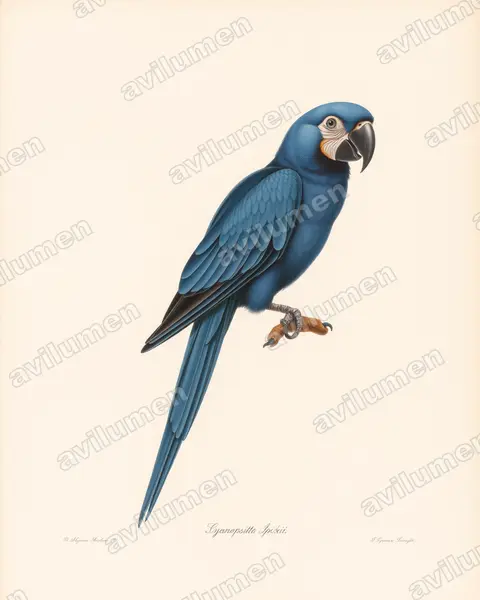
Vintage plate 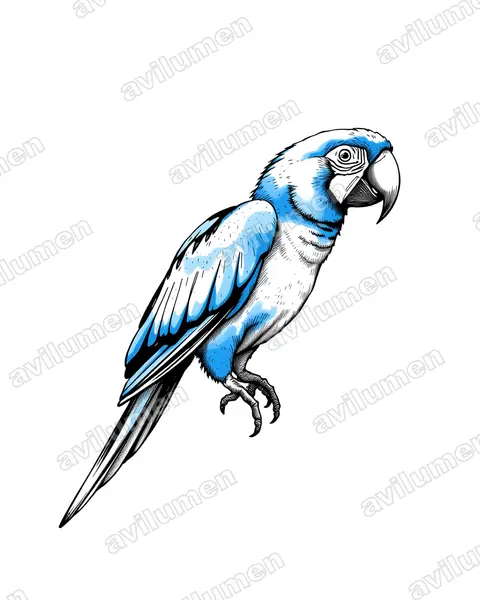
Ink 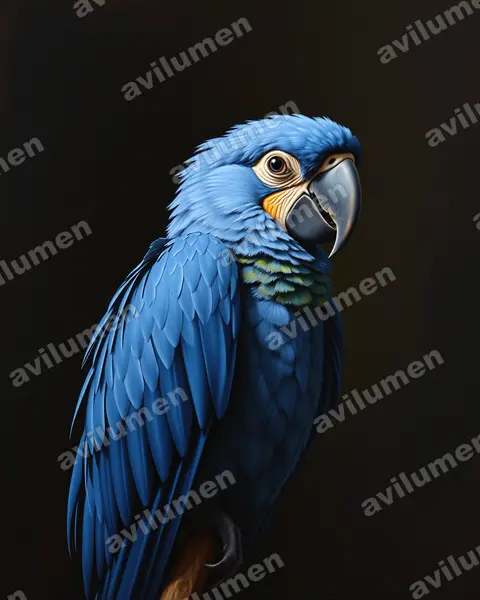
Oil 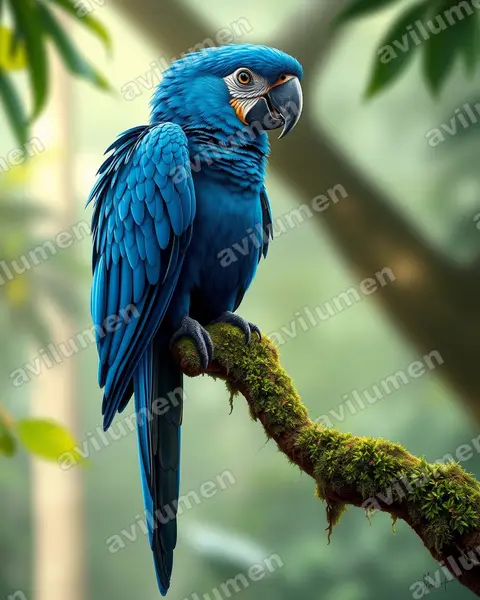
Realistic 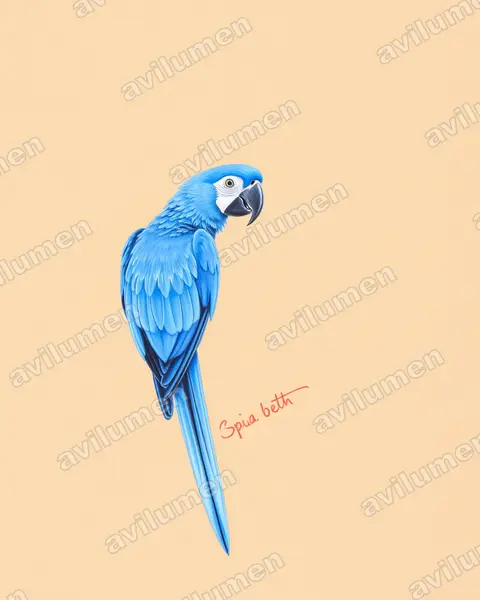
Colored pencil
Digital editions
HD Digital Art Pack — Spix's Macaw
Digital download: 6 high-resolution illustrations of the Spix's Macaw (Cyanopsitta spixii), print-ready. This is a digital file; no animal or physical item is included.
AI Avatar — Spix's Macaw
Generate an avatar fusing your face with the Spix's Macaw (Cyanopsitta spixii). Delivered digitally in 8K, watermark-free. Digital product; no animals are sold or brokered.
Instant download. No live birds are sold.
Frequently asked questions
- Is Cyanopsitta spixii (Spix's Macaw) endangered?
- The IUCN Red List places Cyanopsitta spixii, commonly known as the Spix's Macaw, in the «Extinct in the wild» category. «Extinct in the wild» means it survives only in captivity.
- Where does Cyanopsitta spixii (Spix's Macaw) live?
- Cyanopsitta spixii (Spix's Macaw) is found in Brazil and South America.
- What family does Cyanopsitta spixii (Spix's Macaw) belong to?
- Cyanopsitta spixii (Spix's Macaw) belongs to the family Psittacidae, in the order Psittaciformes.
- What colour is Cyanopsitta spixii (Spix's Macaw)?
- The plumage of Cyanopsitta spixii (Spix's Macaw) combines these colours: Blue.
More from the same family
 Near threatened
Yellow-faced Parrot
Alipiopsitta xanthops
The yellow-faced parrot, formerly also known as the yellow-faced amazon, is the only species of the genus Alipiopsitta. It is a Neotropical parrot, and was classified in the genus Amazona for many years. It is a predominantly green and yellow-plumaged bird with a yellow head. It is a semi-nomadic species found in the cerrado region of Brazil and adjacent Bolivia.
from $1.99
 Least concern
Moluccan King Parrot
Alisterus amboinensis
The Moluccan king parrot is a parrot endemic to Peleng Island, Maluku, and West Papua in Indonesia. It is sometimes referred to as the Ambon king parrot or Amboina king parrot, but this is potentially misleading, as it is found on numerous other islands than Ambon. The male and female are similar in appearance, with a predominantly red head and underparts, green wings, and blue back and tail.
from $1.99
 Least concern
Papuan King Parrot
Alisterus chloropterus
The Papuan king parrot, also known as the green-winged king parrot, is a species of parrot in the family Psittaculidae found in New Guinea. Its natural habitats are subtropical or tropical moist lowland forest and subtropical or tropical moist montane forest.
from $1.99
 Least concern
Australian King Parrot
Alisterus scapularis
The Australian king parrot is a species of parrot endemic to eastern Australia ranging from Cooktown in Queensland to Port Campbell in Victoria. Found in humid and heavily forested upland regions of the eastern portion of the continent, including eucalyptus wooded areas in and directly adjacent to subtropical and temperate rainforest. They feed on fruits and seeds gathered from trees or on the ground.
from $1.99