Norfolk Parakeet
Cyanoramphus cookii
Avilumen editorial team ·

The Norfolk parakeet, also called Tasman parakeet, Norfolk Island green parrot or Norfolk Island red-crowned parakeet, is a species of parrot in the family Psittaculidae. It is endemic to Norfolk Island.
The Norfolk parakeet (Cyanoramphus cookii), also called Tasman parakeet, Norfolk Island green parrot or Norfolk Island red-crowned parakeet, is a species of parrot in the family Psittaculidae. It is endemic to Norfolk Island (located between Australia, New Zealand and New Caledonia in the Tasman Sea).
Taxonomy
George Robert Gray described the Norfolk parakeet in 1859 as Platycercus Cookii, from a specimen in William Bullock's museum, and recorded it as from New Zealand. The species name honours James Cook, who reported the species on Norfolk Island when he landed there in 1774, noting it was the same as those occurring in New Zealand. In 1862, Gray described a specimen from Norfolk Island as Platycercus rayneri, collected by a Mr Rayner. In 1891, Italian ornithologist Tommaso Salvadori confirmed the two taxa as synonymous and coming from Norfolk Island.
It was long considered a subspecies of the red-fronted parakeet of New Zealand. Ornithologists Alfred North (1893) and Graeme Phipps (1981) noted that the Norfolk parakeet was significantly larger than the red-fronted parakeet. Phipps added that further investigation was needed into their status and conservation. DNA analysis in 2001 showed that it was an early offshoot from the other parakeets in the genus Cyanoramphus, with only the New Caledonian and Chatham parakeet more divergent.
"Norfolk parakeet" has been designated the official name by the International Ornithologists' Union (IOC). It is also known as Norfolk Island green parrot, and locally as green parrot. The name "Tasman parakeet" is used by ornithologists Les Christidis and Walter Boles on the argument that this species and the Lord Howe red-crowned parakeet (Cyanoramphus novaezelandiae subflavescens) are probably a single species for which they use biogeographical arguments. Tasman is used for other species with the same distribution and they propose that name for that reason. However, the latter subspecies was not included in the genus-wide phylogenetic reconstruction using DNA sequences, and the lumping of the species should be considered tentative.
Distribution and habitat
Originally found throughout Norfolk Island (to which it is endemic), it vanished from much of its range until by 1908 it was restricted to forest around Mount Pitt in the northwestern corner of the Island. Its natural habitats are native rainforest, from which it ventures into surrounding plantations and orchards.
Diet
Seeds make up over half the Norfolk parakeet's diet, particularly in winter. Five species make up 85% of its diet, including the Norfolk pine (Araucaria heterophylla), niau palm (Rhopalostylis baueri), ake ake (Dodonaea viscosa), as well as the introduced African olive (Olea europaea subsp. cuspidata) and cherry guava (Psidium cattleyanum).
Threats
Once a common species, the Norfolk parakeet had dwindled to under 50 birds by the late 1970s. Factors contributing to its decline include habitat loss, particularly of large old trees with suitable hollows for breeding, killing of eggs and young by rats and cats, shooting by early settlers, and competition for nest sites by introduced crimson rosellas and common starlings. In 1983 a captive breeding program was commenced. Although it was not successful, it sparked interest in the bird's fate in the people of Norfolk Island.
Between 1987 and 2000, a concerted effort to reduce rat and cat populations by trapping, and construction of nesting boxes designed to keep out rats increased parrot numbers, with around 250 young fledged. However, numbers of Norfolk parakeets were difficult to assess and concern was raised between 2009 and 2012 that it might be declining again. A census in 2009 estimated a count of 240 birds.
It is only found in Norfolk Island National Park and the surrounding area.
Text adapted from Wikipedia · CC BY-SA 4.0
Plumage colours
Taxonomy
- Order
- Psittaciformes
- Family
- Psittacidae
- Genus
- Cyanoramphus
- Conservation status
- Not evaluated
Listen to its call
No recording yet
Care guide
Budgie, Conure and Parakeet Care Guide
How to care for budgies, conures, parrotlets, ringnecks and other parakeets: diet, cage setup, health, behavior, breeding and legal status for owners.
Read the guide →Illustration gallery
6 illustrations of Cyanoramphus cookii (Norfolk Parakeet) in different styles, true to its real plumage. Shown watermarked; the art pack includes the high-resolution originals, ready to print.
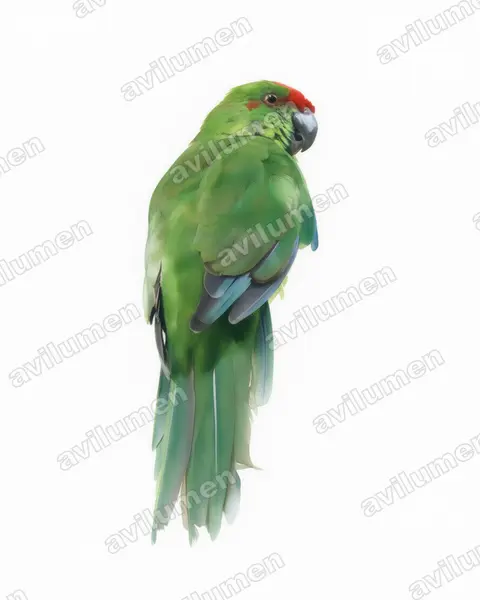
Watercolor 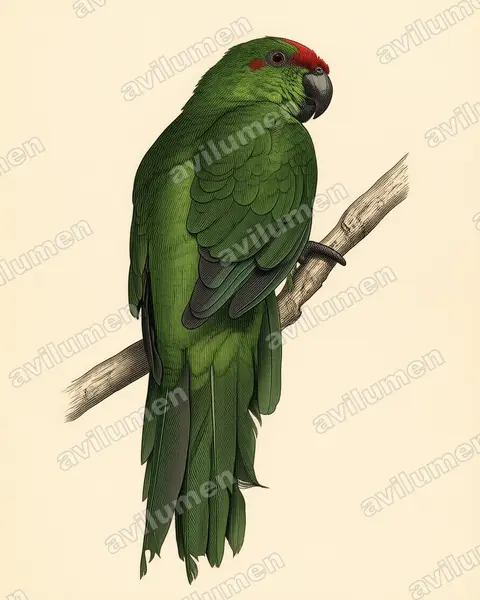
Vintage plate 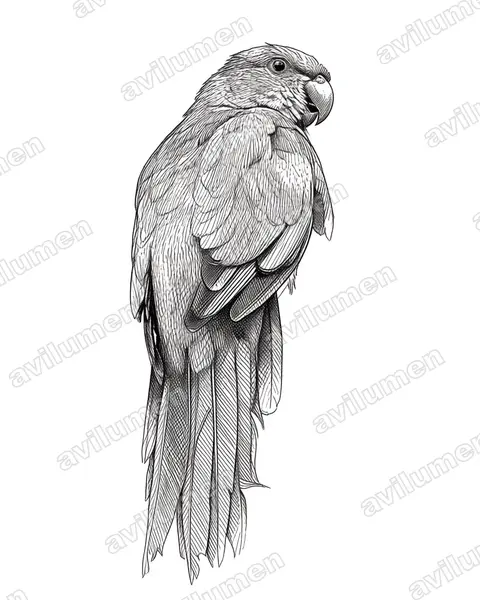
Ink 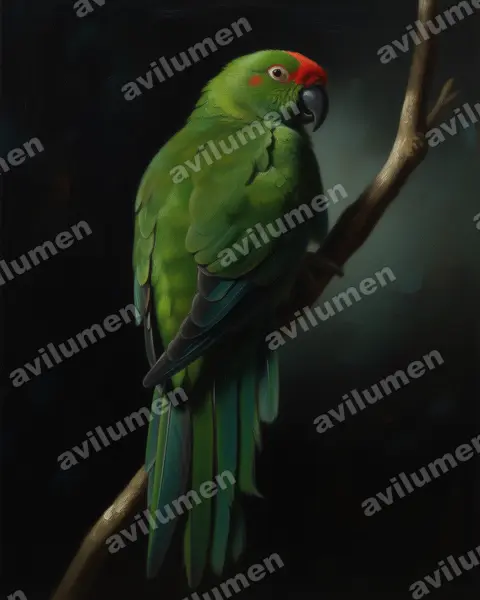
Oil 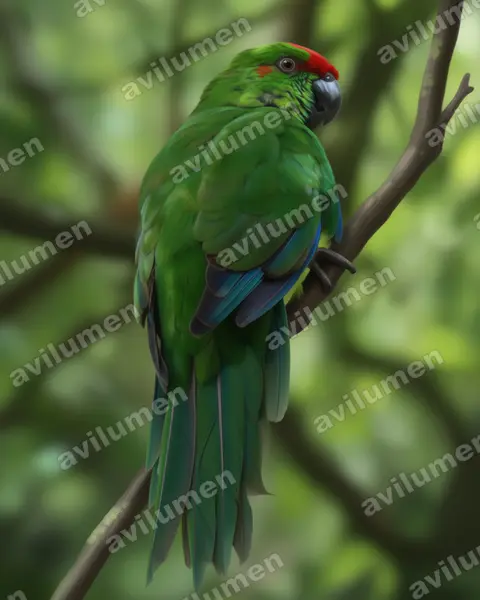
Realistic 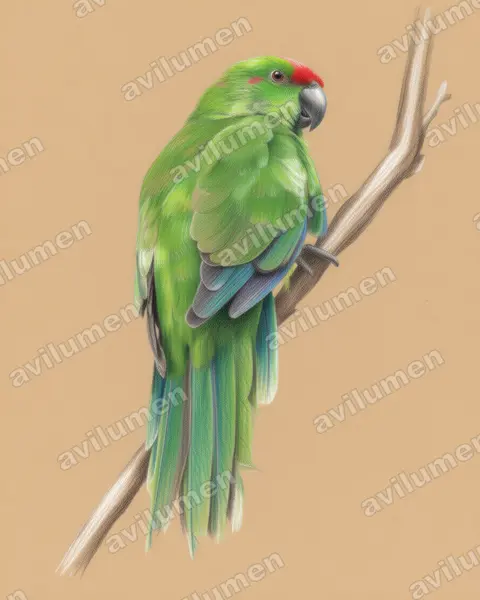
Colored pencil
Illustrations based on the photograph by Duncan Watson (CC BY-SA 4.0), from Wikimedia Commons.
Digital editions
HD Digital Art Pack — Norfolk Parakeet
Digital download: 6 high-resolution illustrations of the Norfolk Parakeet (Cyanoramphus cookii), print-ready. This is a digital file; no animal or physical item is included.
AI Avatar — Norfolk Parakeet
Generate an avatar fusing your face with the Norfolk Parakeet (Cyanoramphus cookii). Delivered digitally in 8K, watermark-free. Digital product; no animals are sold or brokered.
Instant download. No live birds are sold.
Frequently asked questions
- Is Cyanoramphus cookii (Norfolk Parakeet) endangered?
- The IUCN Red List places Cyanoramphus cookii, commonly known as the Norfolk Parakeet, in the «Not evaluated» category. «Not evaluated» means the IUCN has not yet assessed this species.
- What family does Cyanoramphus cookii (Norfolk Parakeet) belong to?
- Cyanoramphus cookii (Norfolk Parakeet) belongs to the family Psittacidae, in the order Psittaciformes.
- What colour is Cyanoramphus cookii (Norfolk Parakeet)?
- The plumage of Cyanoramphus cookii (Norfolk Parakeet) combines these colours: Green.
More from the same family
 Near threatened
Yellow-faced Parrot
Alipiopsitta xanthops
The yellow-faced parrot, formerly also known as the yellow-faced amazon, is the only species of the genus Alipiopsitta. It is a Neotropical parrot, and was classified in the genus Amazona for many years. It is a predominantly green and yellow-plumaged bird with a yellow head. It is a semi-nomadic species found in the cerrado region of Brazil and adjacent Bolivia.
from $1.99
 Least concern
Moluccan King Parrot
Alisterus amboinensis
The Moluccan king parrot is a parrot endemic to Peleng Island, Maluku, and West Papua in Indonesia. It is sometimes referred to as the Ambon king parrot or Amboina king parrot, but this is potentially misleading, as it is found on numerous other islands than Ambon. The male and female are similar in appearance, with a predominantly red head and underparts, green wings, and blue back and tail.
from $1.99
 Least concern
Papuan King Parrot
Alisterus chloropterus
The Papuan king parrot, also known as the green-winged king parrot, is a species of parrot in the family Psittaculidae found in New Guinea. Its natural habitats are subtropical or tropical moist lowland forest and subtropical or tropical moist montane forest.
from $1.99
 Least concern
Australian King Parrot
Alisterus scapularis
The Australian king parrot is a species of parrot endemic to eastern Australia ranging from Cooktown in Queensland to Port Campbell in Victoria. Found in humid and heavily forested upland regions of the eastern portion of the continent, including eucalyptus wooded areas in and directly adjacent to subtropical and temperate rainforest. They feed on fruits and seeds gathered from trees or on the ground.
from $1.99