Antipodes parakeet
Cyanoramphus unicolor
Avilumen editorial team ·

The Antipodes parakeet or Antipodes Island parakeet is a parrot in the family Psittaculidae that is endemic to the Antipodes Islands of New Zealand. It is one of two parrot species found on the islands, and one of only five ground-dwelling parrots in the world.
The Antipodes parakeet or Antipodes Island parakeet (Cyanoramphus unicolor) is a parrot in the family Psittaculidae that is endemic to the Antipodes Islands of New Zealand. It is one of two parrot species found on the islands, and one of only five ground-dwelling parrots in the world. They are long-living birds that may live up to 10 years of age, but the introduction of mice that compete with them for food was a threat to their survival on the Antipodes Islands until the mice were successfully eradicated from the Islands in 2016 (confirmed 2018). Unusually for parrots, they sometimes prey upon other birds, a trait shared by another New Zealand parrot, the kea.
Taxonomy
The Antipodes parakeet was depicted in 1831 by English artist Edward Lear in his Illustrations of the Family of Psittacidae, or Parrots. Lear used the common name "uniform parakeet" and coined the binomial name Platycercus unicolor. The species is now placed in the genus Cyanoramphus that was introduced in 1854 by French ornithologist Charles Lucien Bonaparte.
Its closest relative is Reischek's parakeet, which also lives on the Antipodes Islands. Other relatives include the Norfolk parakeet, Society parakeet, and Chatham Islands parakeet.
Distribution and habitat
The Antipodes parakeet is endemic to the Antipodes Islands of New Zealand. They are common on the main Antipodes Island, but are less common on smaller islands in the group such as Bollons Island. They live in very small numbers on Leeward Island, where they only live in a 0.1 km2 (0.039 sq mi) region of the island. The Antipodes parakeet lives on the 0.1 km2 (0.039 sq mi) Archway Island, as well.
Description
It is the largest species in the genus Cyanoramphus at 30 cm (12 in) long. and makes a penetrating kok-kok-kok-kok noise.
Behaviour and ecology
These parakeets eat leaves, buds, grass, and tussock stalks, as well as sometimes feeding on seeds and flowers, and sometimes scavenge dead seabirds. The Antipodes parakeet also preys on grey-backed storm petrels, entering burrows to kill incubating adults, even digging at the entrance if it is too small.
Antipodes parakeets spend much of their time on the ground and in very small groups, in pairs, or alone.
They are quite inquisitive, territorial, probing, and mischievous.
Their nest is in a tunnel 2 m beneath fibrous peat away from the wind.
Status
Their population is stable, but their conservation status is vulnerable. The population is 2,000-3,000.
Originally entirely restricted to the islands that bear their name, a small captive population, founded with less than 20 individuals, now inhabits the mainland.
Text adapted from Wikipedia · CC BY-SA 4.0
Plumage colours
Distribution

Taxonomy
- Order
- Psittaciformes
- Family
- Psittacidae
- Genus
- Cyanoramphus
- Conservation status
- Vulnerable
Listen to its call
No recording yet
Care guide
Budgie, Conure and Parakeet Care Guide
How to care for budgies, conures, parrotlets, ringnecks and other parakeets: diet, cage setup, health, behavior, breeding and legal status for owners.
Read the guide →Illustration gallery
6 illustrations of Cyanoramphus unicolor (Antipodes parakeet) in different styles, true to its real plumage. Shown watermarked; the art pack includes the high-resolution originals, ready to print.
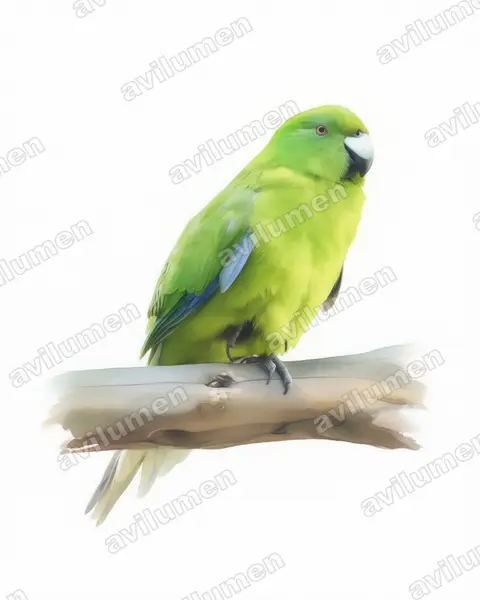
Watercolor 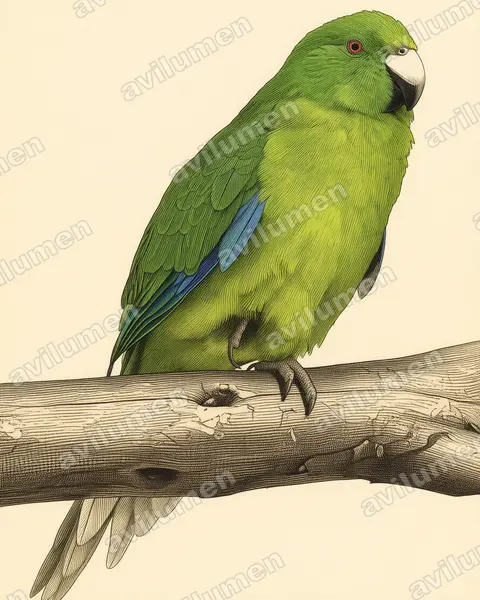
Vintage plate 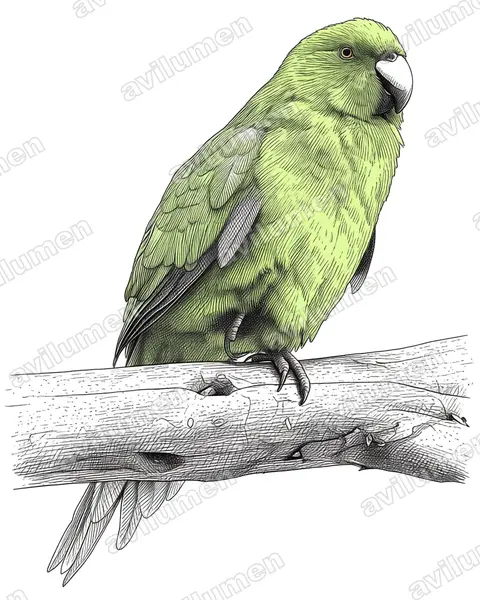
Ink 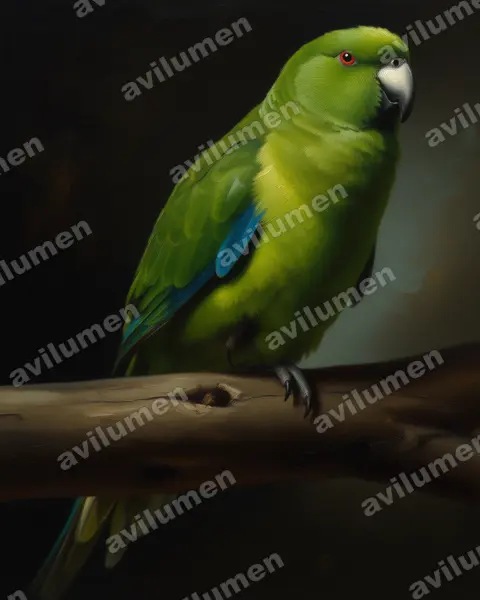
Oil 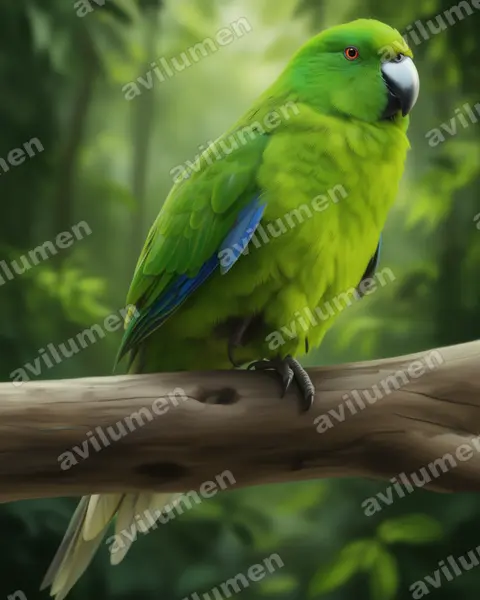
Realistic 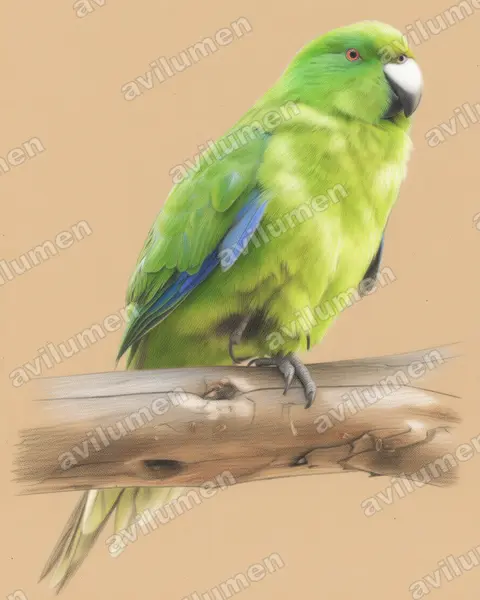
Colored pencil
Illustrations based on the photograph by Pseudopanax at English Wikipedia (Public domain), from Wikimedia Commons.
Digital editions
HD Digital Art Pack — Antipodes parakeet
Digital download: 6 high-resolution illustrations of the Antipodes parakeet (Cyanoramphus unicolor), print-ready. This is a digital file; no animal or physical item is included.
AI Avatar — Antipodes parakeet
Generate an avatar fusing your face with the Antipodes parakeet (Cyanoramphus unicolor). Delivered digitally in 8K, watermark-free. Digital product; no animals are sold or brokered.
Instant download. No live birds are sold.
Frequently asked questions
- Is Cyanoramphus unicolor (Antipodes parakeet) endangered?
- The IUCN Red List places Cyanoramphus unicolor, commonly known as the Antipodes parakeet, in the «Vulnerable» category. «Vulnerable» means it faces a high risk of extinction in the medium term.
- What family does Cyanoramphus unicolor (Antipodes parakeet) belong to?
- Cyanoramphus unicolor (Antipodes parakeet) belongs to the family Psittacidae, in the order Psittaciformes.
- What colour is Cyanoramphus unicolor (Antipodes parakeet)?
- The plumage of Cyanoramphus unicolor (Antipodes parakeet) combines these colours: Green.
More from the same family
 Near threatened
Yellow-faced Parrot
Alipiopsitta xanthops
The yellow-faced parrot, formerly also known as the yellow-faced amazon, is the only species of the genus Alipiopsitta. It is a Neotropical parrot, and was classified in the genus Amazona for many years. It is a predominantly green and yellow-plumaged bird with a yellow head. It is a semi-nomadic species found in the cerrado region of Brazil and adjacent Bolivia.
from $1.99
 Least concern
Moluccan King Parrot
Alisterus amboinensis
The Moluccan king parrot is a parrot endemic to Peleng Island, Maluku, and West Papua in Indonesia. It is sometimes referred to as the Ambon king parrot or Amboina king parrot, but this is potentially misleading, as it is found on numerous other islands than Ambon. The male and female are similar in appearance, with a predominantly red head and underparts, green wings, and blue back and tail.
from $1.99
 Least concern
Papuan King Parrot
Alisterus chloropterus
The Papuan king parrot, also known as the green-winged king parrot, is a species of parrot in the family Psittaculidae found in New Guinea. Its natural habitats are subtropical or tropical moist lowland forest and subtropical or tropical moist montane forest.
from $1.99
 Least concern
Australian King Parrot
Alisterus scapularis
The Australian king parrot is a species of parrot endemic to eastern Australia ranging from Cooktown in Queensland to Port Campbell in Victoria. Found in humid and heavily forested upland regions of the eastern portion of the continent, including eucalyptus wooded areas in and directly adjacent to subtropical and temperate rainforest. They feed on fruits and seeds gathered from trees or on the ground.
from $1.99