Ouvea Parakeet
Eunymphicus uvaeensis
Avilumen editorial team ·

The Ouvea parakeet or Uvea parakeet, is a species of parrot in the genus Eunymphicus, in the family Psittaculidae. It is endemic to the island of Uvea, including Faiava Island in the Loyalty Islands, New Caledonia. The species was once considered conspecific with the horned parakeet of Grande Terre, but they have now been split into two species.
The Ouvea parakeet (Eunymphicus uvaeensis) or Uvea parakeet, is a species of parrot in the genus Eunymphicus, in the family Psittaculidae. It is endemic to the island of Uvea, including Faiava Island in the Loyalty Islands, New Caledonia. The species was once considered conspecific with the horned parakeet of Grande Terre, but they have now been split into two species.
Description
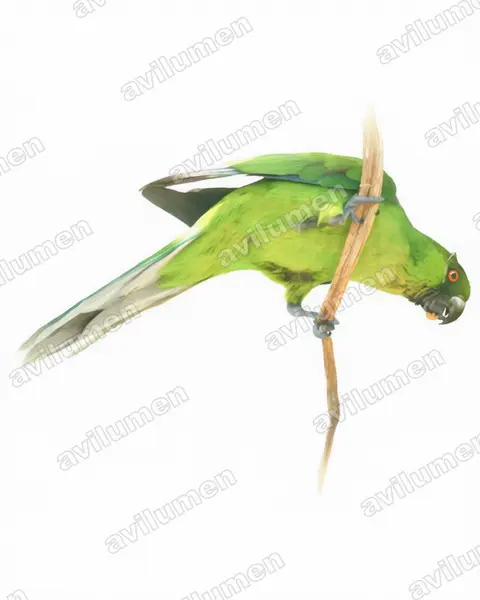
The Ouvea parakeet is a medium-sized parakeet with mostly green plumage and a prominent green crest. The crest is composed of six backward feathers that curl forwards. The underside of the bird tends to be yellower and there is bright blue on the wings and tail. The face is dark and the beak is black, lacking the yellow on the face of the horned parakeet.
Diet
The species has a preference for natural forests and laurel forest habitat while avoiding coconut plantations and coastal vegetation. They are active in the early morning and late afternoon, and avoid activity during the heat of the day. They feed on a variety of foods, with figs of the genus Ficus being particularly important.
Reproduction
The breeding season of the Uvea parakeet is from August to January. The nests are located in natural cavities in native trees, with Syzygium and Mimusops accounting for 90% of nesting trees. Three (occasionally two) eggs are laid in these cavities and incubated for 21 days. The nestling period is around 43 days, with an average of around 1.5 chicks being fledged per nesting attempt. Fledging survival is lower, however, with around 0.75 chicks surviving a month after fledging. The main causes of chick mortality are starvation (most common in the smallest, weakest chick), brown goshawk predation and human collecting (for the pet trade).
Status
It once ranged across the other Loyalty Islands; attempts to reintroduce it to Lifou in 1925 and 1963 failed. One source reports that the reintroduced birds simply flew back to Uvea. Studies of potential nesting success on the two islands showed that future reintroductions to Lifou would fail unless the ship rat population is controlled. It is threatened by habitat loss and the pet trade. Around 30-50% of its habitat has been lost in the last thirty years. Collection for the pet trade not only reduces the number of birds but the collection method, which involves cutting trees open to get at the chicks, renders the nesting sites useless for future breeding attempts and lack of breeding cavities may be limiting the population. In the event that ship rats were to reach Uvea it would be at greater risk of extinction.
The parakeet is listed in Appendix I of CITES and the IUCN considers the conservation status as Vulnerable. This species is threatened because of low numbers, a limited home range and habitat loss. However, in recent years, community involvement in saving the species have contributed to significant gains in increasing the Ouvea parakeet population from an estimated 617 in 1993 to 2,090 in 2009.
Text adapted from Wikipedia · CC BY-SA 4.0
Plumage colours
Taxonomy
- Order
- Psittaciformes
- Family
- Psittacidae
- Genus
- Eunymphicus
- Conservation status
- Vulnerable
Listen to its call
No recording yet
Illustration gallery
6 illustrations of Eunymphicus uvaeensis (Ouvea Parakeet) in different styles, true to its real plumage. Shown watermarked; the art pack includes the high-resolution originals, ready to print.
Watercolor 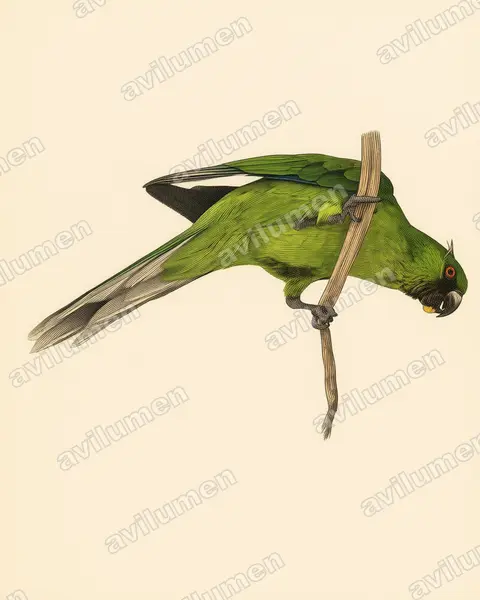
Vintage plate 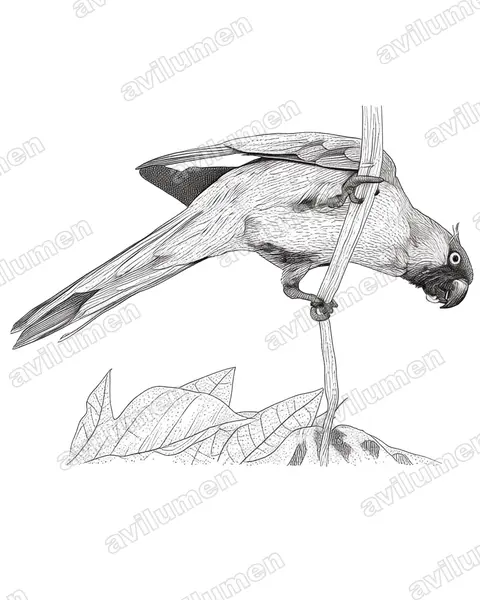
Ink 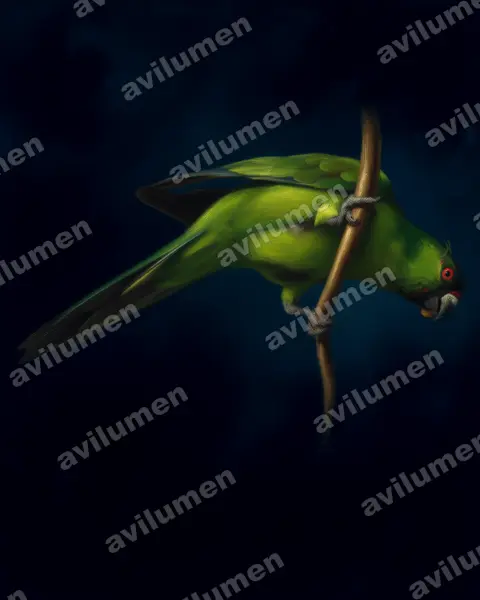
Oil 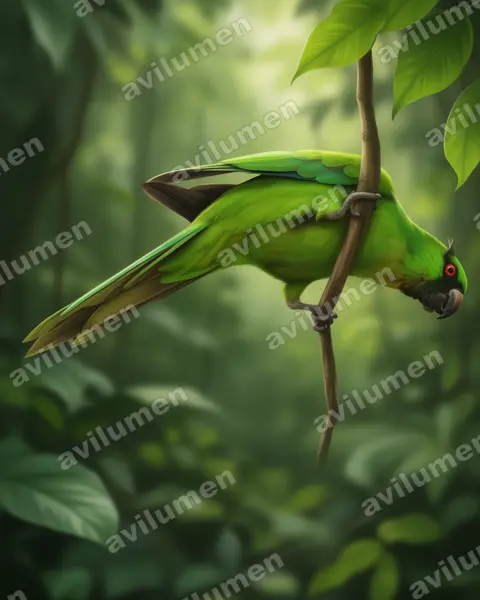
Realistic 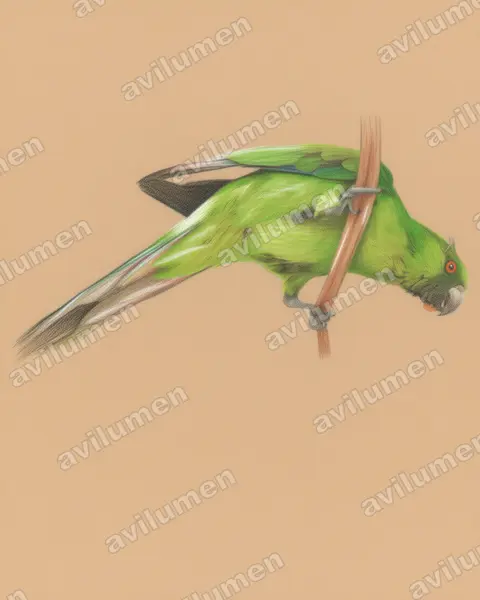
Colored pencil
Illustrations based on the photograph by Tunpin.ong (CC BY-SA 3.0), from Wikimedia Commons.
Digital editions
HD Digital Art Pack — Ouvea Parakeet
Digital download: 6 high-resolution illustrations of the Ouvea Parakeet (Eunymphicus uvaeensis), print-ready. This is a digital file; no animal or physical item is included.
AI Avatar — Ouvea Parakeet
Generate an avatar fusing your face with the Ouvea Parakeet (Eunymphicus uvaeensis). Delivered digitally in 8K, watermark-free. Digital product; no animals are sold or brokered.
Instant download. No live birds are sold.
Frequently asked questions
- Is Eunymphicus uvaeensis (Ouvea Parakeet) endangered?
- The IUCN Red List places Eunymphicus uvaeensis, commonly known as the Ouvea Parakeet, in the «Vulnerable» category. «Vulnerable» means it faces a high risk of extinction in the medium term.
- What family does Eunymphicus uvaeensis (Ouvea Parakeet) belong to?
- Eunymphicus uvaeensis (Ouvea Parakeet) belongs to the family Psittacidae, in the order Psittaciformes.
- What colour is Eunymphicus uvaeensis (Ouvea Parakeet)?
- The plumage of Eunymphicus uvaeensis (Ouvea Parakeet) combines these colours: Green.
More from the same family
 Near threatened
Yellow-faced Parrot
Alipiopsitta xanthops
The yellow-faced parrot, formerly also known as the yellow-faced amazon, is the only species of the genus Alipiopsitta. It is a Neotropical parrot, and was classified in the genus Amazona for many years. It is a predominantly green and yellow-plumaged bird with a yellow head. It is a semi-nomadic species found in the cerrado region of Brazil and adjacent Bolivia.
from $1.99
 Least concern
Moluccan King Parrot
Alisterus amboinensis
The Moluccan king parrot is a parrot endemic to Peleng Island, Maluku, and West Papua in Indonesia. It is sometimes referred to as the Ambon king parrot or Amboina king parrot, but this is potentially misleading, as it is found on numerous other islands than Ambon. The male and female are similar in appearance, with a predominantly red head and underparts, green wings, and blue back and tail.
from $1.99
 Least concern
Papuan King Parrot
Alisterus chloropterus
The Papuan king parrot, also known as the green-winged king parrot, is a species of parrot in the family Psittaculidae found in New Guinea. Its natural habitats are subtropical or tropical moist lowland forest and subtropical or tropical moist montane forest.
from $1.99
 Least concern
Australian King Parrot
Alisterus scapularis
The Australian king parrot is a species of parrot endemic to eastern Australia ranging from Cooktown in Queensland to Port Campbell in Victoria. Found in humid and heavily forested upland regions of the eastern portion of the continent, including eucalyptus wooded areas in and directly adjacent to subtropical and temperate rainforest. They feed on fruits and seeds gathered from trees or on the ground.
from $1.99